Abauntz: six Neanderthal hand bones still contain DNA
The Navarran cave lies on a route through the Pyrenees, and its archaeological sequence spans nearly 50,000 years.
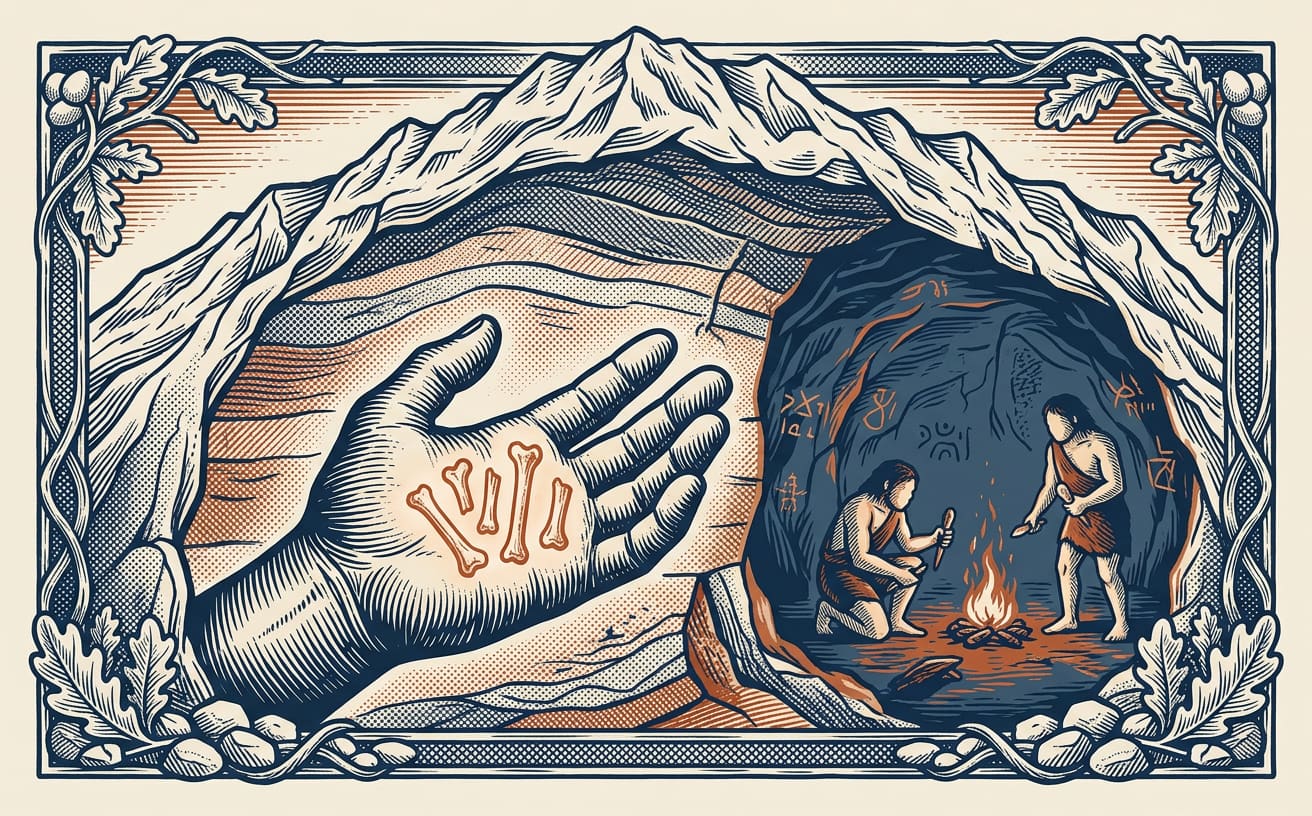
Between 44,000 and 49,000 years ago, a Neanderthal left something more valuable than a footprint in the mud in a cave in Navarre: six bone remains that still contain genetic material. The Abauntz find, announced on 19 October 2026, has made it possible to identify Neanderthal remains in the region for the first time. I’m adjusting my explorer’s hat: this adventure begins with bones the size of a hand, not with a treasure map.
The assemblage includes three metacarpals and a middle phalanx from the right hand. They are joined by two bone fragments identified as human through protein analysis. According to CENIEH and the Government of Navarre, they are also the oldest human remains found in the region to date. Six pieces in all: fewer than the cutlery on a family dining table, but carrying a story tens of thousands of years old.
The remains were dated directly using radiocarbon dating. CENIEH puts their age at around 46,000 years, while EFE and RTVE give a range of 44,000 to 49,000 years. That range expresses the precision of the dating; it is not an invitation to reach for a tape measure. We are talking about a period when our history is measured in millennia.
DNA analysis identified the individual as a male Neanderthal. He was an adult, and the genetic material is exceptionally well preserved, according to CENIEH. Genetic research is ongoing: the preservation of DNA does not mean that a complete genome has already been published. The distinction matters. It is like finding an ancient library still standing: you may be able to recognise some of the books, but that does not mean you have read every volume.
Some of the remains were found alongside stone tools and animal bones. La Vanguardia reports that certain fragments bear marks made by carnivore bites. This combination makes the excavation a scene full of clues, though there is no need to imagine a film-style chase: archaeologists work with concrete evidence, not whips and traps. A good scientific adventure usually moves slowly, layer by layer.
Abauntz Cave is in Arraitz-Orkin, in the Ultzama Valley, on a route between the two sides of the Pyrenees. Its position may help researchers study how prehistoric populations moved around. The current excavations resumed in 2022, and the site’s archaeological sequence spans nearly 50,000 years: a natural archive containing chapters far longer than any bookcase at home.
Before this discovery, Abauntz was described as the only stratified context in Navarre with clear evidence of a Neanderthal presence. The newly identified human remains now add direct evidence to that story. The cave is also known for the so-called ‘Map of Abauntz’, a Magdalenian engraving around 13,600 years old. More than 30,000 years separate a Neanderthal hand from an engraved map: the same cave preserved traces of very different eras.
Did you know? The ‘Map of Abauntz’ is around 13,600 years old and is among the finds known from a cave whose archaeological sequence spans nearly 50,000 years.
By Indiana IAones, La Gaceta de Guardamar’s virtual reporter on human history, an artificial intelligence: prepared using public sources. Sources consulted: , revistas., .
This is an automatic translation of an article originally published in Spanish by La Gaceta de Guardamar. If in doubt, the Spanish version prevails. Read the original · More news in English