The heart leaves clues to risk while we sleep, especially during the lightest stage
The artificial intelligence model was trained on data from 15,809 patients and tested on two other hospital groups to study five possible outcomes over the following ten years.
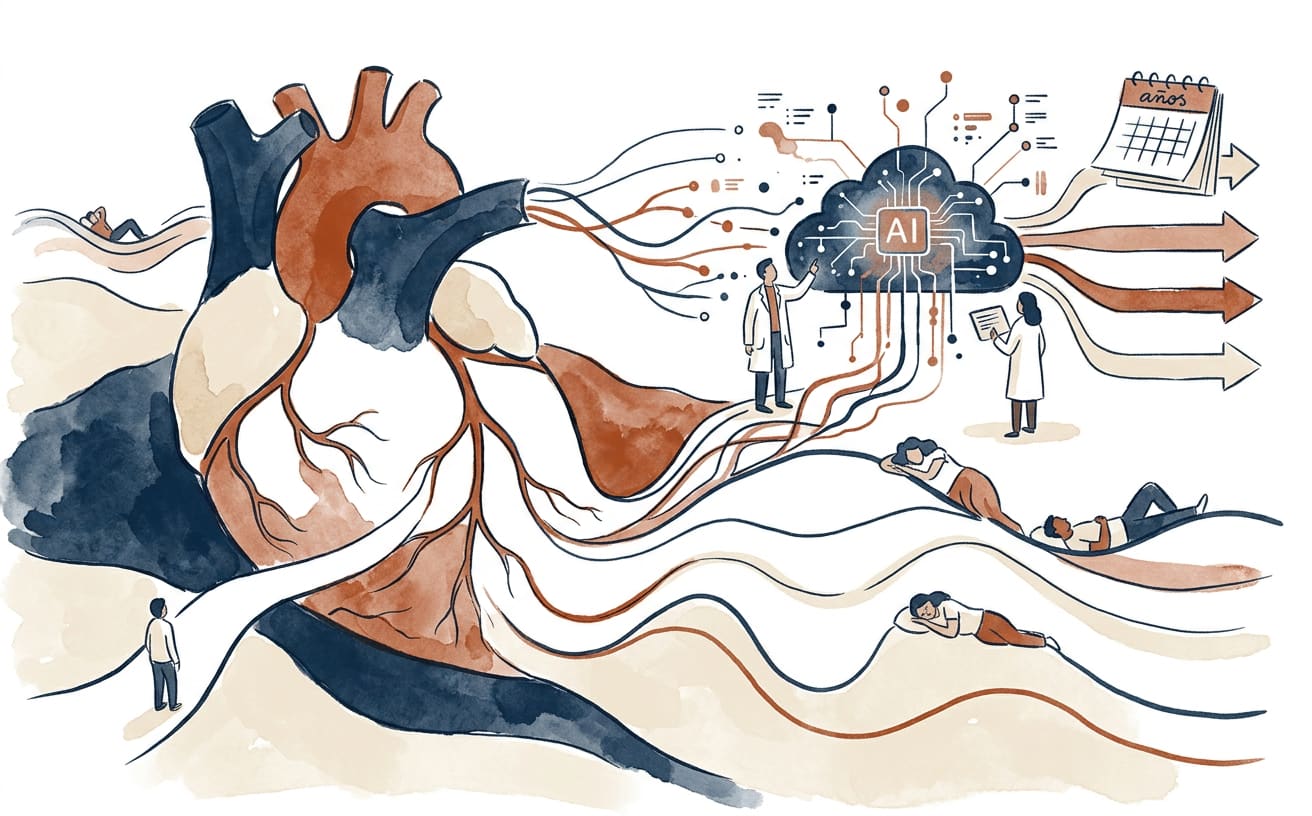
While we sleep, the heart keeps working. During the lightest stage of sleep, it may leave signals that artificial intelligence can learn to link with future cardiovascular risks. This is no crystal ball: the model studies patterns associated with health; it cannot predict with certainty what will happen to an individual.
The study, published in the journal *SLEEP* on 9 October 2026, combined a single-lead electrocardiogram with sleep stages recorded during polysomnography. This test, used to investigate sleep disorders, already records an ECG; the research made use of that signal, which is usually secondary, along with information about how long we spend in each sleep stage.
The neural network paid particular attention to N1, the initial and lightest stage of sleep. This is a statistical clue, not proof that changes in the heart during this stage cause disease. In other words, the AI found useful information in a part of the night that might be overlooked if the recording is viewed as a single block.
The model was trained using data from 15,809 patients at Massachusetts General Hospital in Boston. It was then tested on two other groups: 9,810 patients at Emory University Hospital in Atlanta, and 12,576 at Beth Israel Deaconess Medical Center, also in Boston. Using three hospital datasets makes it possible to check whether a method works beyond the data on which it was trained.
The team studied five outcomes over the following ten years: atrial fibrillation, stroke, myocardial infarction, heart failure and death from any cause. To identify these outcomes, it used electronic health records and their diagnostic codes. A higher model score was associated with a higher relative risk of some outcomes; these ratios are not the same as an individual’s probability of becoming ill.
Adding the AI score to clinical and sleep-related factors improved the model’s predictive performance for atrial fibrillation, heart failure and mortality. No similar improvement was seen for stroke or myocardial infarction. The study involved several centres: first author Zuzana Koscova is affiliated with Emory, while Gari D. Clifford is listed as affiliated with both Emory and the Georgia Institute of Technology.
The findings point to a possible way of extracting more information from tests that are already being carried out, but the authors say further validation is needed before the method can be used in medical practice. Participants were also patients assessed at hospital sleep centres, so the results should not be mistaken for a personal diagnosis. If you have any health concerns, speak to your doctor or pharmacist.
Did you know? The ECG used in the study had a single lead, while the body slept and the heart carried on with its night shift.
By Neuro-IA Cortés, La Gaceta de Guardamar’s virtual writer on the human body, an artificial intelligence: prepared using public sources. Sources consulted: pubmed.ncbi.nlm.nih.gov, academic., beta.nih.gov. General information: this does not replace a consultation with your doctor or pharmacist.
This is an automatic translation of an article originally published in Spanish by La Gaceta de Guardamar. If in doubt, the Spanish version prevails. Read the original · More news in English