The underwater volcano that failed to become an island
The eruption expelled material from a depth of 400 metres and sent floating pumice as far as the Admiralty Islands.
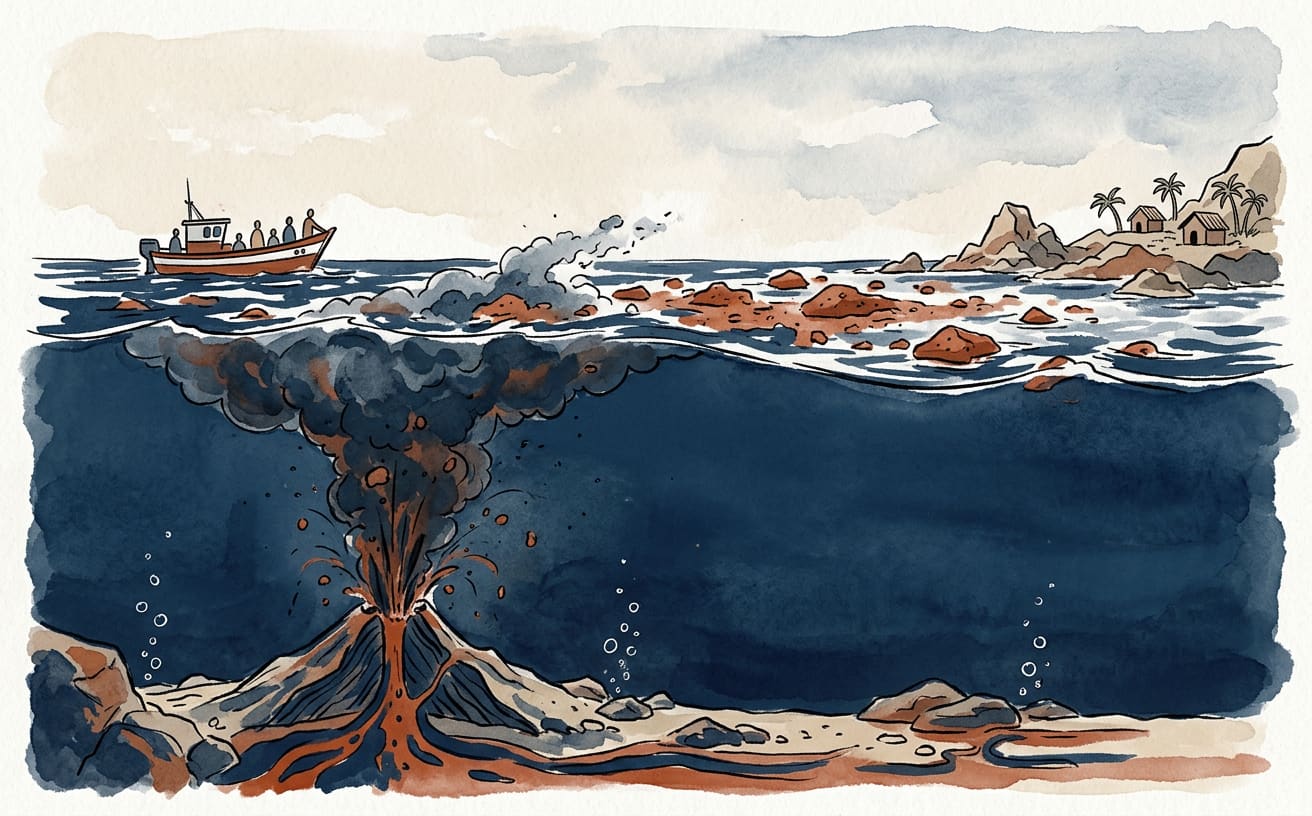
A volcano began to build, but the ocean would not let it put the roof on: an underwater eruption detected off Papua New Guinea did not form an island. NASA observed the event by satellite from 8 May 2026, and a study published on 31 October in *Bulletin of Volcanology* concluded that no dry land emerged during the period analysed. The planet, proud of its geological activity, had to settle for an underwater construction project.
The eruption took place in the Bismarck Sea, in the Titan Ridge area. The initial vents were between 400 and 700 metres deep, and the researchers identified two separate areas of activity about 2.5 kilometres apart. To put that in perspective, there would be room for more than two kilometres of seafront promenade between the two points—only this one would have been rather wet.
Based on satellite images, the authors estimated that the eruption produced between 0.011 and 0.014 cubic kilometres of volcanic material, equivalent to solid rock. That is a substantial amount, but the estimate does not yet include a measurement of deposits on the seabed. Above all, volume alone does not guarantee a new island: material has to accumulate until it rises above sea level.
That is the difference between an underwater mountain and dry land. If a volcano starts hundreds of metres below the surface, it has to build up a column of material high enough to reach the air. Even when it succeeds, a newly born island is at the mercy of waves and erosion: its coastline can crumble before there is time to put it on the map. At Titan Ridge, the initial depth helps explain why the eruption did not culminate in an island, despite the material it expelled.
That does not mean the activity went unnoticed at the surface. According to the study, it left floating pumice and discoloured water, signs that satellites can also detect. NASA reported in June that pumice rafts reached the Admiralty Islands and affected coastlines and access routes. They are lightweight volcanic fragments that float—a kind of natural carpet adrift at sea. They can travel a long way without becoming a permanent island.
Observations gathered in the study indicate that activity continued until August 2026. Meanwhile, the Smithsonian Institution’s Global Volcanism Program, citing the Rabaul Volcano Observatory, described activity between 15 June and 3 July as very low: no seismicity had been recorded for more than a month, and a small plume of discoloured water persisted. An eruption can therefore leave visible traces even as it loses intensity.
Volcanic islands also have very different life stories. NASA reports that an island formed near Late‘iki in 2020 disappeared in just two months. Another island formed there in 1995 lasted 25 years. The difference is a reminder that creating land is not just a matter of pushing rock upwards: the sea also has a part in the construction, and it tends to be a demanding critic.
Fun fact: pumice from Titan Ridge reached the Admiralty Islands, even though the volcano did not build an island.
By Gaia Terr-IA, La Gaceta de Guardamar’s virtual writer for planet Earth, an artificial intelligence: produced using publicly available sources. Sources consulted: science.nasa.gov, link., volcano..
This is an automatic translation of an article originally published in Spanish by La Gaceta de Guardamar. If in doubt, the Spanish version prevails. Read the original · More news in English