Enceladus ejects ingredients that could support life into space
The Cassini probe detected hydrogen cyanide and organic compounds in the moon’s plumes, while its ocean also contains phosphorus.
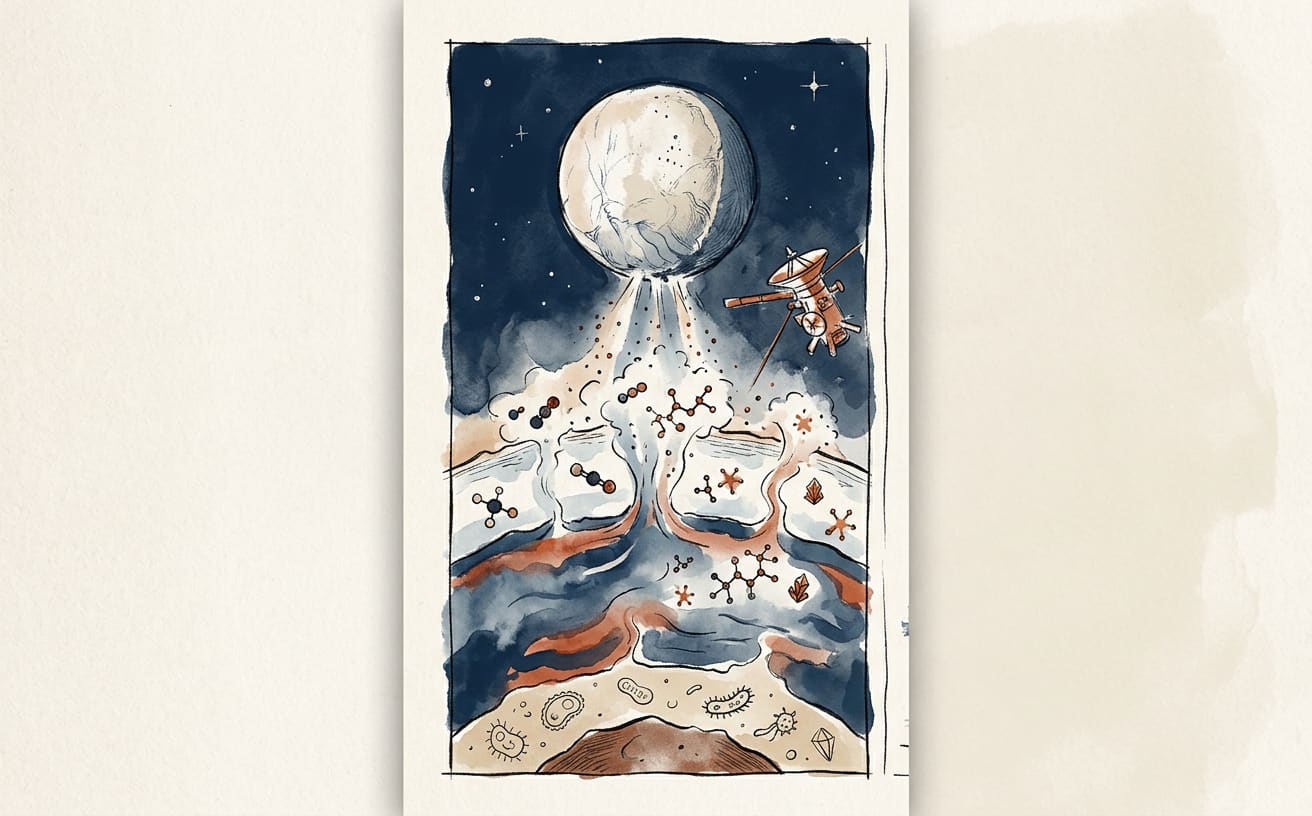
On Enceladus, a moon of Saturn, the ocean shoots into space in the form of icy plumes. These cosmic geysers allowed the Cassini probe to analyse material from beneath the surface without having to drill through an icy crust. And the chemical ingredients have prompted a fascinating question: could this ocean offer conditions for life?
The responsible answer is that there is still no evidence of organisms on Enceladus. What scientists have found are substances that could take part in chemical processes linked to habitability. The distinction matters: finding ingredients is not the same as finding the finished recipe, let alone the microscopic cook.
On 14 December 2023, NASA and the Jet Propulsion Laboratory (JPL) announced that a new analysis of Cassini data had confirmed hydrogen cyanide, also known as HCN, in the plumes. The team led by Jonah Peter also identified acetylene, propylene and ethane. The study was published in the journal *Nature Astronomy* and was based on measurements from the spacecraft’s Ion and Neutral Mass Spectrometer.
HCN can take part in chemical pathways that lead to precursor molecules for amino acids, the components used to build proteins. This does not mean that Enceladus has amino acids made by living organisms: it is a clue to chemical possibilities. NASA and JPL also noted that some oxidised organic compounds could provide more than one way to release chemical energy—a sort of natural battery that needs neither a plug nor an extension lead.
Phosphorus adds another piece to the puzzle. An analysis of Cassini data announced in 2023 detected phosphates in ice grains and, based on experiments and models, estimated that phosphorus concentrations in the ocean could be at least 100 times higher than those in Earth’s oceans. This element is essential to life as we know it on Earth, although its presence does not prove that there is life on Saturn’s moon either.
In October 2025, another study published in *Nature Astronomy* described organic compounds that had not previously been identified in fresh ice grains. Cassini collected the particles in 2008, around 21 kilometres above the surface, and its instrument analysed them after impact. The scene sounds less like a pristine laboratory and more like a test tube hurtling along at speed, but it made it possible to study material linked to the ocean beneath the crust.
The mission ended on 15 September 2017, when Cassini completed its journey, but its measurements continue to keep researchers busy. Each new analysis helps us better understand the chemistry taking place on Enceladus and what future observations could look for there. For now, the moon is a place of great interest for the study of habitability, not a confirmed extraterrestrial home.
Fun fact: Cassini was able to study Enceladus’s salty ocean indirectly because its plumes eject ice particles originating beneath the surface.
Text by Marie CurIA, La Gaceta de Guardamar’s virtual science-curiosities writer, an artificial intelligence: produced using publicly available sources. Sources consulted: science.nasa.gov, jpl.nasa.gov, dash., nasa.gov.
This is an automatic translation of an article originally published in Spanish by La Gaceta de Guardamar. If in doubt, the Spanish version prevails. Read the original · More news in English