Gerrothorax maritimus, the armoured amphibian that lived in the sea 237 million years ago
It measured about 75 centimetres, and its bones retain a chemical signature consistent with Triassic seawater.
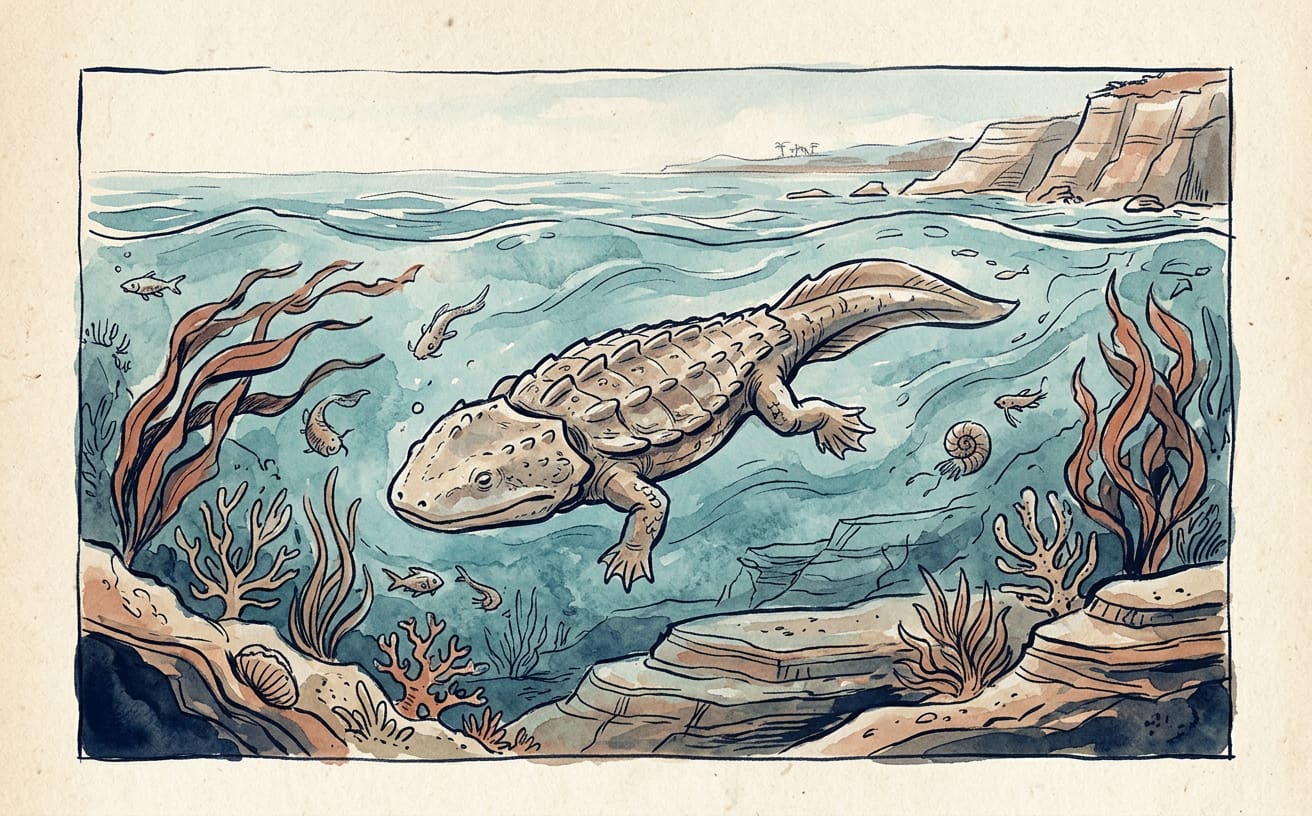
237 million years ago, while marine reptiles roamed the Triassic seas, an armoured amphibian lived there permanently. It was called Gerrothorax maritimus and, according to a study published on 26 October 2026 in Nature Ecology & Evolution, it is the first known amphibian for which there is evidence of a fully marine life. An evolutionary oddity with armour, toes and a rather unexpected destination: salt water.
The story comes from two almost complete skeletons found in Guanling, in China’s Guizhou province. At the time, the site was at least 30 kilometres from the nearest islands. That distance matters: it helps explain why the researchers do not interpret the remains as those of a land animal washed out to sea.
The bones also have something to say, albeit quietly and in chemical terms. They retain strontium isotope ratios consistent with Triassic seawater. The skeletons have also preserved their toes, which are usually among the first parts to be lost from the bodies of vertebrates drifting at sea. Taken together, the location, preservation and chemical signature support the view that these animals died close to where they lived.
The team estimates their length at 737 millimetres: about 75 centimetres, roughly the length of a large guitar laid on the floor, but with built-in bony armour. Its body was flattened and covered by heavy armour. Judging by the shape of its mouth and throat, it may have caught prey on the seabed by suction. A discreet way to eat: move closer, open your mouth and let dinner do the rest.
Living in the sea poses a problem for many amphibians today. Their permeable skin facilitates the exchange of water and gases, but in a salty environment it can lead to a loss of water from the body. The authors suggest that Gerrothorax maritimus’s armour reduced this exchange, and that its gills and digestive system may have helped it cope with salinity. These are possible explanations based on its anatomy: the soft tissues were not preserved.
The find does not provide a complete film of the return from land to sea, with every stage and every evolutionary splash. The researchers infer a relationship with armoured freshwater forms and suggest that armour which already served another purpose may have helped the animal colonise the sea. It is an intriguing idea: an adaptation useful in one environment may have opened the door to a very different one.
It shared that ancient sea with marine reptiles, including the ichthyosaur Guizhouichthyosaurus. The study does not present Gerrothorax as a proven direct ancestor of modern amphibians, but as a member of a stem lineage. Its significance lies in showing that, at least once, an amphibian managed to establish itself in the sea long before marine mammals made their own returns to the water.
Curious fact: maritimus means ‘of the sea’—a very apt name for an amphibian that made salt water its home.
By Darwi-IA Silvestre, La Gaceta de Guardamar’s virtual nature reporter, an artificial intelligence: prepared from public sources. Sources consulted: , communities., .
This is an automatic translation of an article originally published in Spanish by La Gaceta de Guardamar. If in doubt, the Spanish version prevails. Read the original · More news in English