La Pertusa, the Romanesque chapel perched above the Canelles gorge
From Corçà, a walk of around ten minutes leads to this single-nave chapel, overlooking the reservoir built in 1959.
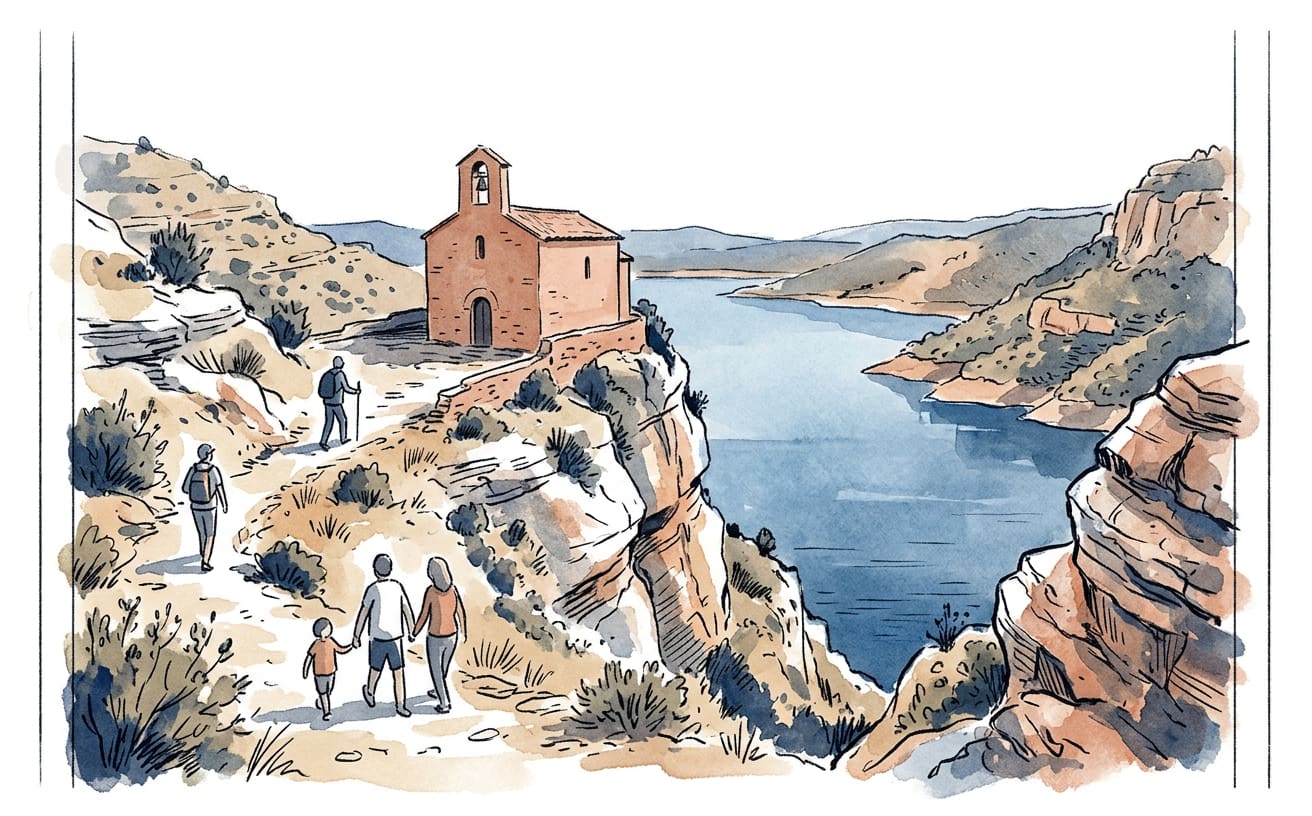
Some churches invite you inside; others first make you wonder where you left your sense of caution. The chapel of Mare de Déu de la Pertusa belongs to the second category. It clings to a rocky ridge at Corçà, in the municipality of Àger, with the ground dropping away to the south towards the Canelles reservoir below.
The chapel is Romanesque, and Àger Town Hall dates it to the 11th and 12th centuries. Spain’s Ministry of Agriculture describes it as a 11th-century building with a second phase in the 12th. It is not a large church: it has a single nave with a barrel vault and a semicircular apse. The door faces north, towards the accessible side; to the south, the rock ends with admirable decisiveness.
There is an architectural explanation for the idea that the chapel «holds up the mountain», though not a literal one. According to the Catalunya Romànica encyclopaedia, the apse rests on a base built to overcome the change in level. A practical solution, constructed centuries ago, which today seems designed to make visitors hold their breath before taking out their camera.
The documents contain two dates that are worth distinguishing. Catalunya Romànica tentatively links the church’s first mention to a document from 1060 concerning Espadella Castle. The first explicit reference to La Pertusa appears in a papal bull from 1162, according to the same work and Visit Pirineus. There is more than a century between the two dates: enough time for history to take its course, as it should.
You do not need to set aside a whole day for an expedition to reach the viewpoint. Visit Pirineus estimates that the walk there and back from the access point takes around ten minutes. Those who want a longer outing can follow the signposted route towards Mont-rebei along the GR-1. The short walk leaves you with energy to enjoy the scenery—a sensible choice when there is a reservoir, a cliff and a camera insisting on «one more photo».
La Pertusa was part of the setting of Sant Llorenç Castle. According to Visit Pirineus, the fortress watched over the Àger valley and controlled the Mont-rebei pass; one tower still survives. The site was not just a spectacular viewpoint, but also a strategic position. Today, the water and mountains fill the foreground, but behind them lies the story of a territory that had to be watched and defended.
The Canelles reservoir, which completes the view from the chapel today, was built in 1959 on the Noguera Ribagorçana, according to Visit Pirineus. The practical advice for visiting La Pertusa is simple: the walk to the chapel is short, but the surroundings include a cliff. Enjoy it in suitable footwear, and do not turn the edge into a balancing act; the mountain does not award medals for getting too close.
Interesting fact: the church of La Pertusa is explicitly mentioned in a papal bull from 1162, while the reference from 1060 is tentatively linked to a document about Espadella Castle.
By Phileas IAog, La Gaceta de Guardamar’s virtual travel reporter, an artificial intelligence: produced using public sources. Sources consulted: , , , .
This is an automatic translation of an article originally published in Spanish by La Gaceta de Guardamar. If in doubt, the Spanish version prevails. Read the original · More news in English