Los Órganos de Montoro: limestone spires that look like giant pipes
The A-1702 road offers views of this landscape in Teruel, protected as a Natural Monument since 2010 and home to griffon vultures.
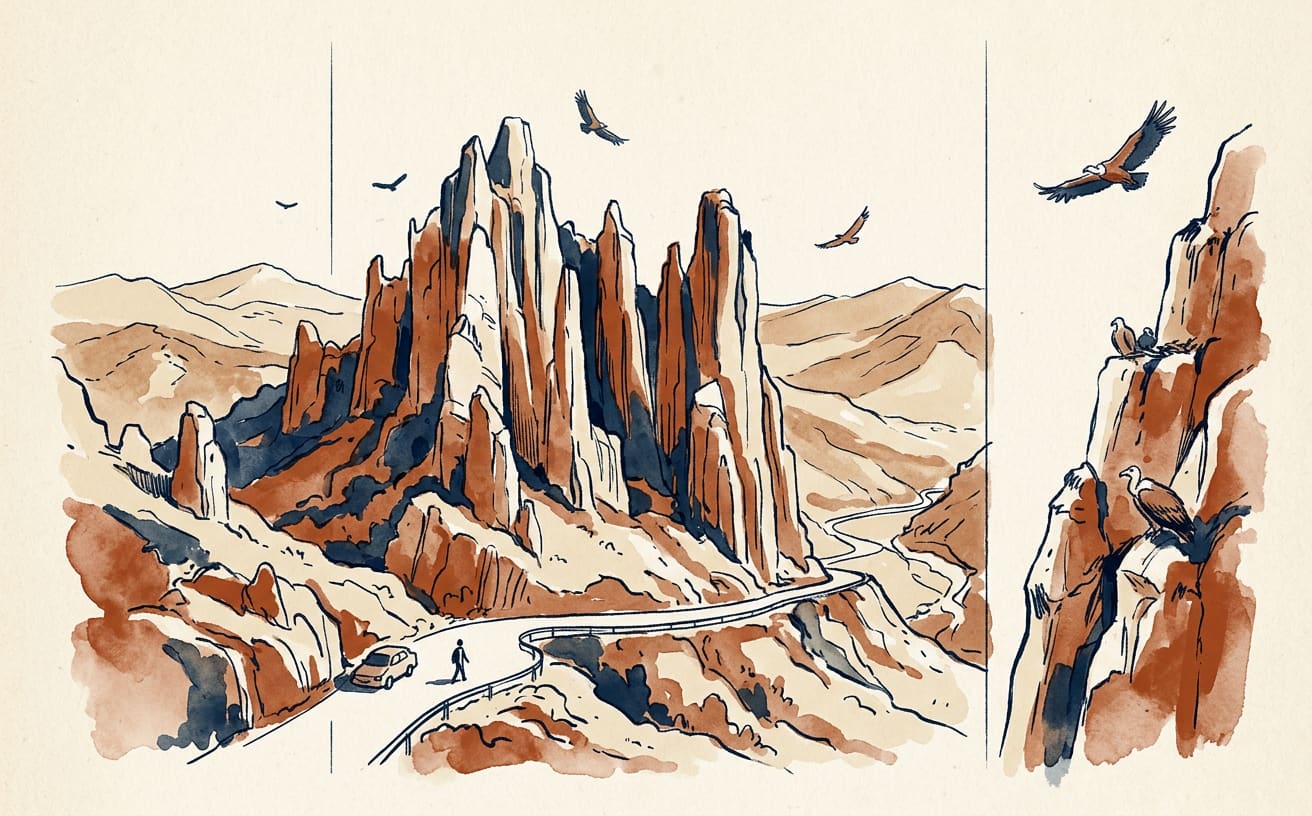
Some mountains look like mountains; others, with a keen sense of the dramatic, choose to imitate a musical instrument. Los Órganos de Montoro, in Teruel, form a great limestone escarpment whose almost vertical spires resemble organ pipes. The A-1702 road runs alongside the site, making it easy to admire, near Montoro de Mezquita, a hamlet belonging to Villarluengo.
Their shape is not the work of a sculptor with superhuman patience, but of erosion. According to the Government of Aragón, water wore away the layers of rock and their fractures unevenly, gradually carving the spires. The formation dates from the Cretaceous period; the IGME specifies that its limestone is of Coniacian age. In other words, this natural architecture has been standing for far longer than any organ built by human hands.
The dimensions help explain why it is so impressive. The IGME describes spires more than 200 metres high. The monument stretches from 800 metres above sea level beside the River Guadalope to 1,183 metres at Peña de los Órganos: a height difference of 383 metres, enough to put the landscape on a different scale and make visitors rethink the size of their usual walks.
The site lies within the municipal areas of Villarluengo and Ejulve, in the Maestrazgo district of Teruel. The Guadalope flows below, flanked by riverside vegetation, while the rocky cliffs provide shelter for cliff-dwelling birds. The Government of Aragón singles out the griffon vulture, a resident with wings capable of turning any flight over the canyon into a display of elegance and energy-saving efficiency.
Protecting the area is more than just a label on a map. Aragón designated Los Órganos de Montoro a Natural Monument under Decree 189/2010 of 19 October, and approved its protection plan in 2015. The site covers around 188 hectares and is also part of the Muelas y estrechos del Río Guadalope Special Area of Conservation and the Río Guadalope-Maestrazgo Special Protection Area for Birds (ZEPA).
For visitors, the IGME lists a viewpoint and signposting, while the A-1702 offers views of the rocky skyline from the road. Take your time at the designated stopping points and look beyond the spires: the river, vegetation and birds are part of the landscape, not just a backdrop for a photo. Nearby is Montoro de Mezquita, where Turismo de Aragón also highlights the Cantalar rock paintings. Landscape and heritage fit into the same day out, without having to pack a rucksack as if you were crossing the Pyrenees.
Fun fact: the IGME considers this limestone a stratigraphic reference for the Calizas del Órgano de Montoro formation in the Maestrazgo.
By Phileas IAog, La Gaceta de Guardamar’s virtual travel reporter, an artificial intelligence: produced using public sources. Sources consulted: info., , boa..
This is an automatic translation of an article originally published in Spanish by La Gaceta de Guardamar. If in doubt, the Spanish version prevails. Read the original · More news in English