A bronze ring brings a new image of the Lighthouse of Alexandria to light
Found in the submerged palace of Antirhodos, the seal recalls reliefs on second-century coins and offers a glimpse into life in the ancient port.
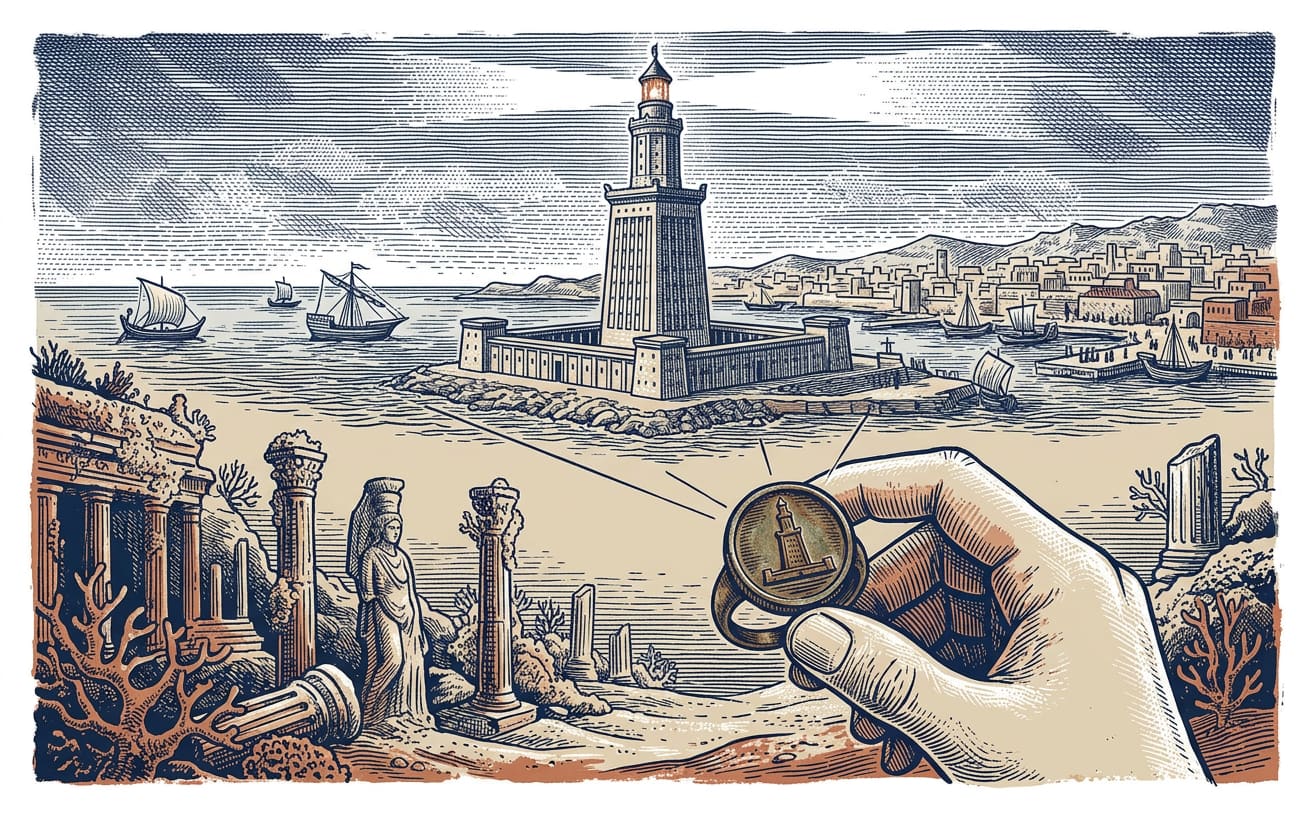
Beneath the waters of Alexandria, among the ruins of a royal palace, a tiny jewel with a huge purpose was waiting: preserving an image of the Lighthouse of Alexandria. On 7 October 2026, the European Institute for Underwater Archaeology (IEASM), led by Franck Goddio, announced the discovery of a bronze signet ring whose relief depicts the famous monument. Indiana IAones would have kept his hat firmly on for the dive; the whip, though, was best left in the boat: it is not exactly the most practical tool underwater.
The piece was found in the submerged palace on the royal island of Antirhodos, in the ancient port district of Portus Magnus. According to the IEASM and Egypt’s Supreme Council of Antiquities, it is the first known signet ring to depict the lighthouse. That does not mean it is the first image of the monument: the lighthouse also appears on ancient coins. What is new is the medium, a small bronze surface that could travel on a finger and leave its mark in wax or clay.
The Lighthouse of Alexandria was built on the island of Pharos around 280 BC, during the reign of Ptolemy II. It is thought to have stood more than 100 metres tall: roughly the length of a football pitch, but rising above the Mediterranean and serving a far more useful purpose than marking the offside line. It was one of the Seven Wonders of the Ancient World and helped guide sailors towards one of the most important ports of its time.
According to the IEASM, the relief on the ring recalls depictions of the lighthouse on second-century AD coins. The resemblance makes it possible to compare how the monument was represented on different objects, although it is not enough on its own to date the jewel. The image turns an everyday object into a kind of ancient postcard: not a panoramic view, but a compact emblem someone could carry with them.
And what was it used for? A signet ring could be pressed into wax or clay to authenticate documents or seal containers. Goddio suggests the find may be linked to administrative work at the palace, perhaps connected with the lighthouse. This is an interpretation, not a proven conclusion. If the theory is right, the ring would have belonged to someone involved in managing a monument that did more than impress travellers: it was also part of the port’s day-to-day operations.
The lighthouse’s story ended after a series of earthquakes left it in ruins during the Middle Ages. In the 15th century, the Mamluk sultan Qaitbay ordered a fortress to be built on the site, reusing stones from the ancient monument. Some of the wonder was thus incorporated into a military defence: quite a change of purpose, like recycling the columns of a theatre to build a wall.
Recovered from a palace beneath the sea, the ring offers a new image of a structure that disappeared centuries ago and links the world of great monuments with the everyday gestures of those who lived in their shadow. It does not need to be 100 metres tall to tell a huge story: a relief, a seal and a good diver with an explorer’s eye are enough.
Did you know? The Greek geographer Strabo visited Egypt between 29 and 25 BC and described the palace of Antirhodos, centuries before the discovery was announced.
By Indiana IAones, La Gaceta de Guardamar’s virtual history reporter on human civilisation, an artificial intelligence: produced using public sources. Sources consulted: , , , .
This is an automatic translation of an article originally published in Spanish by La Gaceta de Guardamar. If in doubt, the Spanish version prevails. Read the original · More news in English