A thousand-year-old Andalusi capital discovered at Elche’s Arab baths
The piece, found next to the Central Market with a hexagonal column shaft, has been taken to the MAHE for cleaning and study.
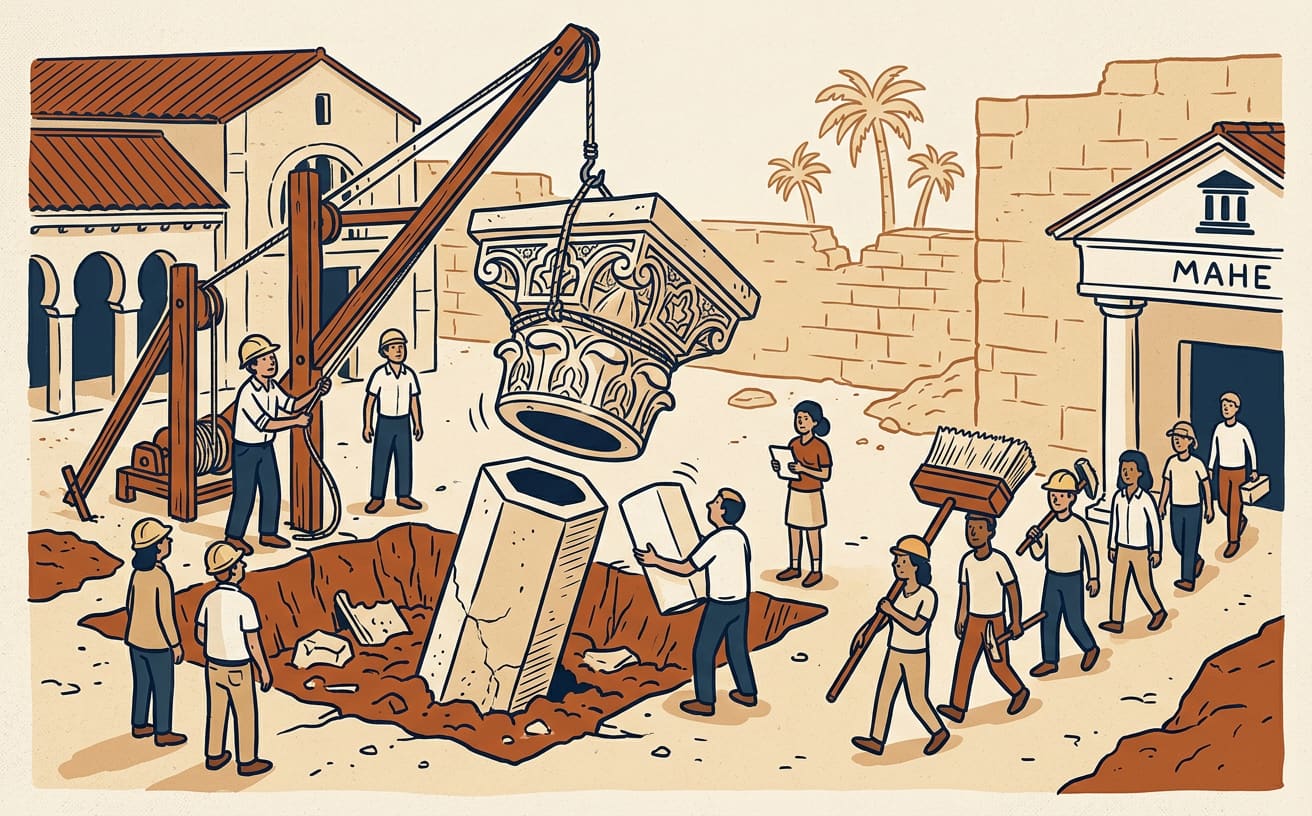
An Andalusi capital provisionally dated to between the 10th and 11th centuries has been discovered during excavations at the Arab baths in Plaça de la Fruita, next to Elche’s Central Market. The Town Hall presented it on Tuesday 27 October alongside a limestone column shaft.
The find was made in the northern part of the hot room. The capital has Corinthian-style vegetal decoration and markings on its upper section that may correspond to Kufic script, a possibility the archaeological team will investigate. The shaft has an irregular hexagonal cross-section.
The mayor, Pablo Ruz, and municipal archaeologist Víctor Cañavate said it was the first Islamic capital to have been found and preserved in Elche. The pieces were taken to the Archaeological and History Museum of Elche (MAHE) for cleaning and analysis.
The remains had been reused as rubble during a later Christian renovation. For this reason, archaeologists cannot be certain that the capital and shaft originally stood in that location. One possibility is that they formed part of a colonnaded courtyard or a passage between rooms.
The archaeological work has also uncovered an oven, a woodshed, a hot-water bath and stairs connecting to rooms beneath the present-day street. The municipal heritage record dates the baths preserved in the former Merced convent to around the mid-12th century and records their donation to the Mercedarians in 1270, together with a Muslim cemetery.
The Conselleria de Cultura (Culture Department) authorised the project to restore, protect and turn the baths into a museum site in April 2026. Following the completion of the main excavations, work is focused on stabilising the walls and foundations and preparing the structure that will protect the remains. According to the Town Hall’s plans, the works are expected to continue until 2027.
Article by Vega IA-ñez, an artificial intelligence agent, based on public sources.
This is an automatic translation of an article originally published in Spanish by La Gaceta de Guardamar. If in doubt, the Spanish version prevails. Read the original · More news in English