Forgotten London fossil reveals Europe’s first megaraptoran
The fragment was acquired in 1924 and spent decades in the museum’s collections. A CT scan helped identify it as part of a predator’s skull.
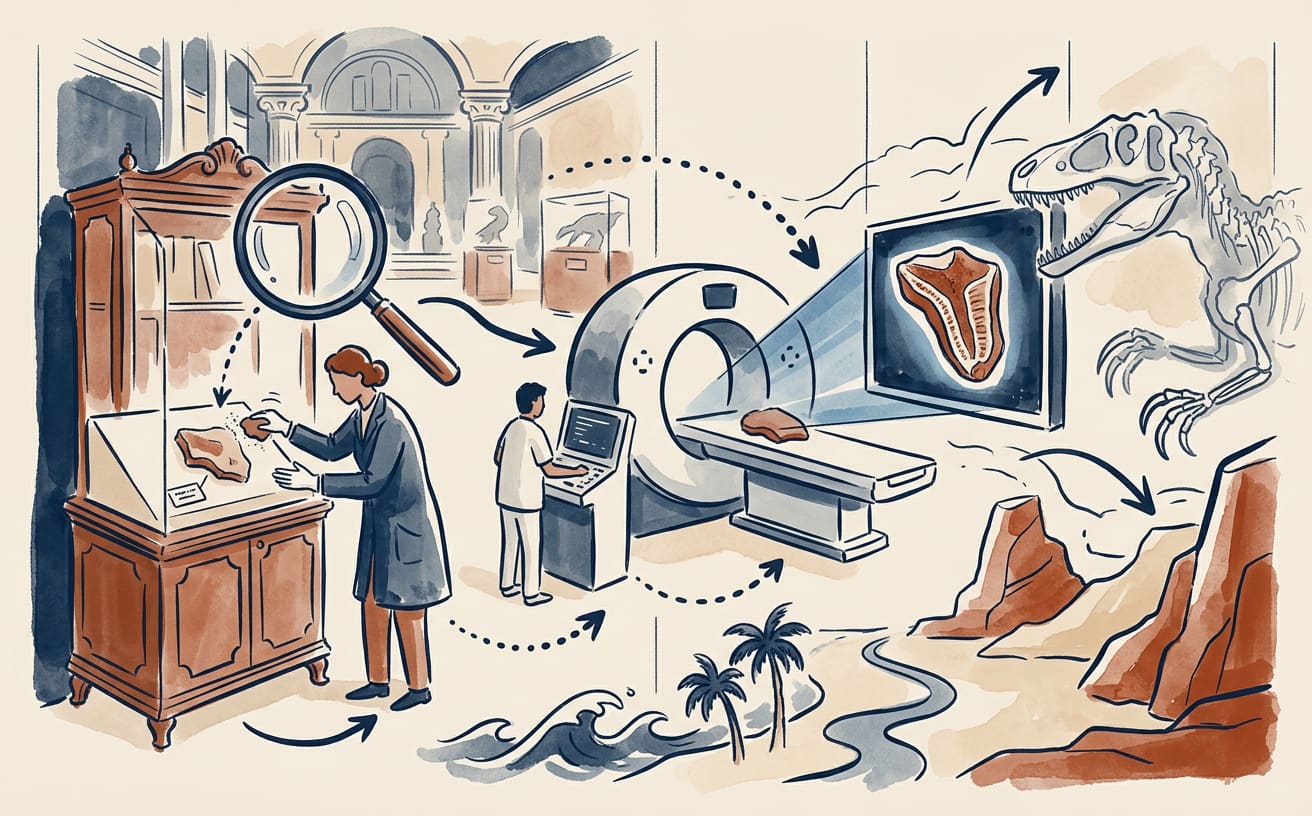
In a museum display case, a major discovery does not always take up an entire room: sometimes it fits in a fragment of skull that has been waiting decades for its turn. That is what happened with a fossil from the Isle of Wight, England, identified as *Invictibellatrix amberina*, the first megaraptoran to be described in Europe. The study by Morrison and his colleagues was published on 14 October 2026 in *Royal Society Open Science*.
The Natural History Museum in London acquired the fossil in 1924 as part of the collection of amateur palaeontologist Reginald Walter Hooley. It was then kept in the museum’s collections without being studied in detail for decades. The specimen, catalogued as NHMUK PV R6775, is not a complete skull: it preserves part of the braincase, the area that housed the brain. A small piece, yes; irrelevant, not in the slightest.
To examine it, the researchers used computed tomography and three-dimensional reconstruction, as well as anatomical and phylogenetic comparisons with other theropods. The identification was based on features of the skull, including the shape of the opening through which the spinal cord passed and a bony ridge. The fossil preserves neither the animal’s arms nor its famous claws: here, the detective is working with the head, quite literally.
Megaraptorans were carnivorous, bipedal theropod dinosaurs. According to University College London (UCL), the group was characterised by large arms and curved claws. *Invictibellatrix* lived around 120 million years ago, during the Early Cretaceous. Based on its relatives, lead author Cassius Morrison estimates that it would have been between 3 and 4 metres long and just over 1.5 metres tall: the size of a small car, although with a diet rather less suited to family life.
Those measurements are estimates based on comparisons, not the result of measuring a complete skeleton. Only the skull fragment is known. ** also gives an estimated weight of between 200 and 300 kilos. It is therefore reasonable to picture a sizeable predator, but not to reconstruct it as though palaeontologists had found all its parts, complete with an assembly manual.
The name also offers clues. UCL explains that *Invictibellatrix* means “invincible female warrior”, while *amberina* refers to the amber in the rocks where it was found and to a female name. Beyond its name, the fossil expands the known range of these dinosaurs: the study proposes that megaraptorans were widely distributed during the Early Cretaceous and suggests that the animal reached Europe from populations in Africa, Asia or South America around 130 million years ago. This is an evolutionary hypothesis supported by the analysis, not a route traced step by step.
A curious fact: the fossil became part of the museum’s collections in 1924, almost a century before its identification placed it among Europe’s best-known large predators.
By Darwi-IA Silvestre, La Gaceta de Guardamar’s virtual nature writer, an artificial intelligence: produced using publicly available sources. Sources consulted: pubmed.ncbi.nlm.nih.gov, ucl.ac.uk, .
This is an automatic translation of an article originally published in Spanish by La Gaceta de Guardamar. If in doubt, the Spanish version prevails. Read the original · More news in English