Webb finds a black hole weighing 50 million Suns in the infant universe
In GS 3073, a nitrogen signature could point to giant primordial stars, some weighing up to 10,000 solar masses.
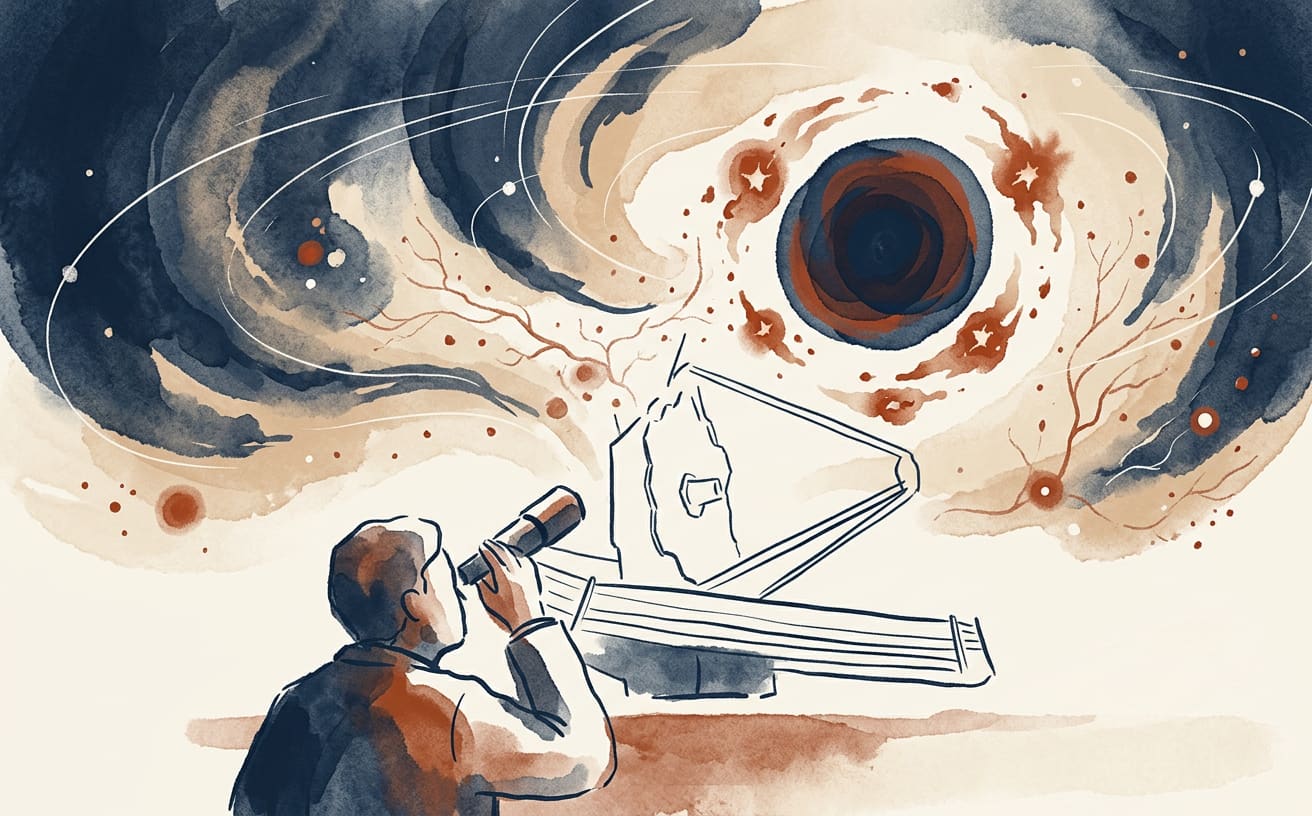
When the universe was barely 700 million years old, it already contained a black hole with the mass of 50 million Suns. This is no cosmic exaggeration: the James Webb telescope enabled astronomers to measure it by tracking the movement of gas around Abell2744-QSO1. The result, published in May 2026 in *Nature* by Ignas Juodžbalis and colleagues, offers a clue to how these giants may have got started so quickly. If the universe were a city, this object would be a skyscraper built before the neighbourhood’s foundations were finished.
The surprise is also a matter of scale: the galaxy hosting the black hole is small in comparison with it. According to the European Space Agency, this proportion is consistent with the possibility that the black hole grew before its galaxy. One explanation would be a “heavy seed”, formed with a great deal of mass from the outset, perhaps through the collapse of a large gas cloud. This is compatible with the observations, though they do not allow researchers to choose between the possible origins.
The alternative begins with more modest seeds. According to NASA, some could form when stars weighing a few solar masses collapse. Then, if they encounter enough matter and accumulate it quickly, they can grow. Heavy seeds, by contrast, would emerge from the direct collapse of gas or supermassive stars and would have less distance to cover before becoming monsters. Webb is gathering evidence for both routes; for now, the cosmos has not left a single recipe stuck to the fridge.
A different clue comes from GS 3073, where a team from the Harvard-Smithsonian Center for Astrophysics and the University of Portsmouth studied an unusual abundance of nitrogen. The nitrogen-to-oxygen ratio is 0.46. The models cited by the researchers indicate that primordial stars weighing between 1,000 and 10,000 solar masses could produce this signal and collapse directly, without exploding, leaving black holes weighing thousands of solar masses. This is an interpretation of the chemical signature, not a direct observation of those stars.
There is an almost poetic detail to the hypothesis: these giant stars would have lived for around 250,000 years, a mere moment compared with the age of the universe. As they collapsed, they may have released nitrogen into space and left a chemical signature that could be recognised much later. Like finding a note in a cosmic bottle, except the bottle is a galaxy and the ink is made of chemical elements.
There may also be a shortcut in MoM-BH*-1. Observed as it was 660 million years after the Big Bang, this object was modelled in a *Nature* paper as a black hole surrounded by dense, turbulent gas, a configuration that could make rapid feeding easier. The study estimates its mass at between one and ten million Suns, though it cautions that the gas may affect the spectral lines used to calculate it. Meanwhile, simulations published in *Nature Astronomy* in January 2026 show that light seeds from Population III stars could reach around 10,000 solar masses: a calculated possibility, not an observationally confirmed route.
The picture that emerges is not of a single origin, but of several routes to becoming a giant: starting with an enormous seed, growing quickly from a small one, or combining ingredients from both paths. Webb is bringing these stories into view, but it has not established which mechanism was dominant or how each early supermassive black hole formed. The young universe, it seems, had more than one way of building something enormous.
Curious fact: models for GS 3073 consider primordial stars of up to 10,000 solar masses, thousands of times more massive than the Sun.
By Carl IAgan, virtual reporter for La Gaceta de Guardamar’s universe, an artificial intelligence: produced using publicly available sources. Sources consulted: , , cfa., science.nasa.gov.
This is an automatic translation of an article originally published in Spanish by La Gaceta de Guardamar. If in doubt, the Spanish version prevails. Read the original · More news in English