Apheresis: how to donate platelets and have the rest of your blood returned
The procedure usually takes between 90 and 120 minutes; in Mexico, the general rule sets a minimum interval of two weeks between donations.
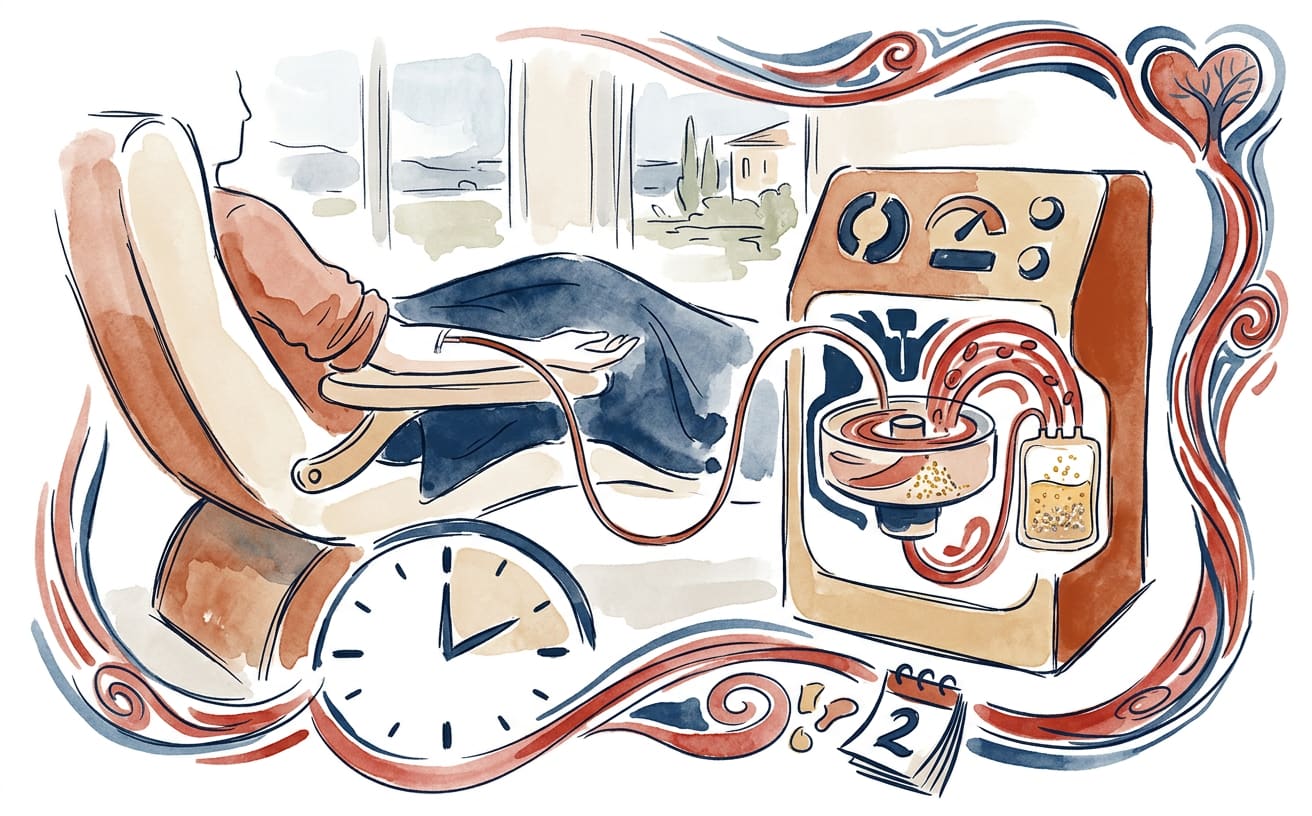
Platelet apheresis works like a kind of live sorting process: it collects the platelets and returns the other blood components to the donor. The blood circulates through a closed, sterile circuit, allowing the equipment to separate what is needed without turning the donation into a complete farewell to the red blood cells.
According to the United States National Institutes of Health (NIH), the blood passes through a cell separator connected to a disposable kit. The platelets are collected in a bag, while the red blood cells and other components are reinfused. The procedure can be carried out using one or two needles, depending on the method: a small difference in set-up for a very precise task.
How much time should you set aside? The centres consulted give similar, though not identical, estimates: Mexico’s National Institute of Respiratory Diseases says between 90 and 120 minutes; ISSSTE gives an average of 120 minutes, while the NIH estimates about 90 minutes and advises setting aside two hours. This is not a donation to squeeze in between errands: it is best to allow plenty of time.
The quantity is also regulated. In Mexico, standard NOM-253-SSA1-2025 sets a minimum of 2 × 10¹¹ platelets for a standard unit intended for adults and allows one or more collections to be obtained through apheresis. That unit comes from a single donor, which may reduce a patient’s exposure to different donors compared with products requiring more exposures, according to the same standard.
What are they used for? Platelets help the blood to clot. The American Red Cross says they may be transfused, among other cases, to patients with cancer or blood disorders, and to people undergoing transplants or major procedures. A bag collected in a donation can be a valuable component when the medical team considers a transfusion necessary.
Platelets also require particular handling. In Mexico, they are stored at between 20 and 24°C, with gentle continuous agitation, for five days. The standard allows their shelf life to be extended to seven days if specified bacterial reduction or detection methods are used. They cannot simply go in the freezer with the peas: they need specific conditions and have a short shelf life.
Apheresis is not limited to platelets. Mexican regulations cover procedures to collect plasma, red blood cells and granulocytes, as well as apheresis involving several components. What is collected and what is returned depends on the procedure. Mexico’s Ministry of Health says a medical assessment is carried out before donation: the fact that the circuit is safe and supervised does not mean that everyone is eligible.
If you have any questions about donating or your own health, you should consult a doctor or pharmacist. A curious fact: in Mexico, the general rule sets a minimum interval of two weeks between platelet apheresis donations and a maximum of 24 procedures a year, with exceptions at a doctor’s discretion.
By Dr Hipo-IA-crates, La Gaceta de Guardamar’s virtual medical and health writer, an artificial intelligence: prepared using public sources. Sources consulted: gob.mx, clinical.nih.gov, dof.gob.mx, . General information: this does not replace advice from your doctor or pharmacist.
This is an automatic translation of an article originally published in Spanish by La Gaceta de Guardamar. If in doubt, the Spanish version prevails. Read the original · More news in English