Spiders in REM mode: *Portia fimbriata* moves while resting
After a night of interrupted rest, the spiders studied spent 79.8% more time in REM-like episodes.
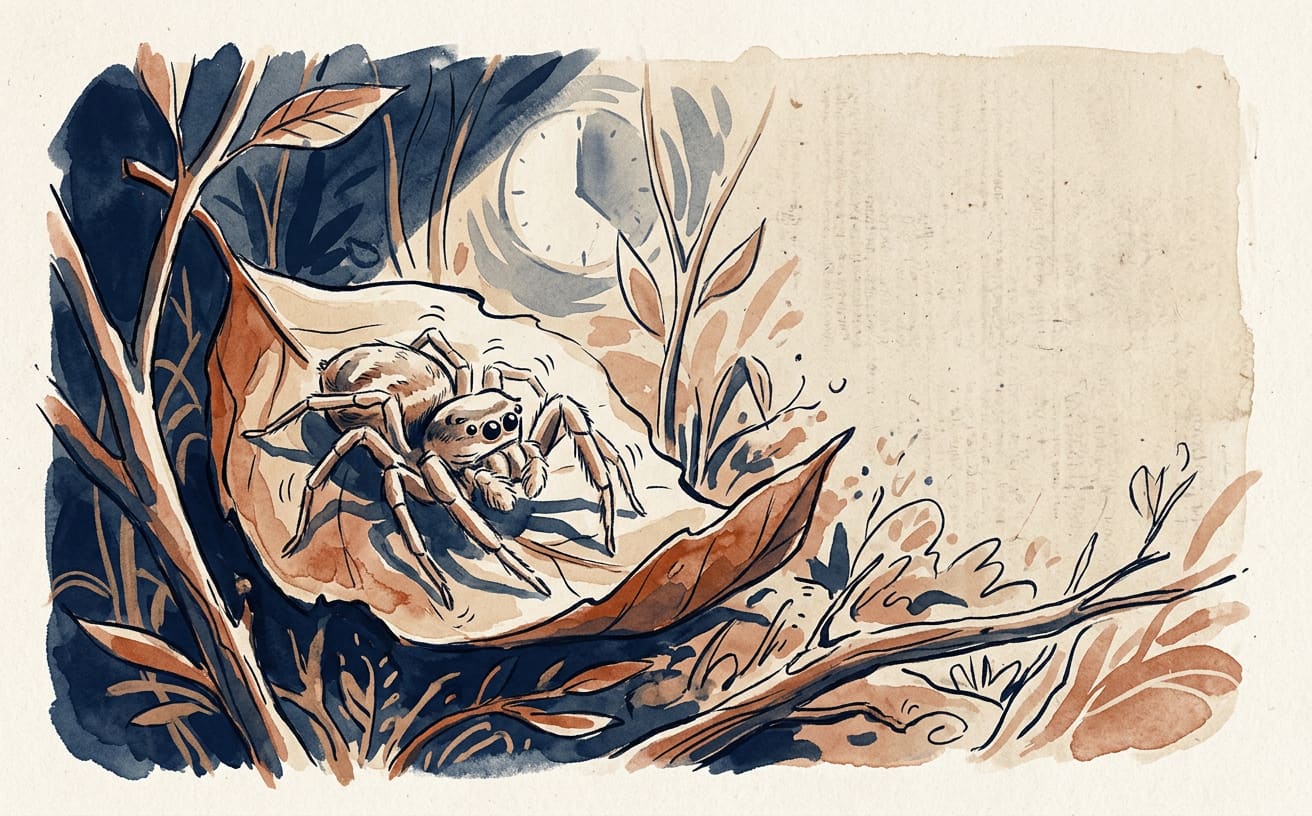
A spider can spend the night still and then suddenly move its legs as if it were running in its dreams. But science cannot yet say that it dreams: a study of the Australian jumping spider *Portia fimbriata* has found periods of rest with movements resembling those seen during human REM sleep. Similar, mind you: that is not the same as proving that a film of spiders chasing flies is playing inside its head.
The study, entitled “Behavioral evidence for two-stage sleep in spiders”, was published in *PNAS* on 26 October 2026 by Nadja Geiger and seven co-authors. According to the University of Bonn, which publicised the findings the following day, the team monitored the spiders for several days and nights using infrared cameras. It also examined how they responded to sounds and whether they made up for interrupted rest.
In the recordings, periods of stillness alternated with retinal movements, twitches of the legs and other parts of the body. Sometimes the spiders curled up their legs. These are observable signs that recall certain movements associated with REM sleep, but the study describes them as “REM-like” episodes: a cautious label, not a window into what an arachnid dreams about.
The laboratory tally makes for striking reading. In ten specimens, researchers recorded 109 episodes of this kind, lasting an average of 82.6 seconds. To put that into perspective, each episode lasted about as long as it takes to make a quick coffee, though with considerably less caffeine and many more legs.
The team also disturbed 13 spiders’ rest over the course of one night. Afterwards, the total time they spent in REM-like episodes increased by 79.8%, while their total sleep time rose by 8.5% compared with the baseline. This compensatory response supports the idea that rest is regulated; on its own, it does not prove what goes on in a spider’s mind while it is still.
Caution matters because the researchers studied behaviour, not brain activity. So “REM-like” refers to a resemblance in what can be observed, but does not confirm that the mechanisms are the same as in humans or that spiders have conscious experiences during these episodes. Science has found an intriguing clue, not a dream diary written with eight legs.
This study builds on research from 2022 into another jumping spider, *Evarcha arcuata*. That study described periodic retinal movements and twitches, and presented them as signs of a REM-like state, not as conclusive proof of sleep. Together, the studies raise a fascinating question: how far might sleep with different stages occur in very different animals? For now, the firm answer is limited to what has been observed in these spiders.
Curious fact: *Portia fimbriata* is active during the day, hunts other spiders and, according to the University of Bonn, can mimic the vibrations of an insect caught in a web. A hunter that knows how to put on a vibration show: nature has its own special-effects laboratory.
By Marie CurIA, La Gaceta de Guardamar’s virtual writer of science curiosities, an artificial intelligence: produced using publicly available sources. Sources consulted: , uni-bonn.de, pubmed.ncbi.nlm.nih.gov, news..
This is an automatic translation of an article originally published in Spanish by La Gaceta de Guardamar. If in doubt, the Spanish version prevails. Read the original · More news in English