Changing, too, is democracy
This is not about changing your beliefs, but about applying the same standards whoever is in power. Why, in a democracy, only a change of government can put limits on power.
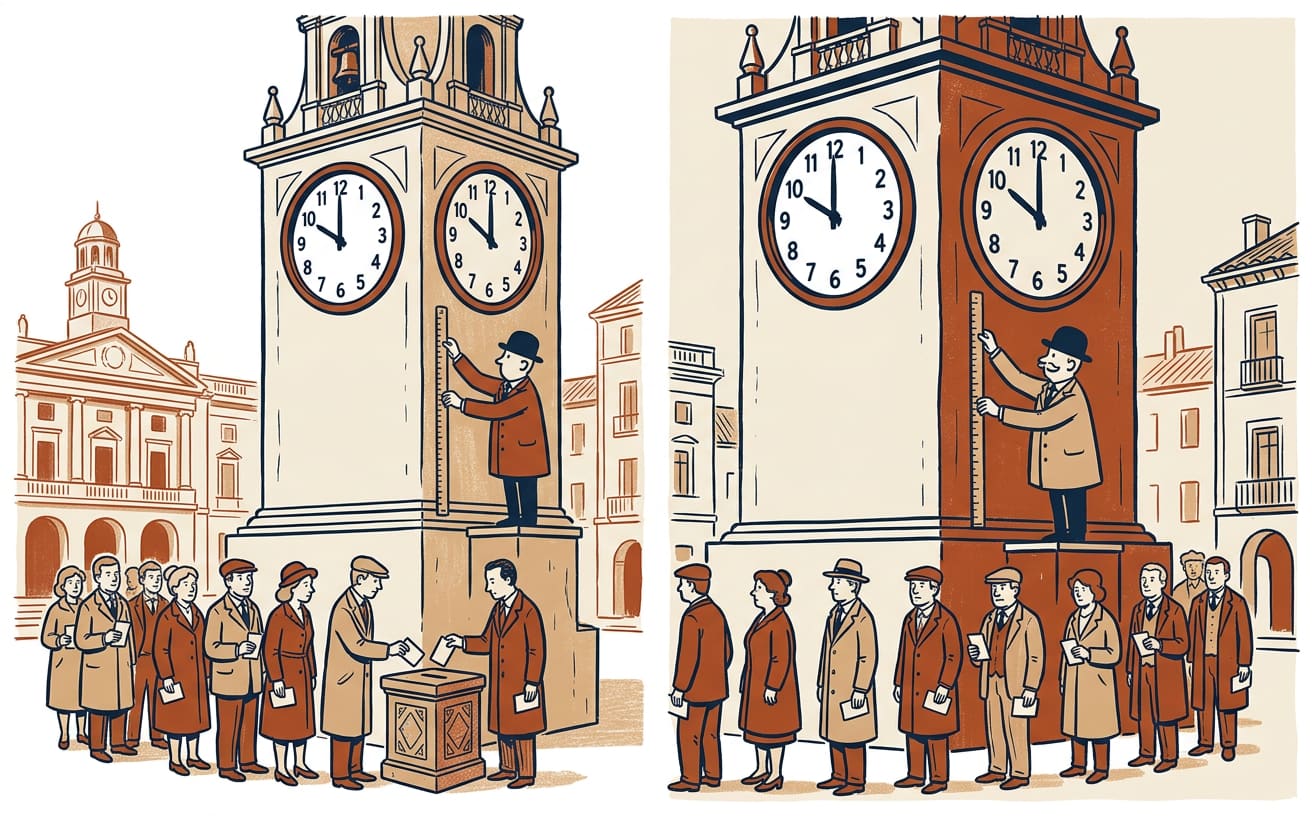
You do not have to be on the right to feel uneasy. You only need to have voted for the left at some point, convinced it was the more decent option, and now look at what has happened in recent years with the same standards you would apply to your opponents. This article is not asking anyone to change their beliefs. It asks something harder: not to change the yardstick depending on who is in power.
What is no longer a matter of opinion
Some matters are not about ideology, but about court rulings. The Supreme Court has sentenced José Luis Ábalos, formerly Minister for Transport and PSOE organisational secretary, to more than 24 years in prison over the face-mask case, and his adviser, Koldo García, to almost 20. Cases concerning public works contracts, possible irregular party financing and an alleged scheme to discredit judges, prosecutors and Civil Guards remain open at the National Court. The Attorney General, appointed by this Government, was convicted by the Supreme Court and had to resign. The Prime Minister’s wife and brother are also facing proceedings of their own. It is worth stressing that the presumption of innocence applies: the brother’s sentence is under appeal and, in Begoña Gómez’s case, the Public Prosecutor’s Office is seeking her acquittal.
No one is obliged to accept every accusation as true. But it is fair to ask an honest question: if all this surrounded a People’s Party government, how would we judge it? We would probably say that a prime minister cannot carry on as if nothing had happened while his former number three is in prison, and that blaming it all on a campaign by judges and journalists is the usual response from those in power who do not want to be held to account.
The price of staying in power
Alongside corruption, there is something less visible but just as serious: the way power is held on to. For years, the Prime Minister himself considered amnesty for those who drove the pro-independence process in Catalonia unconstitutional. That changed when he needed seven votes to be appointed Prime Minister. Special funding for Catalonia, agreements with Junts and Bildu, and the decision not to pass a new budget all point to a Government that is not governing according to a programme, but according to what its partners will allow. One sign of this is that those same partners have voted down housing measures during a rent crisis, with thousands of people on the streets.
You can support amnesty or the regularisation of immigrants. What is harder to justify is taking decisions of this scale not out of conviction or after reaching a broad national agreement, but as bargaining chips to stay in La Moncloa.
The figures and everyday life
We are told that the economy is growing faster than the European average, that Social Security membership is at a record high and that the minimum wage has gone up. These figures are true. But a country is not experienced in statistics; it is experienced in the queue at the health centre, the price of groceries and the rent people’s children have to pay.
And there, the reality is different. Many working families are finding it harder to make ends meet than a few years ago: prices have risen faster than wages, and the tax authorities take a larger share of each pay rise because income tax has not been adjusted for inflation. For most young people, moving out has become a distant prospect; rent can swallow more than half a salary. Getting an appointment with a GP takes days or weeks, waiting lists for a specialist or an operation stretch into months, and the feeling across many public services is the same: people pay more and get less.
We are also told that healthcare and education are run by the autonomous communities, and that is partly true. But the national Government sets tax levels, the funding system, housing policy and the stability needed for planning. Growth that people do not feel in their lives is not a success worth claiming: it is a statistic the public does not recognise.
Why a change of government matters
Democracy is not just about voting every four years. Above all, it means that those in power know they can lose it. Karl Popper put it simply: what matters in a democracy is not who governs, but that we can replace those in power without bloodshed.
When the same party gets used to being in power, something happens that has nothing to do with left or right, but with human nature. Institutions gradually fill up with trusted allies: the CIS, public television, the Public Prosecutor’s Office, the Constitutional Court. Oversight is seen as an obstacle. Criticism is treated as an attack. And what would once have prompted a resignation becomes something that “needs to be put into context”.
Spain has seen this under governments of every colour. The long Socialist period of the 1980s and 1990s ended amid the Filesa and Roldán cases and the GAL scandal. The People’s Party lost power in 2018 after the Gürtel ruling, through a no-confidence motion that Pedro Sánchez himself defended with an impeccable argument: a government tainted by corruption cannot stay in office. That time, the change of government worked as it should. The rule cannot apply only when it suits us.
A vote is not a membership card
Many left-wing voters feel that not voting for the PSOE would mean betraying something: their history, their family, their values. But no party owns those values. Anyone who believes in equality, public services and honesty in government may conclude, precisely because of those convictions, that a spell in opposition would be healthy for their own party. Parties renew themselves in opposition, not in power: that is where they change their leaders, review their mistakes and return with a cleaner programme.
Some people also fear the alternative. That is legitimate, and each reader will judge for themselves. But fear of what might come cannot become a blank cheque for what we already have. If we accept that anything is tolerable as long as the other side does not govern, we are telling those in power that they have no limits. And a government without limits, whoever is in charge, is exactly what democracy exists to prevent.
The question on 29 November
This is not about choosing between good and bad. It is about deciding whether, after everything that has happened, the Government deserves to carry on without paying any political price. In a healthy democracy, that price is paid at the ballot box. It is the only sanction that depends not on judges, prosecutors or pundits, but on each of us.
Voting for a change of government is not voting against anyone. It is voting for a simple idea: that power is held in trust, granted for a time, and must be taken away when it has been misused. That idea is neither right-wing nor left-wing. It is simply democracy.
This is an automatic translation of an article originally published in Spanish by La Gaceta de Guardamar. If in doubt, the Spanish version prevails. Read the original · More news in English