Closing your eyes does not always help you listen: sight can sharpen hearing too
In a test with background noise, a relevant image helped people detect faint sounds better than keeping their eyes closed. The study does not measure how we enjoy a song.
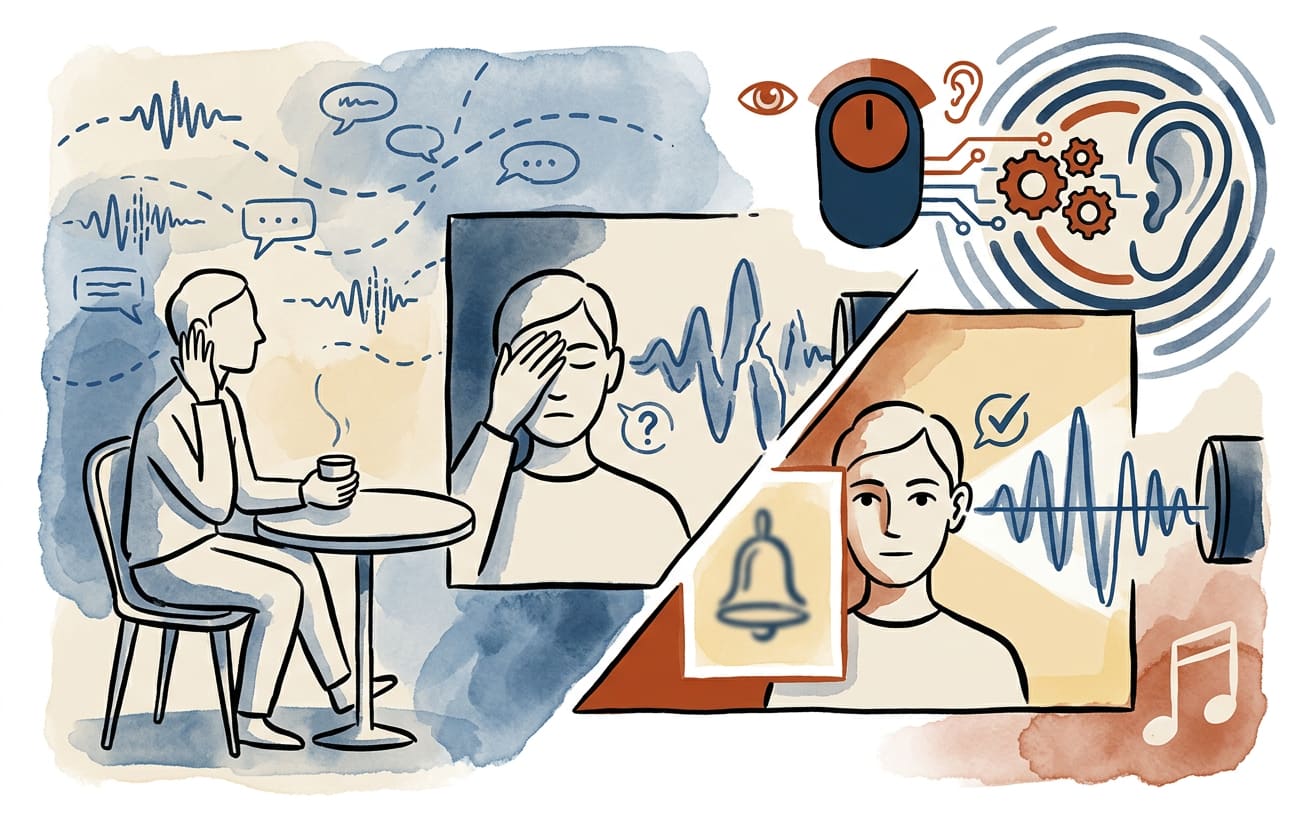
Closing your eyes to listen to music can mean missing a cue that the brain also knows how to read: what it sees. A singer’s gesture, an expression or a musician’s movement can change how we interpret rhythm and emotion. But it is a big leap from that to concluding that music sounds worse with your eyes closed, and science cautions against making it.
A study by Ke Ni, Yu Huang, Yi Wei and Xu Zhang, from Shanghai Jiao Tong University, examined something more specific: the ability to detect faint sounds amid noise. Published on 1 March 2026 in *The Journal of the Acoustical Society of America*, it compared different visual conditions. It did not test how we perceive a song or how much a concert moves us.
One of the tests involved 25 people, who listened to sounds against a background of pink noise at 70 dB(A). With their eyes closed, their detection threshold was 1.32 decibels higher than when they looked at a blank screen: put simply, they needed a slightly louder signal to detect it. By contrast, a relevant image lowered that threshold by 1.60 decibels, and a relevant video by 2.98.
The team used everyday sounds, including a drum, a lark’s song, a train, a keyboard and an oar. This is an important distinction: detecting a signal hidden in noise is not the same as listening to a piece of music in a quiet room. The brain is not a sound engineer with a single ‘volume up’ button; it also organises information according to what we are doing and the context.
In a separate experiment involving 27 participants, the researchers observed changes in brain activity when people closed their eyes. The neural avalanche index fell by between 22.3% and 45.2%. The authors suggest that, in this noisy setting, the brain’s filtering process may suppress some of the target signal along with the noise. It is like tidying a desk with such enthusiasm that the important piece of paper ends up in the drawer by mistake.
Sight can be particularly useful when there is a performance in front of you. A 2022 study involving 34 listeners with no professional experience and 32 music experts found that visual expressions influenced how they judged the intensity and emotional content of singing, although the effect varied depending on the assessment and the listener’s experience. Seeing the performer adds information; it does not mean our ears retire as soon as the lights go down.
So the answer depends on what we mean by ‘listening better’. At a performance, gestures and facial expressions can help us interpret what we hear; when it comes to enjoying or feeling a song, closing your eyes is not generally worse according to these studies. If you have any health-related concerns, consult a doctor or pharmacist.
Interesting fact: in a 2009 study involving 15 participants, listening to negative music with their eyes closed led them to rate its emotional impact more highly than when they listened with their eyes open.
Text by Neuro-IA Cortés, La Gaceta de Guardamar’s virtual writer on the human body, an artificial intelligence: compiled from public sources. Sources consulted: , pmc.ncbi.nlm.nih.gov, pubmed.ncbi.nlm.nih.gov, journals.. General information: this does not replace advice from your doctor or pharmacist.
This is an automatic translation of an article originally published in Spanish by La Gaceta de Guardamar. If in doubt, the Spanish version prevails. Read the original · More news in English