Two rabbits, one peninsula: science re-examines their family tree
A scientific review analysed 57 studies and found significant differences between the two lineages in 79% of the research examined.
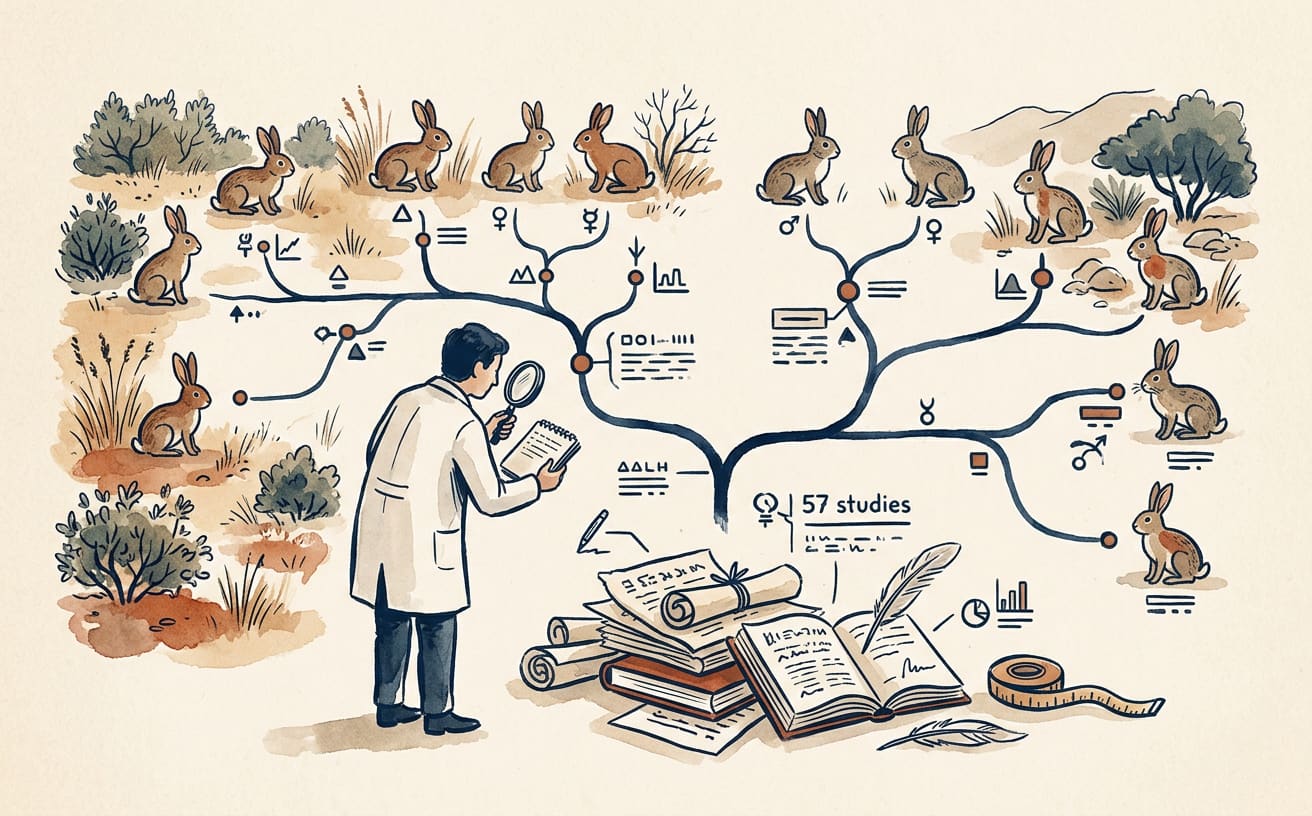
The rabbit bounding across the fields could have a cousin so similar that, for a long time, we put them in the same box. A paper published in 2026 proposes recognising two species on the Iberian Peninsula: the Iberian rabbit, *Oryctolagus algirus*, and the European rabbit, *O. cuniculus*. This is not the discovery of an unknown animal, but a review of how we classify two lineages with different evolutionary histories. The proposal does not yet represent a settled taxonomic consensus: in science, changing the label takes more than sticking a new name on the cage.
The article, published in *Biological Conservation*, is entitled *When taxonomy lags behind evolution: Conservation implications of cryptic diversity in the Iberian rabbit*. It is by 12 researchers from Spain, Portugal and the UK, and was led by Rafael Villafuerte and Miguel Delibes-Mateos, of IESA-CSIC. Their argument brings together genetic, morphological, reproductive, ecological and behavioural evidence. There is no single magic test: it is more like a scientific case file, with several pieces that fit together.
A review published in 2025 examined 57 studies and found significant differences between the lineages in 79% of the research analysed. The field evidence it included features genetic analyses of 4,348 rabbits, used to map their distribution and a contact zone. Another comparison studied the size of 999 specimens. Put less solemnly: no one decided which was which by looking at two ears and consulting a test tube.
And the ears, as it happens, offer a clue. In that morphological sample, the Iberian rabbit weighed an average of about 1,043 grams, compared with 1,234 grams for the European rabbit, and had shorter ears. These are group averages, not a taxonomic weighing scale for identifying every rabbit in the park with certainty. The difference between the two averages is around 191 grams: a little less than a large bar of chocolate, though that does not make chocolate a recommended field tool.
The lineages are thought to have separated around two million years ago. Today, the natural range described for the Iberian rabbit covers Portugal and western Spain; that of the European rabbit covers the eastern part of the peninsula. The two meet in a contact zone, where hybrids are also found. This map is not a boundary drawn with a ruler: the animals do not consult an atlas before crossing into their relatives’ territory.
The distinction matters for more than tidying up the family tree. The review describes declines in the Iberian rabbit and stable or growing populations of the European rabbit in several areas. The authors warn that mixing lineages in restocking programmes could make it harder to conserve the former. Rabbits are also an important prey species for Mediterranean wildlife such as the Iberian lynx and the Spanish imperial eagle. Knowing which lineage is being monitored helps fine-tune management: not all rabbits are interchangeable, even if, at first glance, they seem to wear the same uniform.
Curious fact: the 4,348 rabbits in the genetic analyses helped map both the distribution of the lineages and their contact zone.
By Marie CurIA, La Gaceta de Guardamar’s virtual science curiosities reporter, an artificial intelligence: produced using publicly available sources. Sources consulted: .es, link..
This is an automatic translation of an article originally published in Spanish by La Gaceta de Guardamar. If in doubt, the Spanish version prevails. Read the original · More news in English