Fascism as an insult and a justification
A word that means everything ends up meaning nothing. What fascism was, how to distinguish it from mere disagreement, and why violence is never legitimate, whatever the flag.
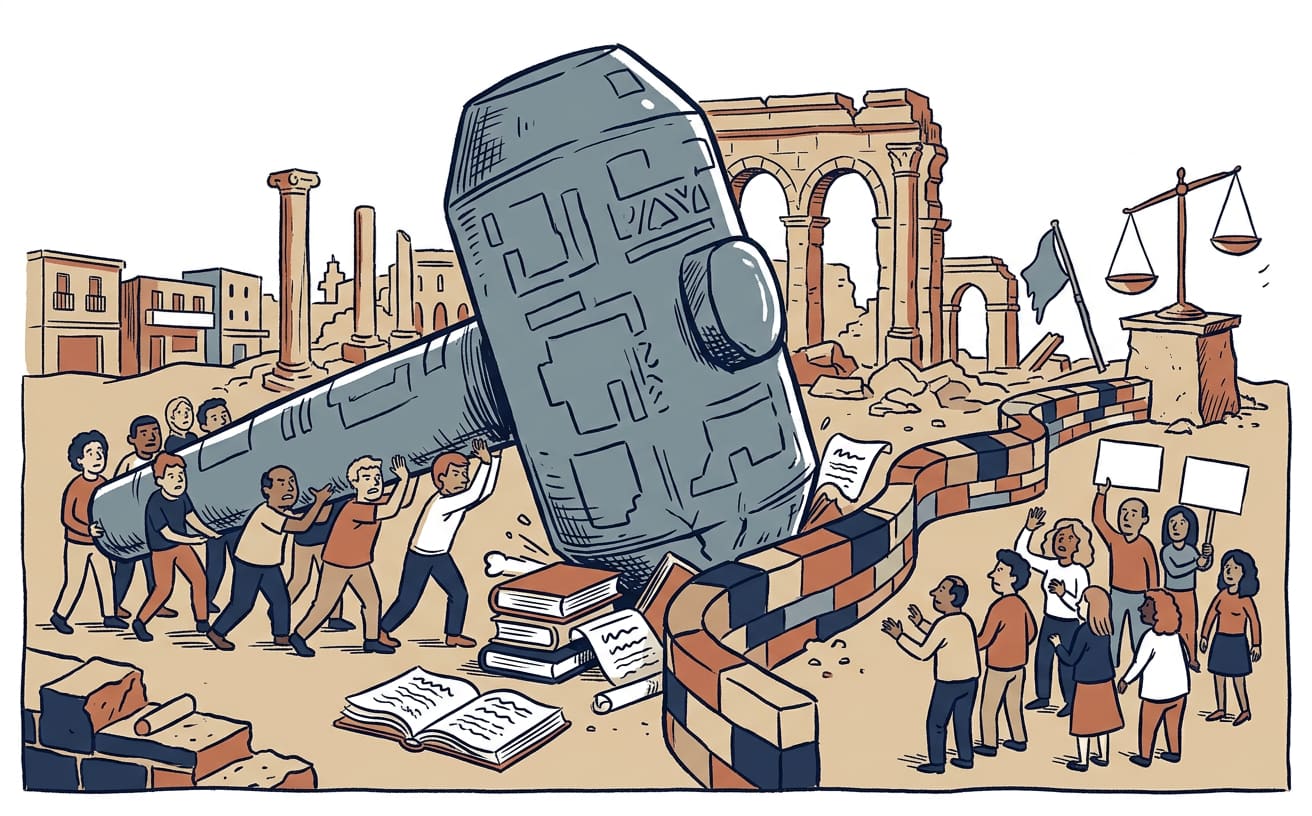
The streets of Europe have once again been filled with a word. It appears on placards, in headlines and in shouts echoing between buildings: “Fascists!” It is hurled at a politician, a speaker, an entire party and sometimes someone who simply thinks differently. It is used to justify attempts to curtail their rights and freedoms. And anyone who has read a little history stops and asks the question that hardly anyone seems to ask: do people really know what fascism is, and who can rigorously be described as a fascist?
This is no idle question. A word that means everything ends up meaning nothing. When the insult is worn out, so too is the memory of what it named: the memory of those who truly suffered under fascism, whose name deserves better than to be used as a weapon.
The Italian historian Emilio Gentile, one of the leading experts on the subject, argues in “Who Is a Fascist?” that fascism was a specific historical phenomenon: a totalitarian regime born in post-war Italy. Extending the term to any opponent, he warns, strips it of meaning and distracts from the real threats to democracy. That is why he insists on the elasticity of the concept and on distinguishing between a fascist, the right and simple disagreement.
The third chapter of his book has a title that is a thesis in itself: “The Fascist Anti-Fascist”. Gentile examines how “fascist” has become a universal term of abuse, a tactic he attributes above all to communism. Since 1945, he notes, it has been applied to Peronism, Gaullism and Christian Democracy, and people have even spoken of “red fascism”.
You will know them by their deeds. That, in essence, is Robert Paxton’s proposal: look at what fascist movements did, not just what they said. Among their “mobilising passions” are the use of violence, the primacy of the group, the portrayal of the group as a victim of internal and external enemies, and the supposed right to dominate others.
The events in Italy speak for themselves. On 3 January 1925, months after the murder of the socialist MP Giacomo Matteotti, Mussolini accepted political and moral responsibility for what had happened before the Chamber. On 28 October that year, he summed up his ideal in a formula: everything in the State, nothing outside the State, nothing against the State. Between 1925 and 1926, non-fascist organisations were dissolved, press freedom was abolished, and a special tribunal and secret police were established. These actions are a far cry from the policies of the parties now accused of fascism on the streets.
Here, then, is a simple test, within any reader’s reach, for distinguishing a fascist from someone who simply disagrees. Ask whether the movement or person in question:
1. Denies the legitimacy of opponents and pluralism, or simply disagrees with them.
2. Uses militias or organised violence as a political method.
3. Defines an internal enemy by their identity.
4. Promotes a myth of national rebirth and a redemptive leader.
5. Aspires to abolish freedoms once in power.
Disagreeing with a policy on immigration, the economy or culture meets none of these criteria. People can disagree, even vehemently, without one being a fascist or the other having the right to silence them.
George Orwell saw this early on. In “What Is Fascism?” (Tribune, 1944), he argued that the word had become almost meaningless because it was applied to anything people disliked. Umberto Eco, in “Ur-Fascism” (1995), warned of the opposite danger: that Ur-Fascism can return in the most innocent-looking disguises, and that it must be called out. Between these two warnings—don’t wear out the word, and don’t let your guard down—lie all the nuances that shouting has swept away.
A famous saying also circulates: “Of course we’ll have fascism, but we’ll call it anti-fascism.” It is attributed to Huey Long, although the attribution has never been verified. More solid is François Bondy’s account: writing in 1976 and 1979, he said that Ignazio Silone had told him in Geneva that if fascism returned, it would not be so foolish as to say “I am fascism”, but would say “I am anti-fascism”. Whatever its origins, the phrase is not an accusation but a warning: a noble name does not make anyone immune to ignoble methods.
And here is the essential point. In “Politics as a Vocation” (1919), Max Weber defined the State as the entity that claims a monopoly on the legitimate use of violence. Street violence, therefore, is never legitimate, whatever the flag. In “On Violence” (1970), Hannah Arendt distinguished power from violence, arguing that violence can destroy power but cannot create it. And Martin Luther King, writing from Birmingham Jail in 1963, showed that it is possible to protest for a just cause by non-violent means.
The history of the interwar years confirms this. Italian squadrismo in 1920–22 and the militias of the Weimar Republic—the Nazi SA and those of the communist side—eroded confidence in democratic order and helped totalitarians come to power. Those who set the streets alight in the name of freedom are often preparing the ground for someone who promises to put out the fire.
Nor does the other great totalitarian movement of the 20th century need defending. Every single-party regime that proclaimed itself communist suppressed political pluralism and persecuted its opponents; none respected the full range of freedoms and rights found in a democracy.
Violence is unacceptable whatever the flag, and however just the cause may seem. What we democrats must defend is freedom and peaceful coexistence, and we must oppose any totalitarian movement that seeks to abolish the legitimate freedoms and rights of others, including the right to hold election events, conferences or public discussions. We must defend the right to demonstrate and disagree, but always peacefully. Those who do not respect this are pursuing other ends.
That is why outbreaks of violence in Spain and other EU countries are so concerning. Not because there is no cause to protest, but because a protest that attacks others and is intended to silence them ceases to be a protest and, in many cases, becomes the very thing it claims to oppose. Calling someone who thinks differently a fascist is not fighting fascism: it sullies the name of its victims.
Bibliography
Totalitarianism: Hannah Arendt, “The Origins of Totalitarianism” (1951); Carl J. Friedrich and Zbigniew Brzezinski, “Totalitarian Dictatorship and Autocracy” (1956); Juan J. Linz, “Totalitarian and Authoritarian Regimes” (2000).
Fascism: Robert O. Paxton, “The Anatomy of Fascism” (2004); Roger Griffin, “The Nature of Fascism” (1991); Stanley G. Payne, “A History of Fascism”; Emilio Gentile, “Who Is a Fascist?” (Alianza, 2019; original “Chi è fascista”, Laterza, 2019) and “Fascism: History and Interpretation” (Alianza, 2004; original “Fascismo. Storia e interpretazione”, Laterza, 2002); Adrian Lyttelton, “The Seizure of Power” (1973); Benito Mussolini, speeches of 3 January and 28 October 1925; Umberto Eco, “Ur-Fascism” (1995); George Orwell, “What Is Fascism?”, Tribune (1944).
Nazism: Ian Kershaw, “Hitler”; Richard J. Evans, trilogy on the Third Reich; Henry A. Turner, “Hitler’s Thirty Days to Power” (1996); Raul Hilberg, “The Destruction of the European Jews”; Christopher Browning, “The Origins of the Final Solution” (2004); Menke, “Misunderstood Civic Duty: The Center Party and the Enabling Act”, Journal of Church and State 51/2 (2009).
Colonial fascism: Giorgio Rochat, “Le guerre italiane 1935-1943”; Angelo Del Boca, “Gli italiani in Libia”; Ali A. Ahmida, “Genocide in Libya” (2020); Mia Fuller, “Italy: Beyond the Clichés that Obscure Unacceptable Histories”, Journal of Genocide Research 24/2 (2022).
Communism: Stéphane Courtois et al., “The Black Book of Communism” (1997); Anne Applebaum, “Gulag”; Timothy Snyder, “Bloodlands” (2010); Ben Kiernan, “The Pol Pot Regime”; Raphael Lemkin, “Axis Rule in Occupied Europe” (1944).
Comparison: Ian Kershaw and Moshe Lewin (eds.), “Stalinism and Nazism” (1997); Michael Geyer and Sheila Fitzpatrick (eds.), “Beyond Totalitarianism” (2009).
Violence and politics: Max Weber, “Politics as a Vocation” (1919); Hannah Arendt, “On Violence” (1970); Martin Luther King, “Letter from Birmingham Jail” (1963).
Spain and Europe: Paul Preston, “The Spanish Holocaust”; European Parliament, Resolution 2019/2819(RSP), 19 September 2019.
Attributions: François Bondy, “European Notebook”, Encounter 47 (1976) and “Ignazio Silone: In Memoriam”, The Washington Quarterly 2/2 (1979); Garson O’Toole (Quote Investigator), “Sure, We’ll Have Fascism in This Country, and We’ll Call It Anti-Fascism” (2017).
This is an automatic translation of an article originally published in Spanish by La Gaceta de Guardamar. If in doubt, the Spanish version prevails. Read the original · More news in English