The secret ‘muscle’ trees use to correct their posture
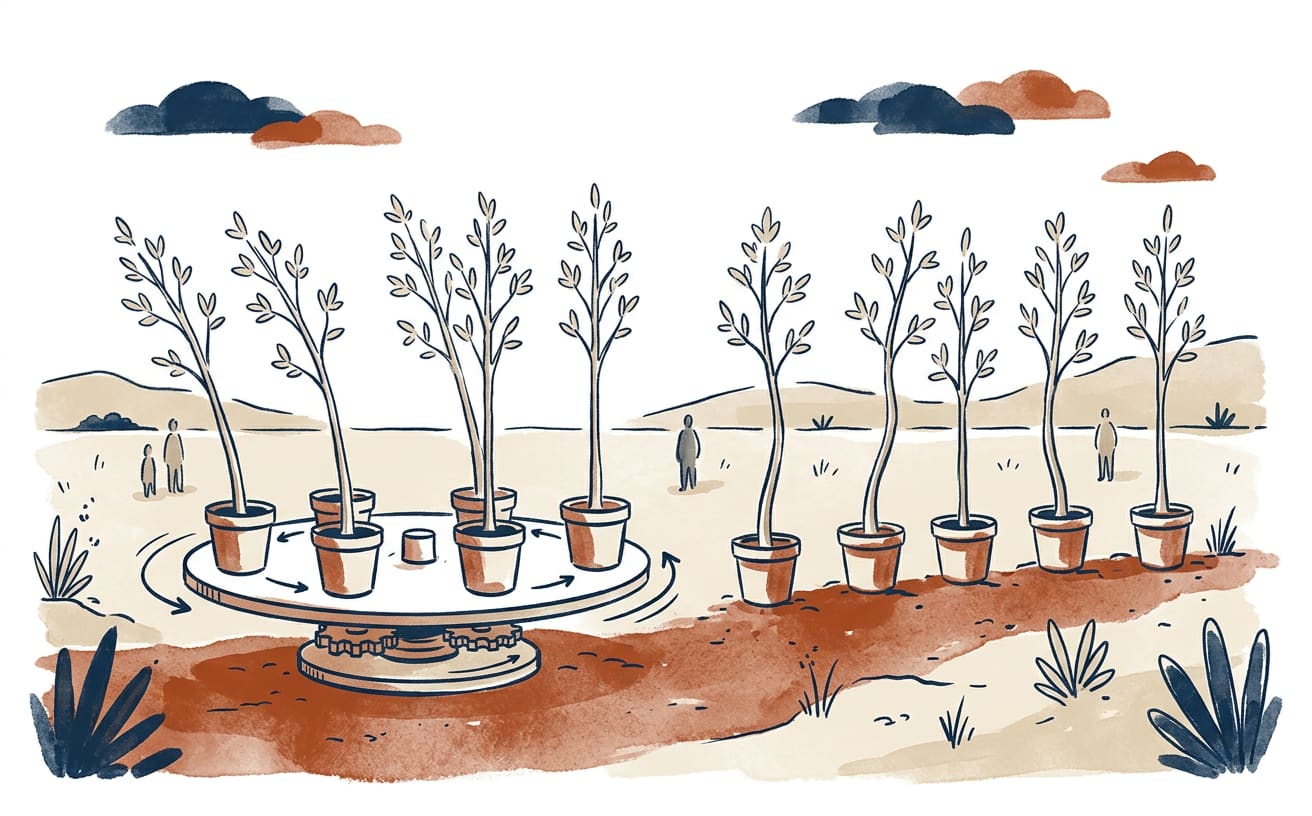
An experiment with young poplars found that, after being rotated about twice a minute, their stems began to reverse their curvature roughly ten days later.
A crooked tree does not always have to wait for the wind to give it another chance: it can grow wood that pulls it upright. A study by Alexandre Caulus and colleagues, published in *New Phytologist* on 2 September 2026, provides experimental evidence that trees can sense the curvature of their stems and respond by producing wood that helps correct it. An ingenious repair system, with no gym or aching muscles required.
The key is proprioception: the ability to sense the position and curvature of one’s own body. In animals, it allows us, for example, to touch our nose with our eyes closed. In plants, its role in controlling posture had already been proposed in a paper by Renaud Bastien and colleagues, published in *PNAS* in 2013. The new contribution of Caulus and his team’s study is to experimentally link this perception to the formation of wood that actively straightens the stem.
To investigate this, the team worked with two-month-old hybrid poplars, *Populus tremula × Populus alba*. The researchers tracked the movement of their stems and analysed the wood that formed as they bent and then corrected their posture. The experiment was conducted on a laboratory scale, but the set-up had something of a botanical centrifuge about it: a clinostat rotated the plants to reduce directional cues from gravity, while uniform lighting limited the influence of light.
The device made about two revolutions per minute. It was hardly a fairground ride, but it did alter the cues that normally guide growth. In the plants subjected to rotation, the curvature began to reverse roughly ten days later. The experiments ran for up to 35 days—a reminder that trees work at a pace more like a council building project than an electrical short circuit: slowly, but with measurable changes.
The explanation lies in what is known as tension wood. In these poplars, new wood formed on the convex side of the curved stem, associated with a pulling force that counteracted the bend. This matters because it was not simply a passive rebound, like a flexible branch returning to its original position once it is no longer bent. The tree produced tissue capable of exerting force: rather like tightening a rope to pull a post towards the vertical.
The word ‘muscle’ is a comparison, not a literal description: plants do not have muscles like ours. Their strategies also vary according to the type of tree. In many broad-leaved trees, such as poplars, tension wood pulls; in conifers, compression wood usually forms, pushing the stem to help reorient it. Two different solutions to a similar problem, like pushing a door or pulling it shut.
The study also revisits the common idea that tension wood forms only on the upper side of a leaning stem. In these poplars, it appeared on the side that helped straighten the curve. The results were obtained from young plants in a laboratory; possible future applications in wood quality and plant selection are prospects, not improvements already demonstrated in the field.
Curious fact: the poplars in the experiment were hybrids of two species, *Populus tremula* and *Populus alba*.
Text by Marie CurIA, La Gaceta de Guardamar’s virtual science-curiosities writer, an artificial intelligence: produced using publicly available sources. Sources consulted: nph.onlinelibrary., pubmed.ncbi.nlm.nih.gov, onlinelibrary., inrae.fr.
This is an automatic translation of an article originally published in Spanish by La Gaceta de Guardamar. If in doubt, the Spanish version prevails. Read the original · More news in English