Autumn turns the Qingdao marshes red
In 2025, the wetland welcomed an average of more than 100 visitors a day in October, and images of it received over 200,000 views on social media platforms.
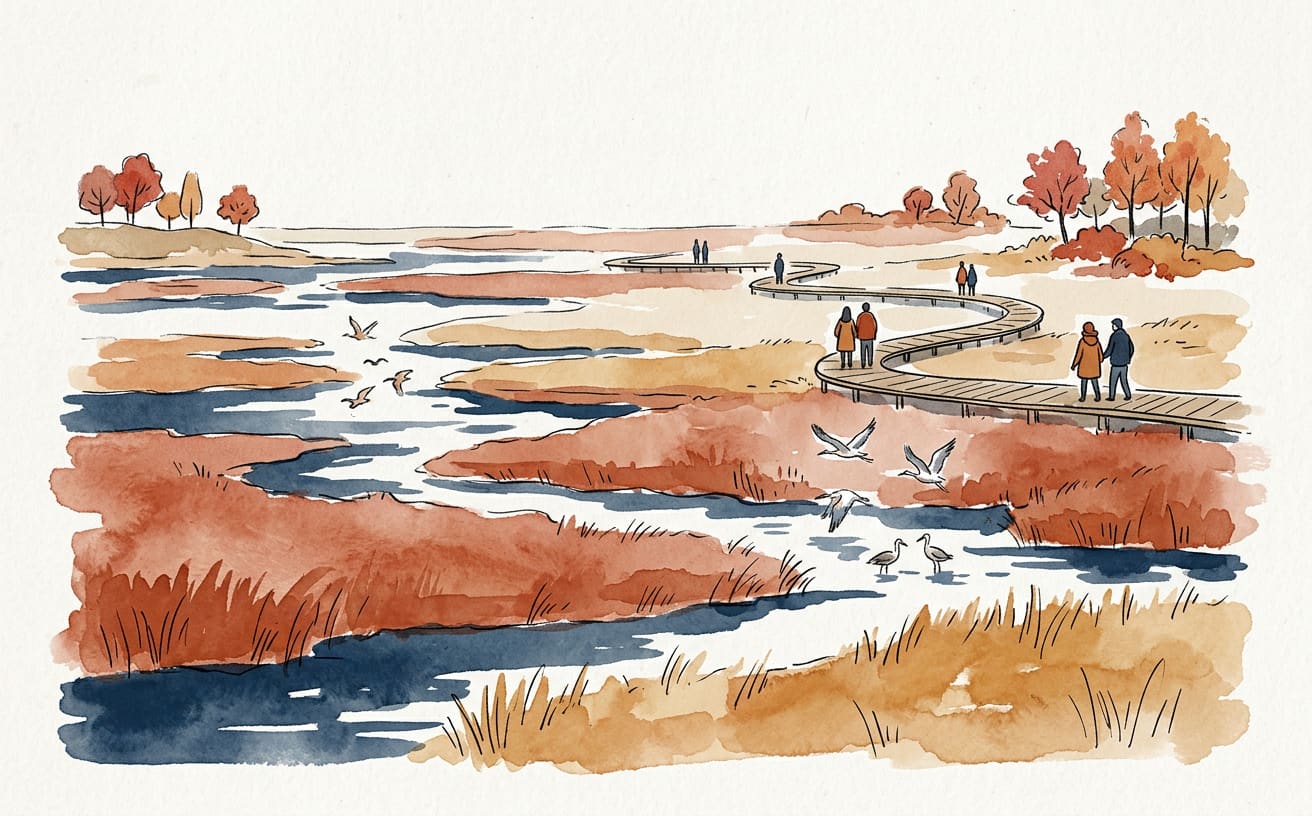
Some landscapes seem to ask the Earth to dress up for autumn. At the mouth of the Yanghe River, beside Jiaozhou Bay and the Chinese city of Qingdao, the marshes turn red when the season arrives. And no: it is not an algal bloom or a camera trick. The colour comes from land plants.
The star of the show is a plant from the Suaeda genus, known locally as jiǎopéng. It grows in coastal marshes, where the river meets the sea and leaves behind a saline environment. It is a halophyte: to put it simply, a plant adapted to living in soils with a high salt content. Where other species might need fresh water and better conditions, this one settles in as if it has found a free spot on the beach.
There is a chemical explanation for the autumn red. Studies of Suaeda salsa have found that pigments called betacyanins build up more in low temperatures and high salinity. According to NASA, in the Liao River estuary the plant changes from green and reddish shades in spring to crimson in autumn, when seasonal conditions favour this pigment. This explains the mechanism studied in that species; it does not definitively identify the plant at Jiaozhou.
The scale of the change is impressive even before you take out your phone. Local outlet reported on 22 October 2026 that the wetland had more than 3,000 mu of red vegetation; another report described the area as around 200 hectares. To put it in perspective, this is not just a patch of colour beside a path, but an expanse capable of turning much of the coastal landscape into a reddish carpet.
The spectacle is not just a uniform postcard, either. The red plants contrast with the blue sea and blend visually with the tidal channels and wetland birds. Local media have reported that visitors come to walk, photograph the landscape and share it on social media. In 2025, the Qingdao district’s official media outlet reported an average of more than 100 visitors a day in October; posts about the place received over 200,000 views on social media platforms that year.
The display is seasonal, not permanent. The vegetation turns red in autumn, and local media were already describing the change in October 2022. So anyone hoping to see the marsh at its brightest should plan an autumn visit, rather than expect a red backdrop all year round. Nature, like any artist, has its own schedule and does not take last-minute bookings.
There is also a useful lesson hidden beneath this photogenic landscape: the contrasts between fresh water, seawater and saline soil create conditions in which plants adapted to them can thrive. At the mouth of the Yanghe, that combination creates a wetland that changes with the seasons. And when autumn arrives, the result is so striking that the marshes end up competing with the sea for visitors’ attention.
Fun fact: images of the wetland received over 200,000 views on social media platforms in 2025.
By Gaia Terr-IA, La Gaceta de Guardamar’s virtual writer from planet Earth, an artificial intelligence: produced using public sources. Sources consulted: qingdao..cn, pubmed.ncbi.nlm.nih.gov, xihaian.gov.cn, bandao.cn.
This is an automatic translation of an article originally published in Spanish by La Gaceta de Guardamar. If in doubt, the Spanish version prevails. Read the original · More news in English