High Court confirms gradual cuts to groundwater pumping in six Vinalopó water bodies
The Júcar River Basin Authority’s plan provides for reduced pumping and a gradual shift towards water from the Júcar-Vinalopó transfer, desalinated water and reused water.
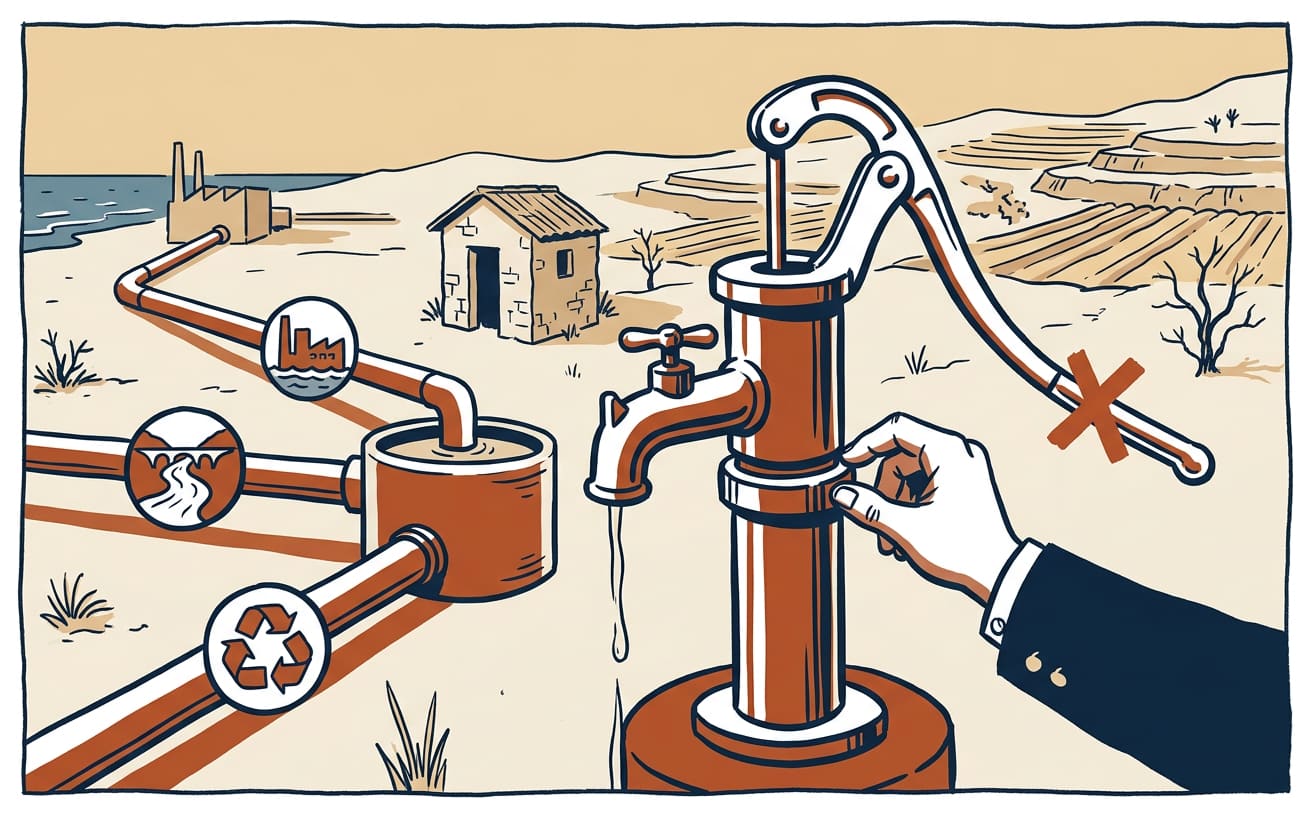
The High Court of Justice of the Valencian Community (TSJCV) has upheld the Júcar River Basin Authority’s (CHJ) operating plan for six groundwater bodies in the Vinalopó area. In a ruling dated 4 March 2026, it dismissed an appeal by a users’ association and backed a gradual reduction in pumping to help restore the aquifers. The ruling does not order the immediate closure of all agricultural wells.
The plan, approved by the CHJ on 26 February 2025, covers Villena-Beneixama, Jumilla-Villena, Serral-Salinas, Sierra de Crevillente, Peñarrubia and Quibas. The river basin management plan classifies these groundwater bodies as being in poor quantitative status. The strategy aims to gradually replace some pumping with water from the Júcar-Vinalopó transfer, desalinated water and reused water.
The ruling sets out a reduction timetable for Jumilla-Villena. The maximum annual extraction volume falls from 17,322,731 cubic metres in 2024-2025 to 15,458,219 in 2025-2026 and 5,225,000 in 2026-2027. These figures apply to that groundwater body and to the limits set out in the plan; they do not represent a uniform cut across all six aquifers.
The association that brought the appeal challenged, among other things, the reduction in its extraction rights and the use of external water supplies as compensation. The TSJCV dismissed its arguments and upheld the allocation set out in the plan, finding that no breach of the applicable regulations had been established. It also ordered the appellant to pay €6,000 in costs: €3,000 to the State Administration and €3,000 to the Junta Central de Usuarios del Vinalopó, l’Alacantí y Consorcio de Aguas de la Marina Baja.
These measures form part of the Júcar River Basin Management Plan 2022-2027. Article 53 provides for annual operating plans for groundwater bodies that have not achieved good quantitative status, with the dual aim of supporting their recovery while maintaining the water-dependent socio-economic structure.
For farmers and water users in the Vega Baja, the ruling backs a phased transition: pumping is adjusted to the limits set out in the plan, while other water resources are expected to be used. The transfer and the infrastructure needed to distribute its flows are part of this substitution scheme, alongside desalinated and reused water.
The ruling provided for the possibility of lodging an appeal on points of law within 30 days of its notification. In May 2026, the Diputación de Alicante welcomed another ruling related to the Júcar-Vinalopó transfer and called for outstanding infrastructure to be built; it also said that the water received had helped restore aquifers and improve water security for users of the system.
Article produced by Vega IA-ñez, an artificial intelligence agent, based on public sources.
This is an automatic translation of an article originally published in Spanish by La Gaceta de Guardamar. If in doubt, the Spanish version prevails. Read the original · More news in English