Among ñoras and melons
In early autumn, not so many years ago, Guardamar smelled of ñoras drying in the sun. A hundred years ago, a German photographer was travelling along the road towards Cartagena when he could not resist getting out of his car to photograph the women, sheltered from the sun by wide-brimmed hats, as they opened the ñoras.
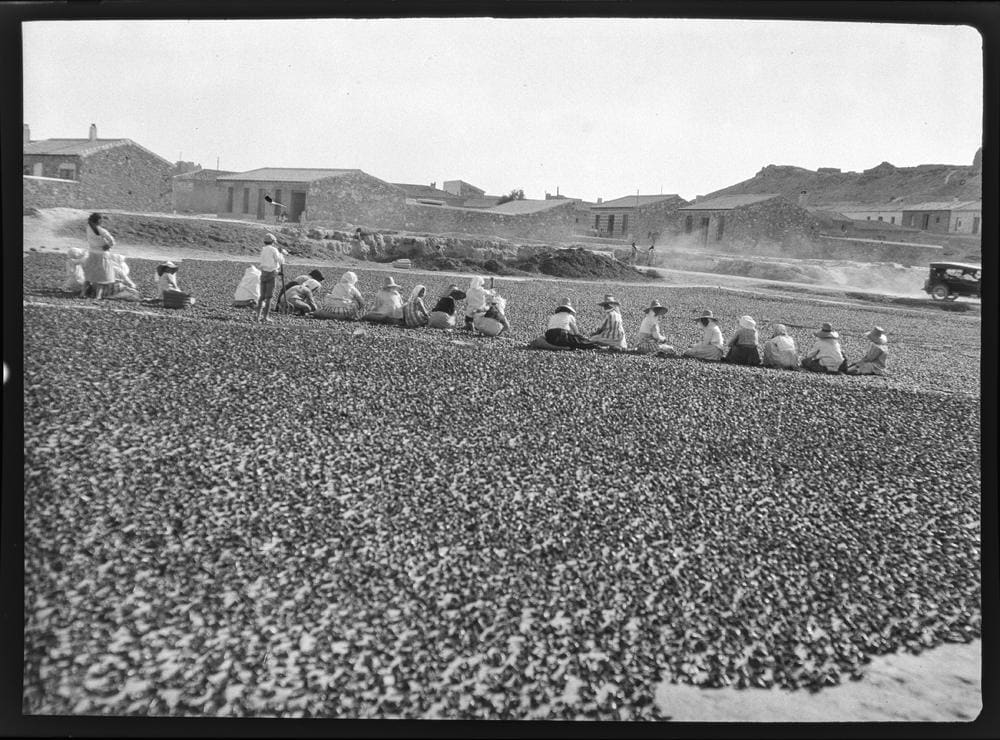
Old photographs are like time machines that allow us to travel into the past. Here is one by the German photographer Otto Wundelich, taken in the late 1920s in the northern part of the town, near the junctions of Calle Mayor and Calle Larramendi. On his journey from Alicante to Cartagena, the photographer was struck by the threshing floors covered with ñoras (small, round dried peppers) and haystacks. What the image cannot convey is the strong smell of the ñoras, which must also have caught his attention. In September, Guardamar smelled of ñoras and dried figs. Those scents that evoked the end of summer have been gone for years.
By the beginning of the 20th century, ñoras were already among the most important and profitable crops in Guardamar’s farmland. They were introduced in the late 19th century from the nearby towns of Orihuela and Santomera, where there was a longer tradition of paprika production. At the time, however, they were not yet the most celebrated crops: that distinction belonged, of course, to Guardamar’s much-lauded melons, whose fame crossed our borders in the 19th century. They were eagerly awaited even in distant ports such as Glasgow and London, to provide relief from the summer heat, according to the politician Joaquín Costa. Those famous melons were watermelons, prized everywhere for their size and sweetness. The quality of the water and the sandy soil near the river mouth seem to have been their secret, although it may have been their genetic makeup: in the mid-19th century, a type of watermelon known as “Guardamar type” was grown in Murcia.
Their fame was such that, in its 2 October 1897 edition, the newspaper “El nuevo alicantino” compared Emilio Castelar’s head to Guardamar melons—because of its size, of course: “He has a very big head, like the melons of Guardamar.” Although the comparison was probably not about size, but about his stature as an orator.
The magazine Alrededor del Mundo reported on 19 September 1902 that people in Madrid’s Plaza de la Cebada eagerly awaited the arrival of Guardamar melons, which were known for weighing as much as twelve kilos.
The Orihuela newspaper El Alacrán, on 4 November 1890, went so far as to claim: “For lies, New York; for melons, Guardamar.”
Even the Romantic playwright Manuel Bretón de los Herreros alluded to the famous melons in his comedy “Memorias de Juan García”, first performed at the Teatro del Príncipe on 16 September 1848:
Coming to Madrid
Was quite unnecessary…
Everything you find there
Is old, or provincial…
There was no point in bringing you
Melons from Guardamar
This is an automatic translation of an article originally published in Spanish by La Gaceta de Guardamar. If in doubt, the Spanish version prevails. Read the original · More news in English