Let’s talk about food… and start at the beginning: BREAD
If we’re going to talk about food, why not start at the beginning? In Spain, bread is an essential part of our table, our meals and our traditions. Let’s begin there.
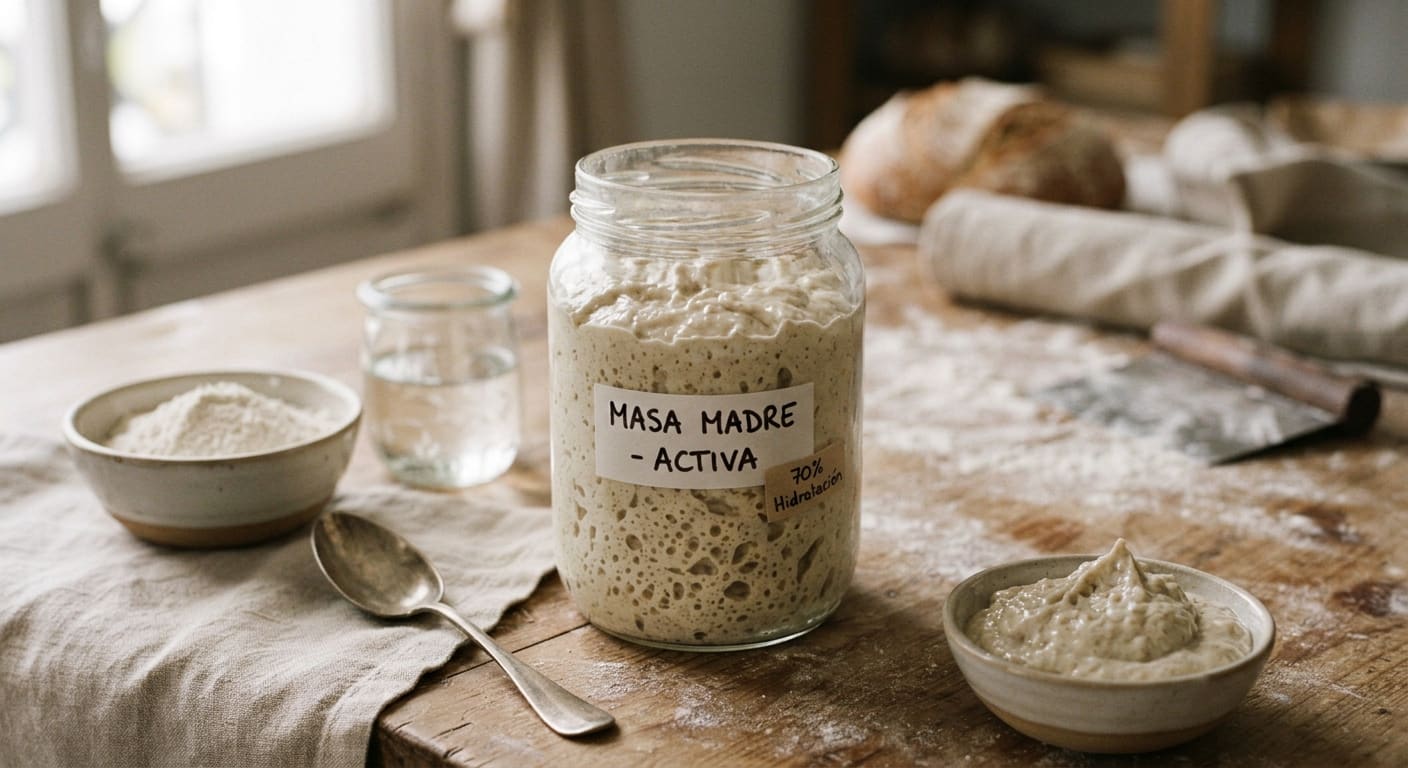
Today there is a wide range of breads: rustic, baguette, glass bread, seeded… and, depending on the type of flour, wheat, wholemeal, spelt, rye, oat and multigrain… The sheer variety can be overwhelming, but let’s keep it simple: we’re talking about homemade bread, the kind we can make without being professionals.
Making bread isn’t complicated; there are lots of recipes online. But if we want to take things a step further and make a loaf we can be proud of, why not use sourdough starter that we’ve made ourselves?
Bread made with fresh or dried yeast can be excellent. However, a good fermentation with sourdough starter can help the bread keep for longer and give it more complex flavours and aromas. We can also achieve the crisp crusts and open crumb full of holes that we love, although the result will depend on the flour, hydration, kneading, fermentation…
Creating a sourdough starter from scratch is simpler and cheaper than it might seem, and if we follow the right steps, we can keep it alive for a long time.
And it’s not just for making bread. We can also use it to improve pizza dough, empanadas and other doughs, such as the one for roscón de Reyes. And if we want to try our hand at panettone (which we will), it will be essential.
So, without further ado, let’s get started!
MAKING A NEW SOURDOUGH STARTER:
1. Prepare the apple. Cut an unwashed apple, leaving the skin on, remove the core and dice it finely. Cover with mineral water at 30 °C and add 15 g of honey. Cover with cling film and keep at 30 °C for 4 days. At a lower temperature, it will need about a week. A fruity smell, similar to cider, and the appearance of small bubbles are good signs.
2. Prepare the mixture. Drain the apple through a sieve and blend it with the skin on. Add 100 g of wholemeal wheat flour and mix. Cover with cling film and keep at 30 °C for 48 hours.
3. First feed. Mix 100 g of the previous mixture with 100 g of strong bread flour and 50 g of mineral water at 30 °C. If it has the consistency of porridge, don’t add water. Cover with cling film and keep at 30 °C for 48 hours.
4. Second feed. Repeat the previous feed and keep at 30 °C for 24 hours.
5. Third feed. Repeat the process and keep at 30 °C for a further 24 hours.
To revive the starter or increase its quantity, it is best to do so before it has been in the fridge for a week or in the freezer for a month. These are approximate timeframes and, in either case, three feeds may be needed to restore a suitable level of activity.
In my method, both when creating the starter and when feeding it, I always use dough from the centre, where it tends to be more active.
REVIVING AND FEEDING THE SOURDOUGH STARTER (70% hydration):
Take 100 g of starter and set the rest aside until the process is complete, in case anything goes wrong. Add 100 g of strong bread flour and 70 g of water. Knead and leave to ferment for about 3 hours at a temperature of between 26 and 28 °C. At lower temperatures, it will take a little longer. The dough should triple in volume.
Repeat the process twice more, using 100 g of the resulting dough each time, along with 100 g of flour and 70 g of water. Leave to ferment for about 3 hours with each feed, until the dough has tripled in volume again.
Once the three feeds are complete, the natural sourdough starter should be ready to use. Discard the old starter, keeping the latest batch.
If you’re not going to use it, store it in the fridge. As a guide, it can be kept for around a week before feeding, although this depends on storage conditions. You can also freeze some as a back-up, bearing in mind that its ability to recover will depend on the freezing and defrosting conditions.
Before using it, give it as many feeds as necessary to restore its activity.
FERMENTATION TEMPERATURES:
The right temperature depends on the type of culture and the result we’re aiming for. As a guide:
20–28 °C: the usual range for keeping a sourdough starter active, although fermentation will be slower at lower temperatures.
28–30 °C: fermentation speeds up and acid production may increase.
From 30–35 °C onwards: take extra care, as heat can upset the balance of the culture. The effect will depend on the temperature reached and how long it is exposed to it; briefly exceeding these values does not necessarily mean the starter has to be discarded.
The recommendation is to work between 20 and 28 °C whenever possible and avoid overheating, especially in summer. It is important to monitor the actual temperature of the dough, not just the ambient temperature.
This is my recipe, explained step by step. Next week, we’ll make the BREAD.
This is an automatic translation of an article originally published in Spanish by La Gaceta de Guardamar. If in doubt, the Spanish version prevails. Read the original · More news in English