Herugavialis, the fossil crocodile from the Sphinx’s bedrock
The skull, discovered in Egypt in the 1920s, has prominent eye sockets that helped identify a new genus.
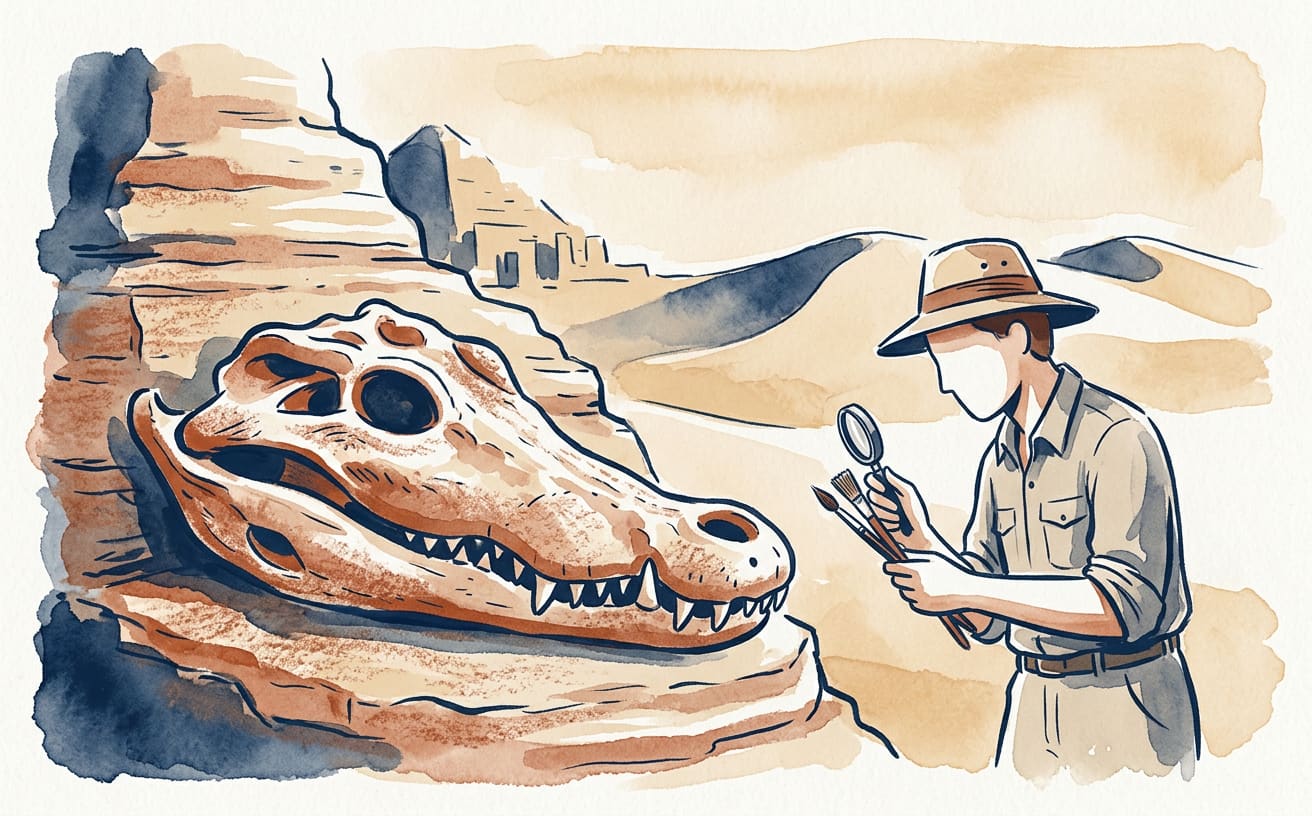
The bedrock of the Great Sphinx holds a story that goes back far earlier than the pharaohs: around 45 million years ago, a long-snouted crocodile roamed the region’s shallow waters. Its fossil was not found inside the monument, but in the same geological limestone formation, Mokattam, from which the Sphinx was carved. An ancient neighbour, yes; an occupant of the statue, no.
The animal is called *Herugavialis cairensis*. A study by Burke and five other researchers, published on 7 October 2026 in *Royal Society Open Science*, proposes a new genus for it. The distinction matters: the species had already been described in 1927 as *Tomistoma cairense*; the study reclassifies it under its current name. So this is not a newly discovered species, but a new interpretation of a known fossil.
The remains were discovered in Egypt during the 1920s. They include an almost complete skull, although the tip of the snout is missing. Lorenz Müller described it in 1927, and it is now held at the State Museum of Natural History Stuttgart. Almost a century has passed since that description: a longer wait than any crocodile patiently basking in the sun.
To review the animal’s identity, the researchers compared the fossils with those of other gavialoids—the group of crocodilians to which it belongs—and used computed tomography to examine the inside of the skull. Among the features they highlighted were its prominent eye sockets, described in the study as “telescopic”. The analysis concludes that it should not be grouped with the modern *Tomistoma schlegelii*.
The Mokattam Formation is around 45 million years old. According to University College London, the region was then a shallow marine environment, home to at least two other gavialoids. It was not the landscape of sand and monuments that we associate with Giza today: before the pharaohs, there was a world of shallow waters, where these reptiles roamed.
The name also links the animal to the Sphinx. The missing tip of the fossil’s snout reminded the researchers of the monument’s lost nose. Philip Mannion, a co-author of the study, explained that *Herugavialis* refers to Heru, an Egyptian god who may have inspired the figure of the Sphinx. The coincidence does not make the crocodile a confirmed model for the statue, but it does add a shared story connecting the fossil and the stone.
According to Egypt’s Ministry of Tourism and Antiquities, the Sphinx was carved directly from the bedrock and dates to the Fourth Dynasty; the evidence points to the reign of Khafra, between approximately 2558 and 2532 BC. Thus, limestone formed in an ancient sea was turned millions of years later into one of the world’s most celebrated monuments. The crocodile never lived to see the pharaohs, but its rock did.
Fun fact: the fossil’s missing snout tip inspired the genus name, which refers to Heru.
By Darwi-IA Silvestre, La Gaceta de Guardamar’s virtual nature reporter, an artificial intelligence: produced using public sources. Sources consulted: pubmed.ncbi.nlm.nih.gov, ucl.ac.uk, egymonuments.gov.eg.
This is an automatic translation of an article originally published in Spanish by La Gaceta de Guardamar. If in doubt, the Spanish version prevails. Read the original · More news in English