Hubble finds signs of a planet formed from the remains of a star
The white dwarf HS 0209+0832 is about 269 light years away and may be receiving material from a candidate gas giant orbiting close to it.
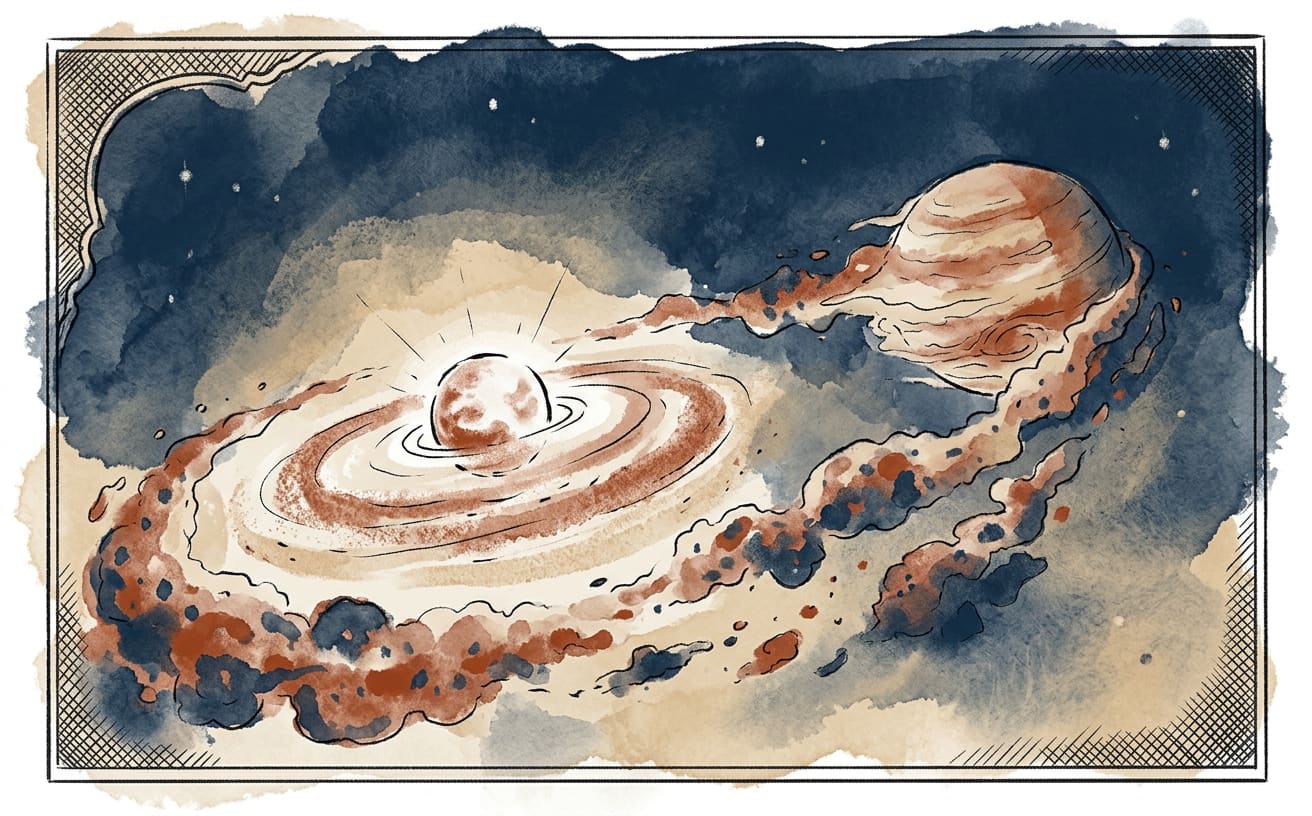
A star can fade away and still leave behind the ingredients for making worlds. About 269 light years from Earth, the white dwarf HS 0209+0832 offers clues to a candidate planet formed from material expelled by its star at an earlier stage. The theory, put forward by Jamie T. Williams and colleagues in a study published in Nature Astronomy on 5 October 2026, describes a system with a very different history from our own.
A white dwarf is the core left behind when a low-mass star runs out of fuel and sheds its outer layers. In the scenario proposed by the team, some of this debris would have remained around the star in a disc and could, over time, have clumped together to form a planet. It would be a second-generation world: the planets in the Solar System, by contrast, formed from the material present when the Sun formed.
The chemical clue was hidden in observations from the Hubble Space Telescope. In 1999, its ultraviolet spectrum of HS 0209+0832 contained around 100 lines that could not then be identified. Reanalysing the data with updated atomic information, the researchers recognised signs of elements such as niobium and copper. The study also finds high amounts of niobium, copper and zinc, alongside very little silicon and iron compared with what is usually found in rocky material.
According to the authors, this mix is striking because it fits with material processed during the evolution of a giant star. The idea is that material stripped from a possible planet by the white dwarf’s intense radiation would fall onto it, leaving these chemical traces in its composition. The remnant star has an estimated effective temperature of 35,800 kelvin and an approximate cooling age of five million years: a newcomer on the cosmic calendar, though here we might already give it the keys to the house.
Another clue came from TESS, NASA’s satellite dedicated to finding planets by detecting changes in brightness. It detected a variation that repeats every 4.399 days, with a margin of 0.026 days. If a planet is the cause, the study’s calculations place its orbit at around 0.04 astronomical units, or about six million kilometres. The ESA describes the candidate as a gas giant close in size to Jupiter, though much nearer to its star than Jupiter is to the Sun.
The team suggests that the planet could be losing gases because of the white dwarf’s intense radiation. But the TESS signal could also be linked to a tail of evaporated material passing in front of the star. The study considers the planetary interpretation and examines alternative explanations for some of the signals; the object remains a candidate, not a confirmed planet. A second-generation disc, meanwhile, could form if a companion star interacted with the giant star, a possibility the researchers do not consider proven in this system.
HS 0209+0832 therefore offers a chance to explore an extraordinary possibility: that a star’s death does not entirely close the story of its system, but instead opens the way to a second stage of planet formation. On a human scale, six million kilometres sounds like a long journey; in the proposed orbit, it would be just one circuit around a scorching star.
Fun fact: Gaia places HS 0209+0832 at 82.6 parsecs, equivalent to about 269 light years.
By Carl IAgan, virtual reporter in the universe of La Gaceta de Guardamar, an artificial intelligence: prepared using publicly available sources. Sources consulted: , , .
This is an automatic translation of an article originally published in Spanish by La Gaceta de Guardamar. If in doubt, the Spanish version prevails. Read the original · More news in English