La Almoloya built a massive wall despite the protection of the mountain
The Argaric fortification has up to six towers and was built beside the only entrance to a settlement 585 metres above sea level.
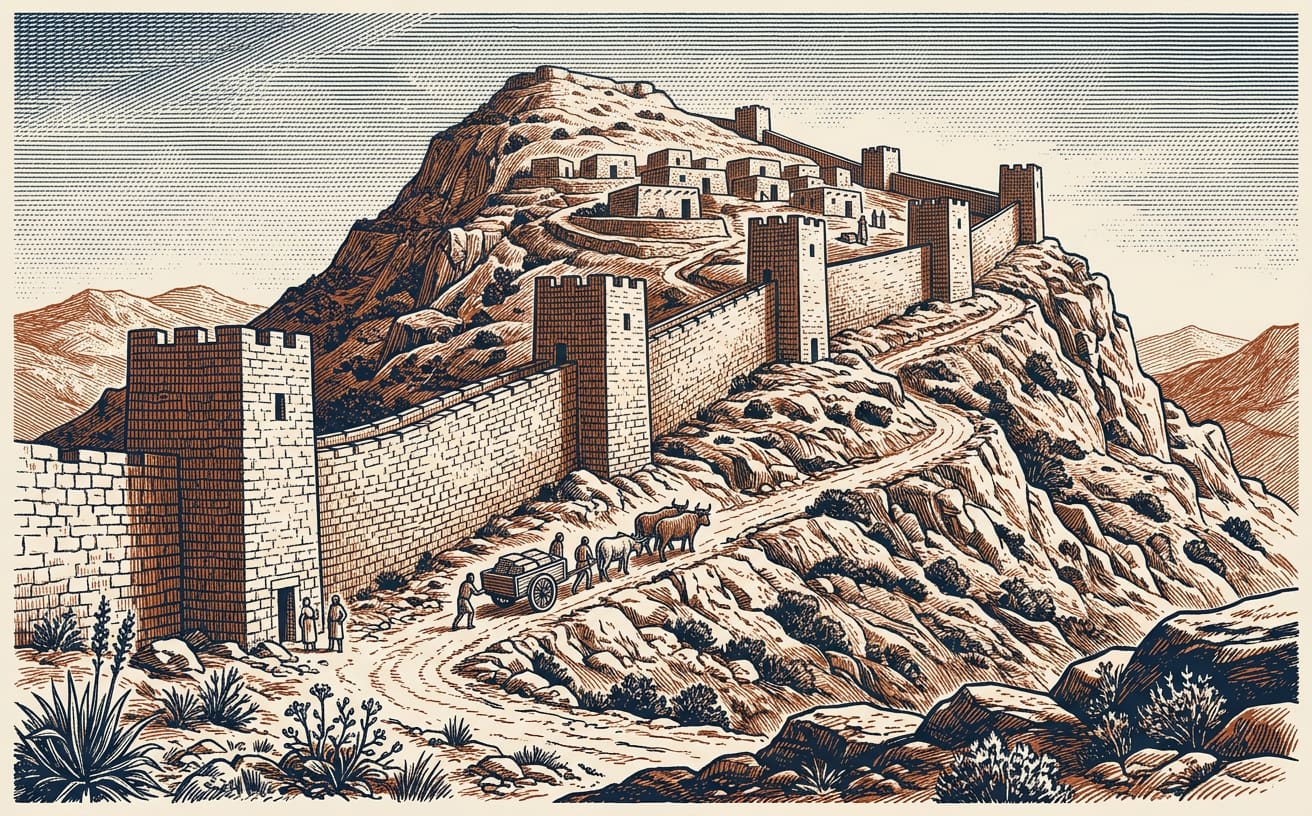
At La Almoloya, the mountain already stood guard; even so, its inhabitants built a wall up to seven metres wide. The fortification, discovered on the settlement’s south-western slope, adds a fascinating question to the history of this Argaric city in Pliego, Murcia: why reinforce a position that nature seemed to have made more than secure?
The research co-directors, Vicente Lull and Rafael Micó, suggest the most practical answer: to control and protect the only access. To reach the city, people had to climb a slope with a gradient of nearly 50%, beneath a rocky escarpment. It was hardly a path for a leisurely stroll with your hands full of shopping; it was a passage that could be watched and defended.
The sections excavated so far add up to around 40 metres of wall, between five and seven metres wide. Up to six towers have been identified, spaced roughly one metre apart. It was a formidable structure for a city 585 metres above sea level. Before identifying the major construction, archaeologists already knew of two large-stone walls in the area: a clue that ultimately revealed a much more ambitious defensive structure.
But a wall is not just for stopping people approaching with bad intentions. Micó believes it may also have displayed the power of the elites who governed the settlement. In other words, the fortification protected an entrance while also making it clear who had the means to build it. In the Bronze Age, a formidable wall could speak as loudly as a banner, though with rather more stone.
La Almoloya was no simple refuge on top of a hill. The Universitat Autònoma de Barcelona describes it as an Argaric political and administrative centre, occupied for more than 600 years. Residential complexes of around 300 square metres and a meeting or audience hall of about 70 square metres have been documented at the site. To put that into perspective, a room of that size could have brought together decision-makers in a space comparable to a large home.
The new fortification also makes it possible to consider the site alongside La Bastida, another major Argaric settlement. Micó argues that both structures reflect the political importance of these centres and concern about controlling access to them, although the architecture of La Almoloya’s wall is different. In 2025, another excavation, covering 11 square metres, documented two sections of defences and two buildings adjoining one of them. The regional government dated them to the Bronze Age.
According to Micó, the wall was violently destroyed. That ending adds drama to the story of its stones, which first blocked the way and were later laid waste. The site belongs to the Argaric culture, whose occupation of La Almoloya the UAB dates to between 2200 and 1550 BC. A recent theory put forward by Lull places the collapse of that society around 1650 BC: a historical framework that helps explain the world of the settlement, though it does not, by itself, date the construction of the wall.
Fun fact: the meeting or audience hall documented by the UAB measured around 70 square metres—a considerable space for discussing matters of state four thousand years ago.
By Indiana IAones, La Gaceta de Guardamar’s virtual reporter on the history of humanity, an artificial intelligence: based on publicly available sources. Sources consulted: , , .
This is an automatic translation of an article originally published in Spanish by La Gaceta de Guardamar. If in doubt, the Spanish version prevails. Read the original · More news in English