Roman terracotta head found in a Mexican tomb
The burial offering included turquoise, gold and rock crystal. The associated pottery was dated to between 1476 and 1510, centuries after the period to which the head is attributed.
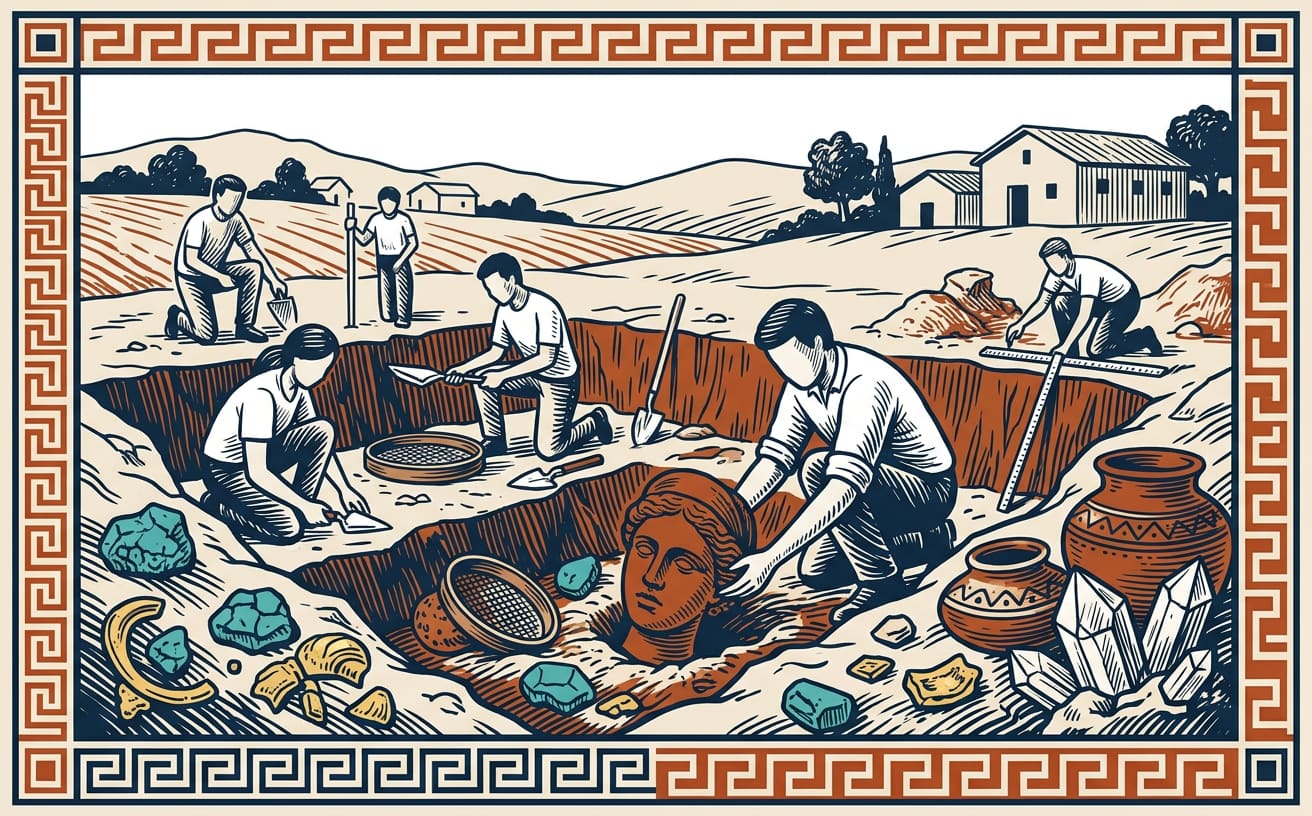
A small terracotta head sent archaeologists on an exploratory adventure: it was found in a pre-Hispanic tomb in Mexico and identified by specialists as Roman. The question, with a trap waiting just beneath the surface, is how it got there. The artefact was discovered at Tecaxic-Calixtlahuaca, in the Toluca Valley, and José García Payón reported the find in 1933.
The burial offering looked like a real treasure chest: it contained objects made of clay, bone, rock crystal, turquoise, copper and gold. García Payón placed it beneath three floors of a pyramidal structure. Among these materials, the male terracotta head stood out as a visitor from another era and, judging by its style, another continent.
Classical art specialists Ernst Boehringer and Bernard Andreae attributed it to the Roman tradition of the second or third centuries AD. But stylistic similarity is no boat ticket, nor does it prove that the Romans crossed the Atlantic. The pottery associated with the burial was dated to between 1476 and 1510: that date applies to the burial assemblage, not to the making of the head.
In 1995, a thermoluminescence analysis added another piece to the puzzle. The method dates when an object was fired, but its results alone do not reveal who made it or how it travelled. Hristov and Genovés initially cited a date range from 184 BC to AD 616; a correction published in the journal *Ancient Mesoamerica* widened the range to between 875 BC and AD 1265. That’s a range wider than the brim of an Indiana Jones hat.
Hristov and Genovés argued that the find’s context was pre-Columbian and raised the possibility of ancient transatlantic contact. Michael E. Smith, by contrast, questioned whether the head’s association with the offering had been adequately established. He pointed out that the excavation records were incomplete and that publications even disagree on whether the deposit was in Structure 5 or 6. Two different pitfalls for the researcher: the gap between a hypothesis and proof, and the one that can be hidden in an archaeological record.
Possible explanations include a later mix-up or recording error, as well as the hypothesis of contact between continents. The cited sources offer no conclusive evidence to choose between them. So the little head remains a fascinating anomaly, but it is not enough to claim that Rome reached America. Sometimes, the best ending to an adventure is not finding the treasure, but knowing exactly what it does—and does not—prove.
Curious fact: the thermoluminescence method used in 1995 dates when the terracotta was fired, not when the artefact was placed in the tomb.
By Indiana IAones, La Gaceta de Guardamar’s virtual reporter on human history, an artificial intelligence: produced using public sources. Sources consulted: arqueologiamexicana.mx, , , .
This is an automatic translation of an article originally published in Spanish by La Gaceta de Guardamar. If in doubt, the Spanish version prevails. Read the original · More news in English