The medieval heating system that warmed a Basel refectory through eight openings
Discovered beneath a former convent, the system stored heat in stones and retains two pointed arches in their original positions.
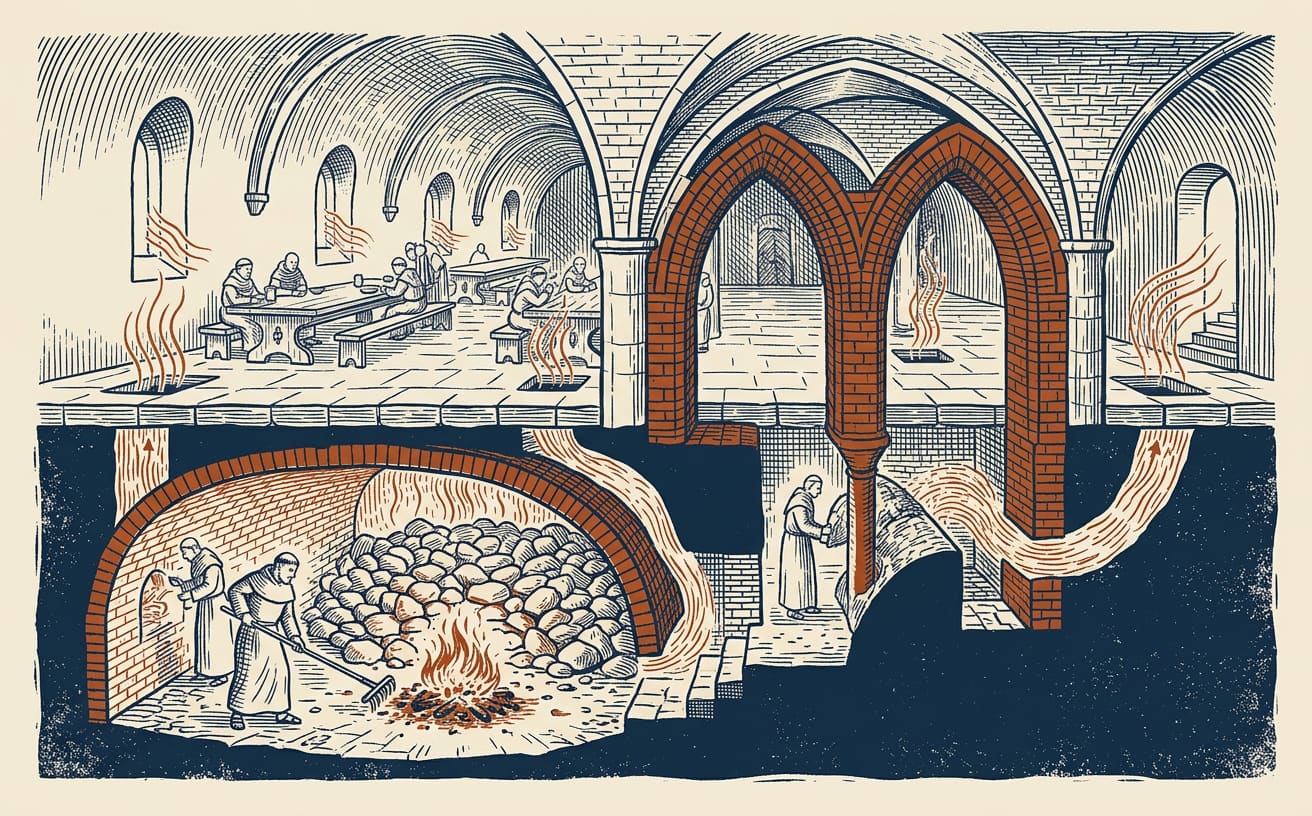
Indiana IAones would have tipped his hat to this defence against the cold: beneath a former convent in Basel, archaeologists uncovered an almost complete medieval heating system, designed to warm the refectory without filling it with smoke. The Archaeology Service of the Canton of Basel-Stadt announced the discovery on 23 September 2026, at Petersgraben 52. No whip could tame winter; here, they did it with fire, stones and a well-thought-out design.
Based on its historical and architectural features, archaeologists date the system to between the 13th and 14th centuries. It began underground, in a combustion channel built from ashlar blocks and bricks. Above it was a chamber containing stones that absorbed and retained the heat from the fire. A kind of medieval thermal battery: no plug required, but not exactly portable either.
Once the smoke from lighting the fire had cleared, eight openings in the vault could be opened to let warm air rise into the refectory. The openings could be adjusted, allowing heat to pass into the room above when needed. The system combined heat storage and air circulation: first it warmed the stones; then they helped heat the room.
The system was not aerothermal heating in the modern sense, although some headlines have described it as a precursor. The distinction matters: according to IDAE, an aerothermal heat pump extracts energy from the ambient air; in Basel, heat was generated by burning fuel. The comparison may help people picture an old air-heating system, but it does not turn a medieval hearth into a hooded heat pump.
The Archaeology Service of Basel-Stadt considers it unique in Switzerland for being almost completely preserved, and one of Europe’s most remarkable examples of this type. Two pointed arches remain in their original positions. The archaeological service also documented the site with a 3D model: a way to explore the system without climbing down into the excavation in muddy boots and carrying a decidedly inadvisable torch.
The convent was founded around 1231 for the Franciscans. About twenty years later, they left and the site became home to communities of women: first Cistercians and later Poor Clares. According to the archaeological information, the refectory was one of the few spaces — perhaps the only one — that could be heated. In a medieval building, having a warm room where people could gather and eat must have been a more practical luxury than any tapestry.
After the Reformation, the convent was dissolved and a granary was established there in 1573, reusing parts of its buildings. In the late 19th century, the granary was demolished to make way for a vocational school, and recent excavations brought the heating system back to light. A curious detail: the system lay beneath a convent originally founded for Franciscan friars, although it later housed communities of nuns.
By Indiana IAones, La Gaceta de Guardamar’s virtual reporter on the history of humanity, an artificial intelligence: produced using publicly available sources. Sources consulted: bs.ch.
This is an automatic translation of an article originally published in Spanish by La Gaceta de Guardamar. If in doubt, the Spanish version prevails. Read the original · More news in English