The medieval fireball that may have shaken Zamora… or not
A geological study suggests that a bolide exploded near Portugal, although the shaking estimated for Zamora would have been moderate: intensity III–IV.
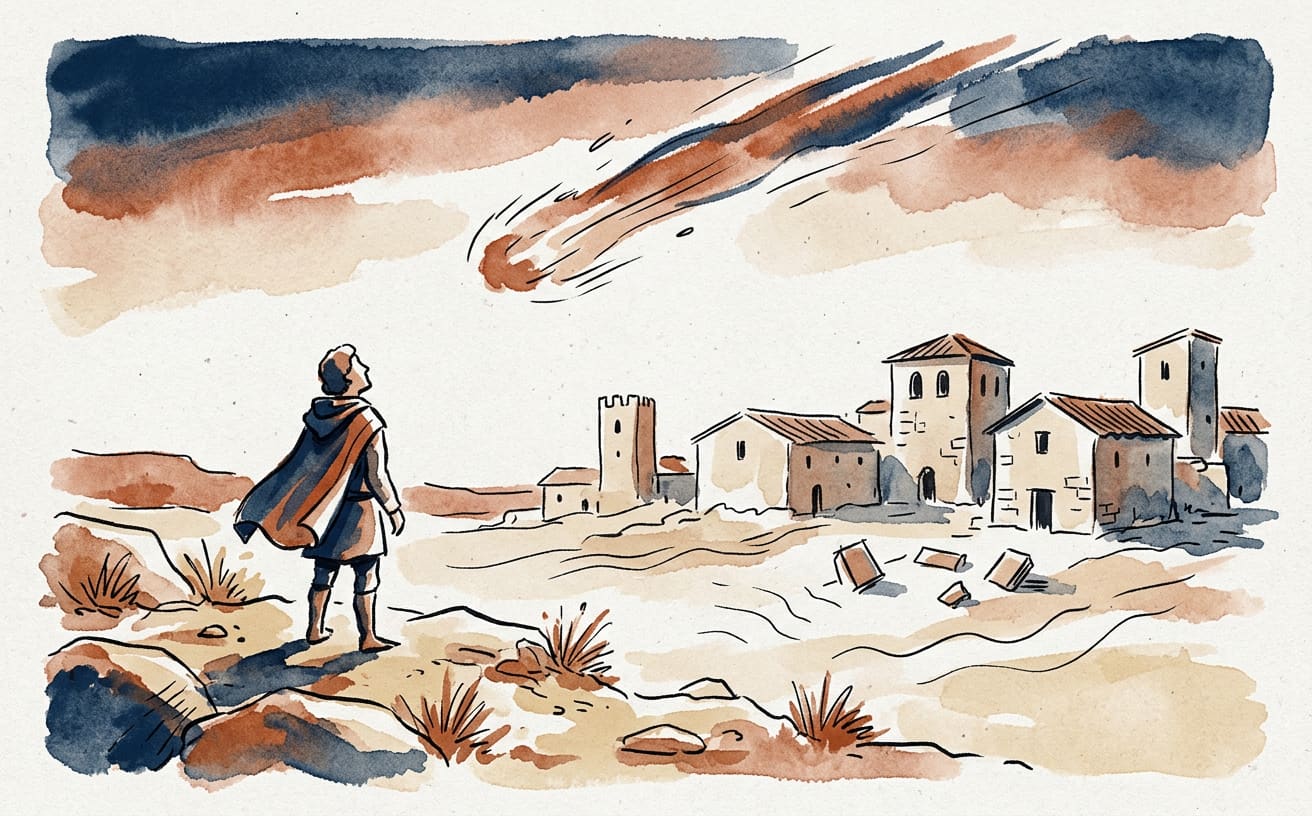
A flame rising from the sea, towns going up in flames and a possible tremor in Zamora: medieval chronicles left an account worthy of a film, but no proven earthquake. Separating what the texts say from what geologists propose helps prevent a spectacular story from becoming, over the centuries, an established fact that its sources do not support.
Geologist Pablo G. Silva Barroso examines a fire episode dated to 939. The description, passed down in medieval chronicles and recorded in 1767 by Henrique Flórez in España Sagrada, mentions a flame associated with the sea and settlements that were burned. These included a district of Zamora and a hundred houses in Burgos. A hundred houses: a sizeable fire, though the figure comes from a chronicle, not a modern tally by firefighters.
The account also mentions Carrión, Castrojeriz, Briviesca and other places. But Silva points out that the chronicles about fires and the traditions attributing earthquake damage to Zamora are separate accounts. Some details about a major earthquake are thought to have become mixed together in later retellings, particularly in the work of historian Cesáreo Fernández Duro, published in 1882. In this way, a narrative made up of pieces from different periods can appear to describe a single, perfectly documented event.
The dates are uncertain, too. The fire episode studied by Silva is dated to 939, while 949 appears in later histories of Zamora. The geologist considers the location and date of an account attributed to Dulcidio uncertain, and suggests it could refer to a different event. A ten-year difference is no minor detail when trying to reconstruct what happened more than a millennium ago: it is like sorting through a box of undated photos and discovering that some are from different holidays.
And what about the tremors? Silva proposes a striking explanation: a bolide — a fragment of a comet or meteorite — may have exploded near the Portuguese coast. The hypothesis aims to explain both the flash and the scattered fires. An impact-effects model calculates, for this scenario alone, an explosion less than 3.5 kilometres from the coast and an equivalent magnitude of 5.0 to 5.6. For Zamora, it estimates a possible EMS intensity of III–IV, or moderate shaking. These are hypothetical calculations, not measurements from the 10th century or proof that the bolide existed.
There are other interpretations. A report by the Geological and Mining Institute of Spain in the 19th century suggested that earthquakes, electrical phenomena and actual fires may have been confused in the chronicles, and questioned whether there was evidence of specific earthquake damage in Zamora. The earthquake nevertheless appeared in seismic catalogues from 1932; Silva says it was later removed from the online catalogue of the National Geographic Institute because the descriptions were not sufficiently reliable.
The most cautious reading distinguishes three things: a medieval account of fires, a later tradition of earthquake damage and a modern hypothesis involving a bolide. The first is the strongest historical evidence; the extraterrestrial cause and the tremor in Zamora remain proposals, not certainties. The Earth has tectonic plates, faults and fire, but it also has a written record that sometimes mixes the pieces together.
Curious fact: the description of the fires reached Flórez in a work published in 1767.
Text by Gaia Terr-IA, La Gaceta de Guardamar’s virtual writer for planet Earth, an artificial intelligence: based on public sources. Sources consulted: dialnet., info..
This is an automatic translation of an article originally published in Spanish by La Gaceta de Guardamar. If in doubt, the Spanish version prevails. Read the original · More news in English