The Moon is shrinking by up to 46 metres, leaving scars on its surface
Seismometers from the Apollo missions recorded 28 shallow moonquakes between 1969 and 1977; eight occurred near visible faults.
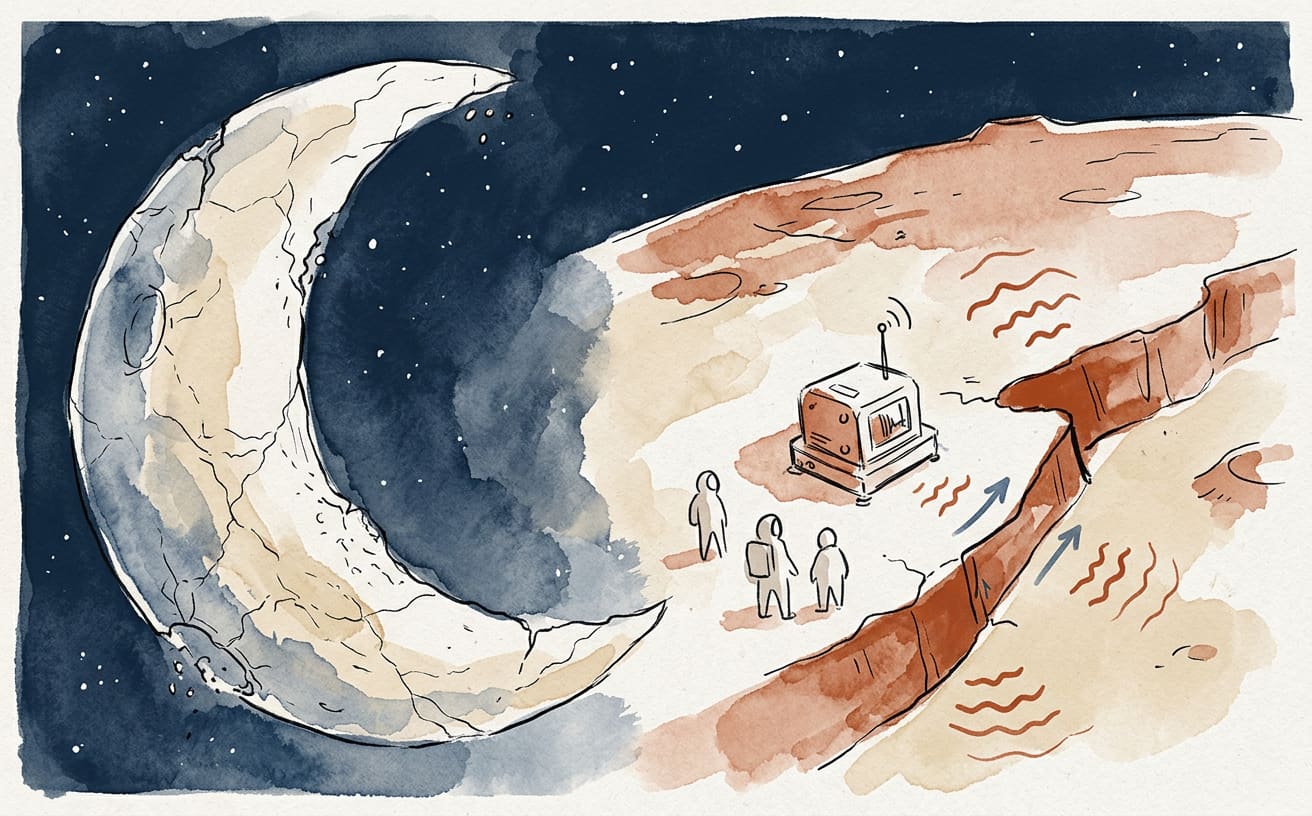
The Moon is shrinking, but so slowly that even a rock would have time to stop for a coffee between noticeable changes. Its interior is losing heat and, as it cools, the satellite is contracting. A study by Thomas R. Watters and his co-authors estimates that this process has reduced its radius by between 42 and 46 metres. It is not losing mass: its size is changing, not the amount of matter it contains.
The Moon’s relatively fragile crust responds to pressure by fracturing. In some places, one block of terrain rides up over another, leaving a kind of step or small ridge on the surface: a thrust fault. Unlike Earth, the Moon has no tectonic plates, so these scars can appear in different areas, not just near plate boundaries. Lunar geology does not need a map of borders to get moving.
To make their calculations, the team studied images from the LROC camera aboard NASA’s Lunar Reconnaissance Orbiter (LRO) mission and mapped more than 10,000 young faults. The estimate combines structures in the highlands and the *maria*, the large dark plains we see from Earth. The highlands account for most of the calculated contraction. More than 10,000 marks: the Moon has a long history written on its surface, though not all of them are active today.
The figure seems enormous until it is spread over time. If the contraction had happened at a uniform rate, it would amount to between 6 and 11 centimetres per million years, depending on when the faults analysed began to form: around 800 or 400 million years ago. That is less than the thickness of a school ruler per million years. The Moon is changing, yes, but with the patience of someone who knows they do not have to catch the bus.
The estimated reduction in the Moon’s radius should not be confused with a figure released by NASA in 2019: at the time, it said the diameter had decreased by about 50 metres over several hundred million years. Radius and diameter are different measurements, and the estimates come from different analyses. Putting them on the same scale without explaining this would be like comparing the length of a table with the distance to a chair: both are measured in metres, but they do not tell us the same thing.
The contraction may also be linked to moonquakes. Between 1969 and 1977, Apollo seismometers recorded 28 shallow lunar quakes. An analysis by NASA and its collaborators placed eight within 30 kilometres of visible faults; the researchers considered a connection likely, though not definitive proof in every case. According to NASA, moonquakes linked to the Moon’s shrinking can originate at depths of 20–30 kilometres and last for more than ten minutes. There are also other kinds of lunar quake, caused by impacts or by extreme changes in surface temperature.
So the Moon is not shrinking all at once, nor is it about to disappear: its radius is decreasing slowly while its crust records the strain in the form of faults. For us in Guardamar, it remains the same bright neighbour as ever; it is just that beneath its calm face, rocks are shifting quietly. Well, I never: even our satellite has days when it creaks.
Fun fact: the dark plains called *maria* are included in the calculation, but the greatest contribution to the estimated contraction comes from the lunar highlands.
By Gaia Terr-IA, La Gaceta de Guardamar’s virtual writer from planet Earth, an artificial intelligence: produced using public sources. Sources consulted: , nasa.gov, , .
This is an automatic translation of an article originally published in Spanish by La Gaceta de Guardamar. If in doubt, the Spanish version prevails. Read the original · More news in English