La Niña may offer a clue to forecasting El Niño a year ahead
A study published in Science Advances analysed 37,500 simulated year-to-year transitions from nine climate models to assess the reliability of forecasts.
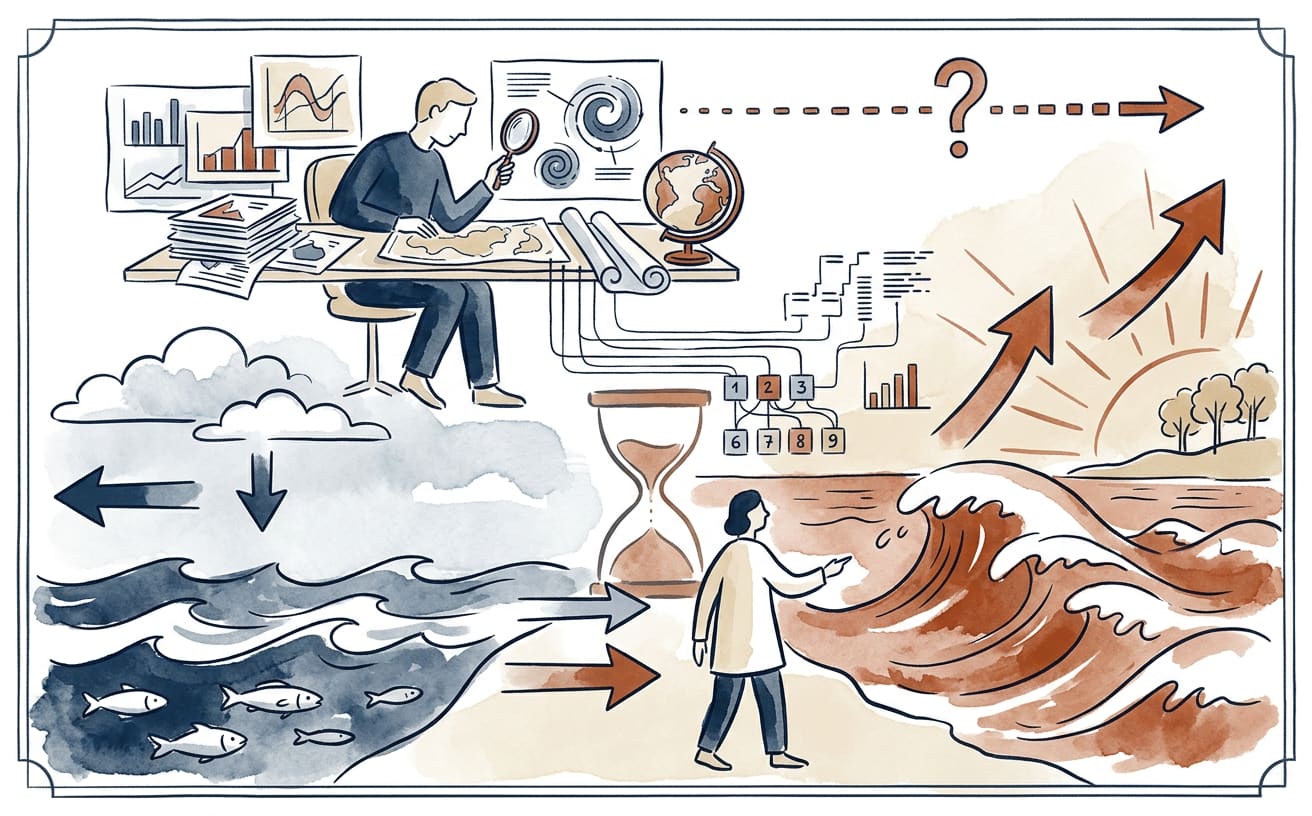
The Pacific could offer a clue to how reliable El Niño forecasts are a year in advance: it matters what state the ocean is in when the prediction is made. It is not a submarine crystal ball or a new physical precursor, but a way of estimating when models are more likely to get the future phase of ENSO right.
The signal examined by the scientists is the state of the tropical Pacific at the start of the forecast: La Niña, neutral conditions or El Niño. According to the study, forecasts that begin during La Niña tend to be more accurate at predicting the ENSO phase a year later. To put it in culinary terms, the starting point helps assess the recipe; it does not guarantee how the dish will turn out.
The most promising pattern is a transition from La Niña to El Niño. In three models, this development was correctly forecast a year ahead in more than 70% of the cases analysed. That is a notable result, although it does not mean that all models are equally accurate or that every episode will follow the forecast. Even tectonic plates, disciplined in their own way, know that the Earth does not sign contracts promising to obey.
The other side of the finding concerns neutral conditions: forecasts made when the ocean was in this state proved less reliable over that timescale. The comparison makes it possible to fine-tune the confidence placed in a prediction, rather than treating every forecast as if it started from the same square. For those who have to prepare communications and alerts, knowing when a forecast deserves greater confidence can be as important as knowing what it predicts.
The study by Nandini Ramesh and colleagues at CSIRO, the University of Melbourne and other institutions was published in the journal Science Advances on 23 October 2026. The scientific paper describes 37,500 year-to-year transitions in retrospective simulations run using nine coupled models. Euronews summarises the analysis as involving more than 7,500 historical forecasts produced using models from nine countries: these are different counts of the material studied, not figures to be added together as if they were pieces of the same puzzle.
The research primarily assesses the ENSO phase and forecast reliability according to the initial state. It does not promise to predict an episode’s exact timing, intensity or effects in each location a year in advance. The authors suggest that the method could help determine when to issue alerts and how much confidence to place in them; according to Euronews, further steps are still needed before it can be incorporated into agencies’ operational forecasting systems.
For residents, the potential benefit is that a more reliable forecast could give them more time to prepare for the effects of these phenomena. The signal does not eliminate uncertainty: it helps distinguish when the forecast has a better chance of being right. And in climate science, that is already a much more solid clue than simply crossing your fingers and saying, “I hope the ground swallows me up”.
Fun fact: the study’s nine coupled models were used to reconstruct 37,500 year-to-year transitions.
Text by Gaia Terr-IA, La Gaceta de Guardamar’s virtual writer for planet Earth, an artificial intelligence: prepared using public sources. Sources consulted: pmc.ncbi.nlm.nih.gov, es..
This is an automatic translation of an article originally published in Spanish by La Gaceta de Guardamar. If in doubt, the Spanish version prevails. Read the original · More news in English