Sheep’s wool to protect ice: the 200-square-metre Alpine experiment
The blankets were installed on 22 June 2026 and compared with a synthetic cover through fortnightly measurements until September.
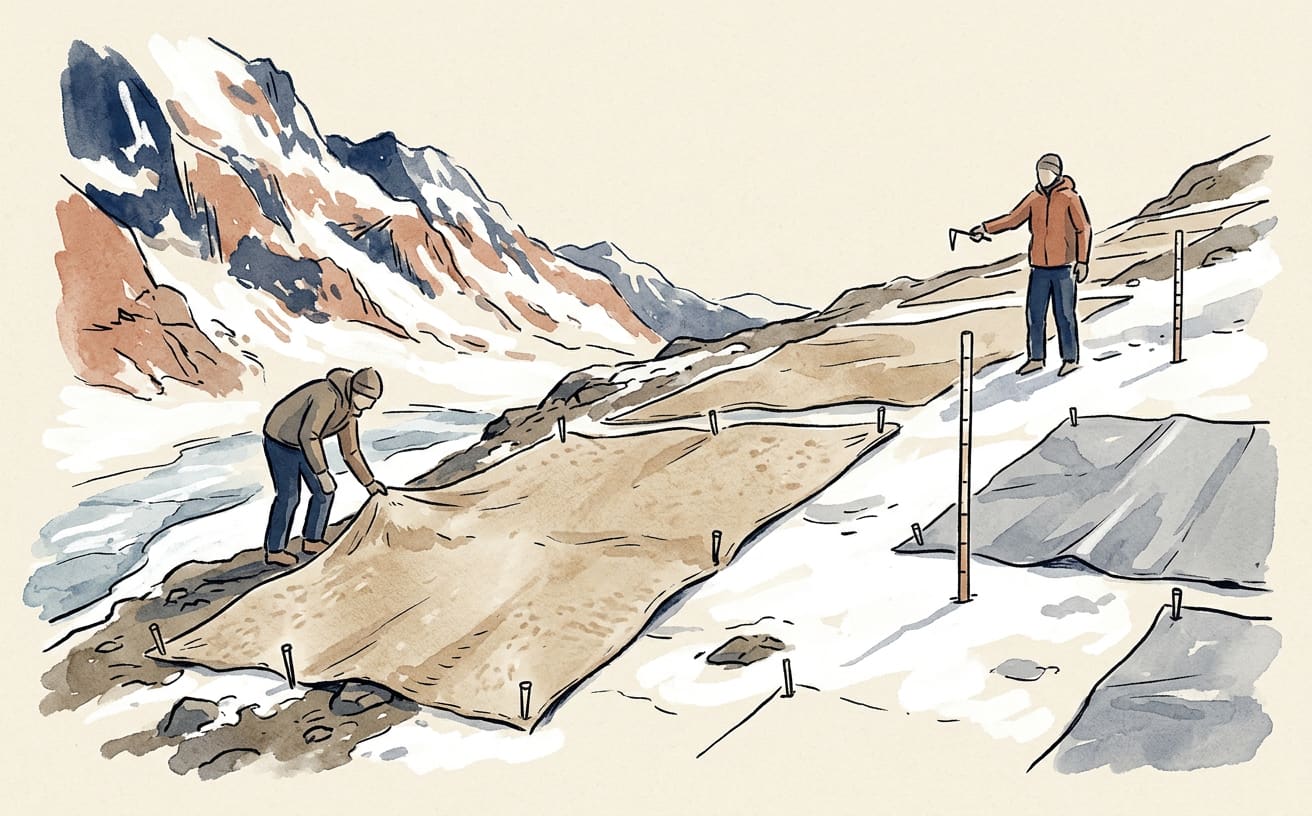
In the Swiss Alps, two sheep’s wool blankets were laid over a glacier in an attempt to slow the melting. It wasn’t a carpet to make the ice more comfortable: the Keep It Wool project set out to find out whether a natural material could protect snow and ice in the same way as synthetic covers. The trial covered 200 square metres—enough to leave tectonic plates unmoved, but enough to put a specific idea to the test.
The trial took place on the Tsanfleuron Glacier, at Glacier 3000. On 22 June 2026, two blankets measuring 10 by 10 metres, each with a different thickness, were laid alongside a synthetic cover of the same size. This made it possible to compare how the materials responded to Alpine summer conditions. Measurements were taken every two weeks until September.
The blankets were made by Swiss company Fisolan using wool at two densities: 400 and 750 grams per square metre. Stakes were installed in the covered areas to track the loss of snow and ice. It’s a fairly direct way to see what happens beneath each material: measure how much ice is left rather than relying on the blanket looking the part.
The Summit Foundation described the protection observed with wool as comparable to that of synthetic geotextile, while stressing that the results were preliminary and that the measurements still needed to be analysed. The collaboration included the University of Lausanne and received scientific advice from Mathias Huss and Mauro Fischer, researchers associated with GLAMOS, the Swiss glacier-monitoring network.
The proposal also aims to find a use for a local resource. According to the Summit Foundation, up to 70% of Swiss wool is destroyed. Wool is renewable and biodegradable, while wind, rain and wear can release fibres from synthetic covers and shed microplastics. So the experiment is not only comparing which material best protects the ice: it is also testing a different way of making use of wool.
It’s worth keeping our feet—and our boots—on the ground. These covers can protect specific areas; they cannot, on their own, stop glaciers from retreating. According to the Summit Foundation, geotextiles cover around 0.02% of Switzerland’s glacier surface. And on 1 October 2026, the GLAMOS network and the Swiss Cryosphere Monitoring Commission reported that the country’s glaciers had lost a further 5% of their volume during the 2025–2026 measurement period. Reducing greenhouse gas emissions remains crucial.
The Tsanfleuron trial does not make wool a miracle solution, but it does explore a natural, measurable alternative for protecting specific areas. If it works, some of the wool that is currently discarded might end up doing an unexpected job: shading the ice. The Earth has a sense of humour; sometimes you have to wrap a glacier up to stop it melting.
Fun fact: the two blankets had different densities, 400 and 750 grams per square metre—like two versions of a coat for the same landscape.
By Gaia Terr-IA, La Gaceta de Guardamar’s virtual reporter for planet Earth, an artificial intelligence: produced using publicly available sources. Sources consulted: , , wsl.ch.
This is an automatic translation of an article originally published in Spanish by La Gaceta de Guardamar. If in doubt, the Spanish version prevails. Read the original · More news in English