Free to choose: citizens are not captive customers
School, doctor and pension assigned: we pay in advance for education, healthcare and pensions without being able to choose. A case for freedom of choice, with 2025 figures.
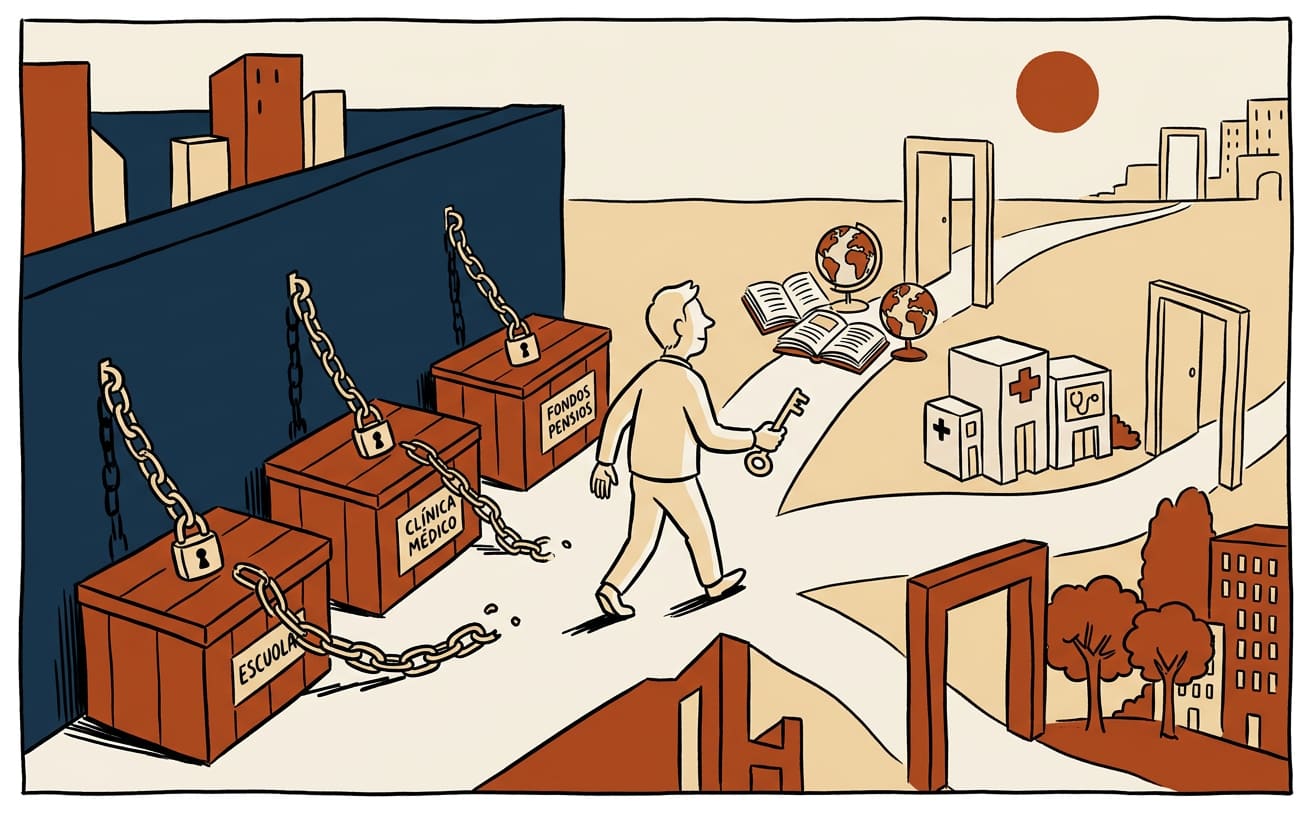
For decades, we have accepted an idea without questioning it: that what matters is whether a service is public, not whether it works. Assigned school, assigned doctor, assigned pension. The state decides, citizens pay and keep quiet, and they call that solidarity.
But paying is not the same as choosing. Schools, health centres and pensions are paid for in advance, with every payslip, whether we use them or not. We are forced customers of a sole provider that has no fear of losing anyone. And we know what happens in any sector when a provider has its customers captive. Let us look at the three main pillars: education, healthcare and pensions.
Education: those who pay and those who experience it
Spain recorded its worst PISA results since 2000: 451 points in reading and 457 in maths. This is not just a problem for Spain, as the OECD average has also fallen, but it is a worrying result for which nobody is held accountable.
And many families have already made their choice. In Aragón, 24% of pupils attend state-funded independent schools and 6.7% attend private schools; in Andalucía, 22.7% go to state-funded independent schools and 4.4% to independent private schools. Between one in four and one in three families choose not to use the state school place allocated to them. State-funded independent schools, funded by the state and chosen by families, are precisely the model of freedom we support—and the one that comes under the most attack.
They say that the better PISA results achieved by state-funded independent and private schools are explained solely by families’ financial means. I doubt that is the whole story. Socio-economic background may play a part, but that raises another question: why do so many families make the effort to leave the school allocated to them? They do not do it because of a statistical report. They do it because they know their children, their teachers and their neighbourhood better than any ministry. We may not know how to measure precisely which school is better, but we do know who should decide: those who pay for it and those who experience it.
Healthcare: we pay twice to avoid waiting
At the end of 2025, 853,509 patients were waiting for an operation—a record—with an average wait of 121 days and 21.6% waiting more than six months. Within the same system, average waits range from 50 days in Madrid to 173 in Andalucía. Those living in the wrong region cannot do anything about it.
That is why people take out health insurance. There are around 12.6 million people with private health insurance, about 26% of the population. Millions of families pay taxes and a premium on top, so they do not have to wait. They have not changed their political views: they have voted with their wallets, the most honest vote of all.
And the state itself recognises the principle when it suits. Under Muface, almost a million civil servants have chosen a private insurer instead of public healthcare. If it is a good option for those who run the system, why deny it to everyone else?
This is no utopia: the Netherlands has compulsory universal health insurance, delivered by private insurers competing with one another. Nobody is left out, but every citizen gets to choose.
Pensions: saving for a rainy day
Only 13% of Spaniards trust that the state pension will be enough to maintain their standard of living, while 53% believe they will need additional savings. People are already doing so: there are 7.24 million individual pension plan accounts, with €96,331 million saved. And they are doing it even though contributions to individual plans are well below pre-reform levels: the system itself discourages private saving.
Other countries have not been afraid to act. Sweden reformed its system and allocated part of the contributions to individual investment accounts managed by private providers.
Consider the self-employed. Their monthly contribution is at least around €200, close to €600 in the highest band on the minimum contribution base, and can theoretically reach around €1,600. It is compulsory, and is paid by those who already have health insurance, a pension plan and income protection if they are off work just as much as anyone else. Why can they not decide what to do with that money?
The objections, honestly addressed
They will say the market abandons the most vulnerable. That is a serious argument and deserves an answer: freedom of choice does not mean abandonment. It means funding the person, not the institution. A school voucher, a health insurance premium covered for those who cannot afford it, a guaranteed minimum pension. Having a safety net does not mean we all have to travel in the same carriage.
They will also say that international experience is mixed. That is true: freedom to choose a school has led to greater socio-economic segregation in some countries, and Chile’s shift to individual capitalisation cost an average of 3.5% of GDP over fifteen years. That is precisely why it must be designed well, with clear rules. Refusing to discuss it is not reasonable.
Free and well-informed citizens
Perhaps the underlying problem is that nobody has taught us how to choose. We are not taught how to compare insurance policies, calculate a pension or make decisions about our own money. We have grown used to others deciding for us, and it is only a short step from there to paternalism.
A model like this is not opposed to public services. It trusts citizens to be free, informed and responsible for their money and their lives. And the unanswered question is simple: if public services are so good, why are they so afraid of letting us choose?
This is an automatic translation of an article originally published in Spanish by La Gaceta de Guardamar. If in doubt, the Spanish version prevails. Read the original · More news in English