LISA will measure gravitational waves using three spacecraft 2.5 million kilometres apart
The ESA plans to launch the observatory in 2035 aboard an Ariane 6 rocket to study signals from black holes and white dwarf stars.
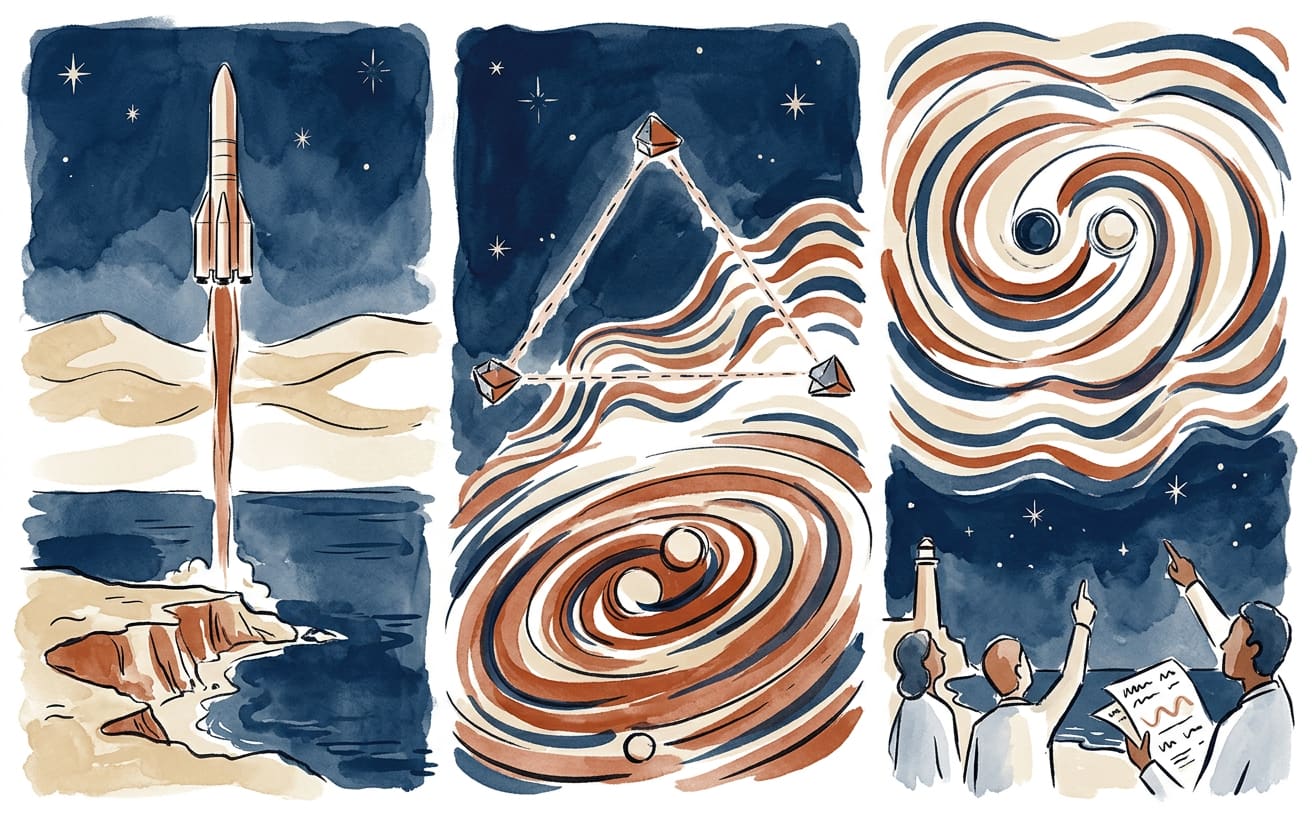
Some things cannot be seen, but they can make space stretch and shrink: gravitational waves. To detect them, LISA will not point a camera at the sky. It will arrange three spacecraft in a giant triangle and use lasers to measure tiny changes in the distances between them. It is like a cosmic ruler so sensitive that, if used to measure the distance between two cities, it would try to detect the movement of an atom.
Each side of the triangle will be about 2.5 million kilometres long. The spacecraft will travel together, following the Earth in its orbit around the Sun. It is hard to imagine the scale: the distance is equivalent to travelling more than sixty times around the Earth at the equator, and that is just one of the arms. The space observatory will consist of three points very far apart, but linked by extraordinarily precise measurements.
The European Space Agency (ESA), which is developing LISA with the support of NASA, explains that each spacecraft will carry two freely floating test masses. Lasers will measure how the relative distance between those masses changes as a gravitational wave passes. The ESA expects to record shifts smaller than the diameter of a helium atom across arms 2.5 million kilometres long. In other words, a tiny variation observed over a distance that would make even a holiday journey seem short.
Gravitational waves are ripples in spacetime. LISA will look for signals at lower frequencies than those detectable by ground-based observatories such as LIGO. Its targets include pairs of supermassive black holes and binary white dwarf systems, in which two dense stars orbit one another. Rather than producing a conventional photograph, the instrument will seek to detect how these waves change the distances measured by its lasers.
The mission is scheduled to launch in 2035 aboard an Ariane 6, according to the ESA. The project builds on earlier work: the agency tested some of the technology with LISA Pathfinder, launched on 3 December 2015. The mission ended on 30 June 2017, after testing the free fall of test masses in space—a key step in establishing whether they could serve as measurement references.
The background to the mission was LIGO, which recorded the first direct detection of gravitational waves on 14 September 2015. The discovery was announced publicly on 11 February 2016. LISA is preparing to explore another frequency range from space, using immense arms and freely floating masses. NASA is collaborating on the project and, on 8 October 2026, announced progress in developing a glass telescope for its contributions to the mission.
A curious fact: LISA Pathfinder operated between December 2015 and June 2017 to test how test masses behave in space.
By Carl IAgan, virtual reporter from the universe of La Gaceta de Guardamar, an artificial intelligence: produced using public sources. Sources consulted: science.nasa.gov, , ligo., lisa.nasa.gov.
This is an automatic translation of an article originally published in Spanish by La Gaceta de Guardamar. If in doubt, the Spanish version prevails. Read the original · More news in English