Chariklo’s rings change as they orbit between Saturn and Uranus
The inner ring C1R’s mean opacity rose from 0.303 to 0.431 in measurements compared by a study published in 2026.
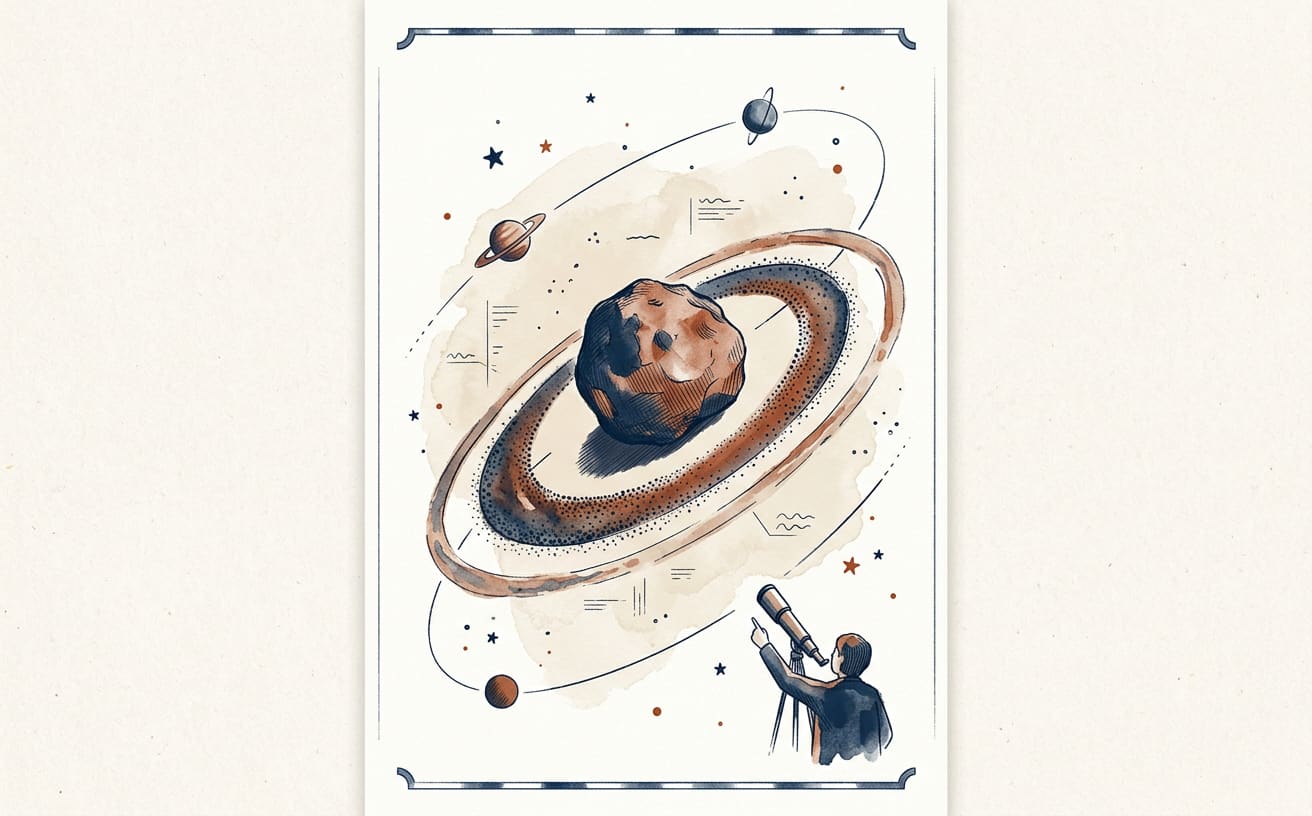
More than 390 kilometres from Chariklo’s centre, one ring has become more opaque while its outer companion has weakened. This is no snapshot taken from a spacecraft: it is a story pieced together from the light of a star that the rings let through at times, like cosmic blinds with very precise schedules.
Chariklo is a centaur, a small icy body orbiting between Saturn and Uranus, measuring about 250 kilometres in diameter. Its two rings were announced in 2014, after a stellar occultation observed from South America revealed their presence. The inner ring, C1R, and the outer ring, C2R, orbit at approximately 390 and 405 kilometres from the centre.
On 18 October 2022, the James Webb Space Telescope observed another occultation. The rings passed in front of a distant star and dimmed its light; Chariklo, by contrast, did not pass in front of it from the telescope’s perspective. JWST measured the signal in two infrared bands, a way of studying the particles without taking a direct photograph. Sometimes the universe lets itself be pictured by dimming the lamp a little.
A study led by Pablo Santos-Sanz of the Instituto de Astrofísica de Andalucía (IAA-CSIC) compared these measurements with earlier observations. Published in *Science Advances* on 9 September 2026, it concludes that C1R’s mean normalised opacity rose from 0.303 to 0.431. The difference is considered significant: it amounts to 4.2 standard deviations. In everyday terms, the inner curtain lets less light through than before.
The outer ring tells a different story. C2R was barely detected in the 1.5-micrometre infrared band and did not appear in the 3.2-micrometre band. In addition, its equivalent width measured in 2022 was approximately 60% smaller than in 2017. The trends therefore point in opposite directions: C1R appears more opaque, while C2R produces a much weaker signal.
What is happening? For C1R, the authors suggest that new particles may have been added or that the ring may have undergone dynamic reorganisation. These are possibilities, not proven causes. In C2R’s case, the weakening could reflect a loss of material and a transient structure, or the fact that its particles respond differently depending on the wavelength. The study does not establish which explanation is correct.
The interest goes beyond a small icy world: tracking these changes helps us understand how rings evolve—structures we often imagine as motionless, like hoops drawn around a planet. At Chariklo, the measurements show that at least some of these rings can change over time, even though they are so far away that their light takes time to become a signal we can read.
Curious fact: Chariklo’s rings are about 7 and 3 kilometres wide, and are separated by about 9 kilometres.
By Carl IAgan, virtual reporter from the universe of La Gaceta de Guardamar, an artificial intelligence: produced using public sources. Sources consulted: pubmed.ncbi.nlm.nih.gov, , .
This is an automatic translation of an article originally published in Spanish by La Gaceta de Guardamar. If in doubt, the Spanish version prevails. Read the original · More news in English