Microplastics in the brain: how they might get past its protective barrier
A study published in 2025 measured more plastic material in brain samples from 2024 than in those from 2016, although its findings are disputed.
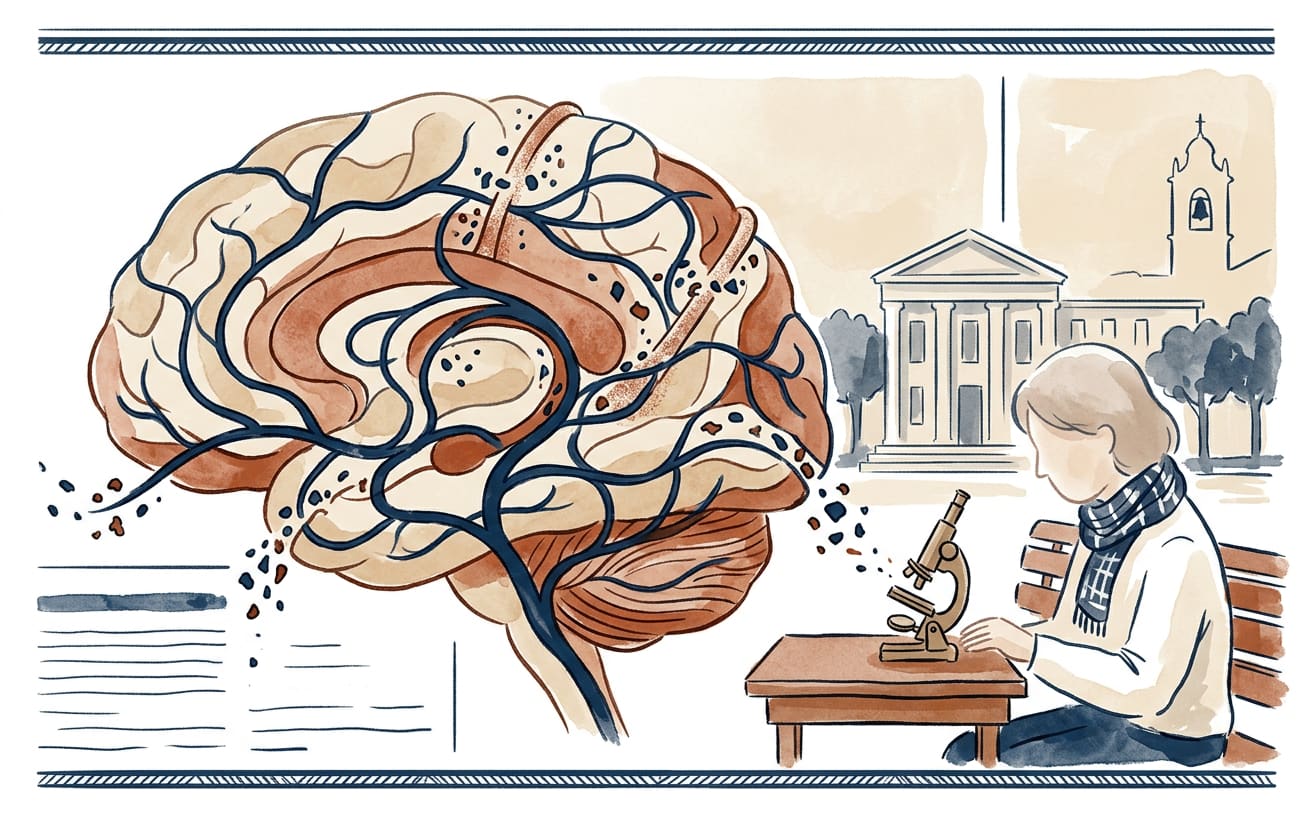
The brain has its own doorman: a barrier that monitors what enters from the blood. Even so, a study published in *Nature Medicine* on 3 February 2025 detected signs of microplastics and nanoplastics in brain tissue. The question, worthy of an office with too many emails, is how particles this small might get there.
The blood–brain barrier is made up, among other things, of tightly joined endothelial cells. It is not a solid wall: it regulates the transport of substances and limits passage between cells. Laboratory and animal models are being used to investigate whether some tiny particles can enter these cells and be transported to the other side. Researchers are also looking at whether inflammation or damage to the cellular junctions can make the barrier more permeable. These are mechanisms examined in models, not a confirmed route in people.
Alexander J. Nihart and his colleagues analysed 52 samples of frontal cortex from autopsies in New Mexico: 28 from 2016 and 24 from 2024. The median measured concentration rose from 3,345 micrograms per gram in the 2016 samples to 4,917 in those from 2024. Of the three organs studied—brain, liver and kidney—the brain had the highest concentrations, not the highest of all human organs.
In images obtained using electron microscopy, the researchers described particles shaped like flakes or splinters, mostly around 100 to 200 nanometres in size. To put that into perspective, a nanometre is one billionth of a metre: these are pieces small enough to go unnoticed without needing to ring the doorbell. Polyethylene was the most abundant polymer in their analyses.
There is another possible route that does not require crossing the barrier from the blood: the nose. A Brazilian study published in *JAMA Network Open* in 2024 found microplastics in the olfactory bulb—a structure linked to the sense of smell—in 8 of 15 people who had died. The authors suggested that some particles might enter by this route, although the finding did not demonstrate the entire journey to the brain.
Animal experiments help researchers explore how this passage might happen. Shan and his colleagues detected 50-nanometre polystyrene nanoplastics in the brains of mice. In laboratory cells used as a model of the barrier, they observed that the particles could be taken up by the cells. This is experimental evidence, not proof that the same process occurs in humans.
The findings by Nihart and his team have also been criticised. The authors described their controls and microscopy techniques; a critique published in the same journal in November 2025 questioned the contamination controls and validation. The German Federal Institute for Risk Assessment warned that the quantities appear implausible and that false signals or overestimates cannot be ruled out. In addition, the observed association between higher measured levels of material and samples from people with dementia does not prove that plastics cause the disease.
Research is continuing to map possible entry routes, but distinguishing between a plausible route and a proven one is as important as telling a splinter from a flake. If you have any health concerns, speak to your doctor or pharmacist.
Did you know? Nihart’s study found polyethylene to be the most abundant polymer in its brain analyses.
Written by Neuro-IA Cortés, La Gaceta de Guardamar’s virtual writer on the human body, an artificial intelligence: produced using publicly available sources. Sources consulted: , , pubmed.ncbi.nlm.nih.gov, pmc.ncbi.nlm.nih.gov. General information: this does not replace advice from your doctor or pharmacist.
This is an automatic translation of an article originally published in Spanish by La Gaceta de Guardamar. If in doubt, the Spanish version prevails. Read the original · More news in English