MMX is on its way to Phobos to bring samples of the Martian moon back to Earth
The Japanese spacecraft is due to reach Mars in August 2027 and aims to collect at least 10 grams of material from Phobos.
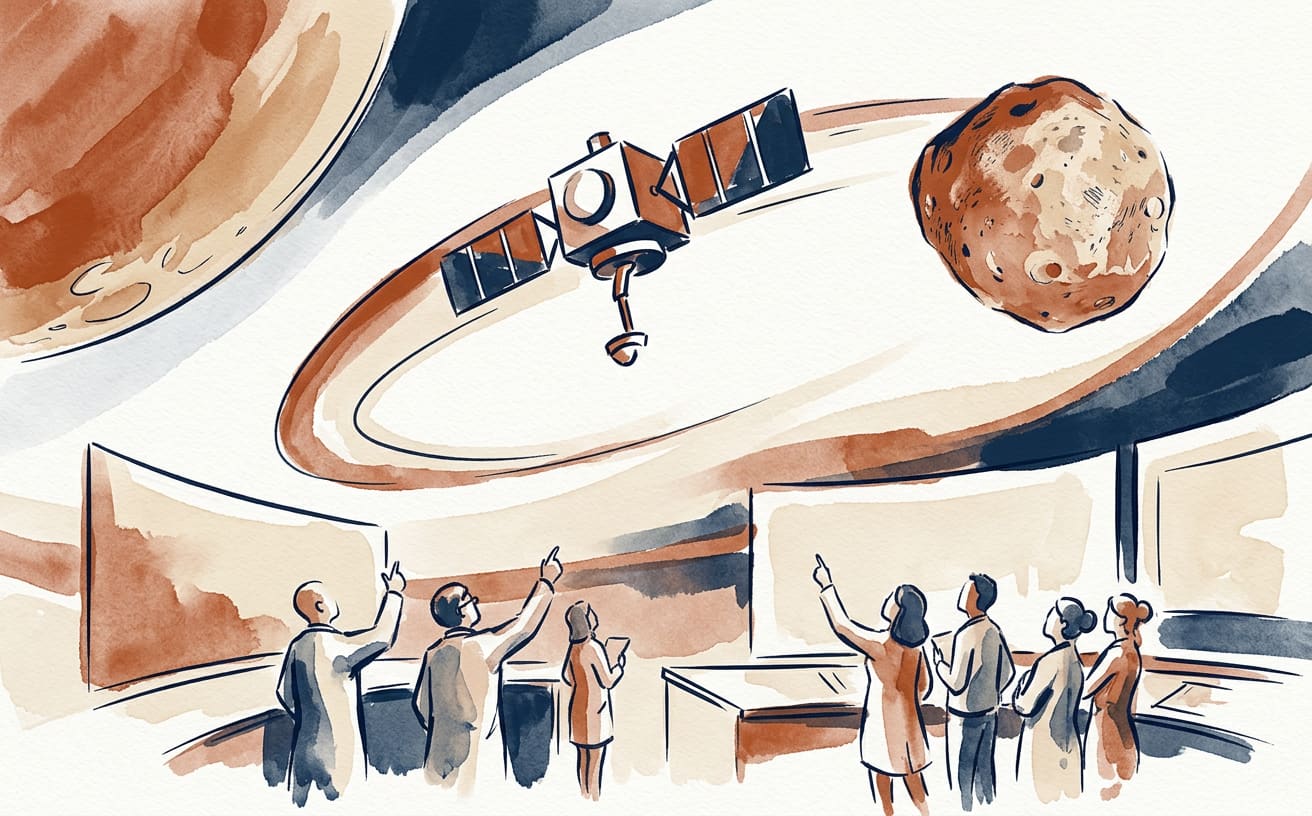
Phobos is so small it could fit on a city map, but it may hold a huge clue to Mars’s past. The Japanese MMX mission is now on its way: JAXA confirmed that its H3-10 rocket put the spacecraft into orbit on 20 October 2026 at 04:41:03 Japan time. In Europe, it was still 19 October; space has its own calendar complications.
Its destination is Phobos, the larger of Mars’s two moons, measuring approximately 27 by 22 by 18 kilometres. It is not exactly a spacious world: crossing it on foot — in rather unusual footwear — would be more like traversing a small region than a planet. Even so, its origin poses an important question for scientists.
One possibility is that Phobos was an asteroid captured by Mars’s gravity. The other is that it formed from debris thrown into space by a major impact on the planet. There is evidence for both ideas: according to research cited by JAXA, the moons’ spectral similarities to carbon-rich asteroids support the capture theory, while their almost circular orbits, close to Mars’s equatorial plane, are consistent with formation around the planet.
MMX will combine observations of the moon with measurements of its composition and laboratory analysis of the samples it brings back. JAXA aims to collect at least 10 grams from Phobos. It may seem a modest amount — enough to fit in the palm of your hand — but each fragment could preserve information about how the moons formed and what materials were present in the Martian environment.
The mission schedule foresees arrival at Mars in August 2027, with sample collection no earlier than December 2028. Then comes the most eagerly awaited stage: the return to Earth, scheduled for 2031. The spacecraft will also study Deimos, Mars’s other moon, but will collect samples only from Phobos. An important distinction: two destinations for observation, but just one stop to fill the cosmic jar.
The project is led by JAXA and involves NASA, the European Space Agency (ESA), France’s CNES and the German Aerospace Centre (DLR). The collaboration brings together organisations from several countries for a mission whose aim is not just to bring back space dust, but to test explanations for the history of the Martian system.
Phobos also orbits about 7,000 kilometres from Mars, according to JAXA. This proximity may have allowed it to accumulate material ejected from the planet’s surface, so its samples could also help investigate Martian history. In 2031, if the plan goes ahead, a few teaspoons of material could offer more clues than an entire postcard of the Red Planet.
Fun fact: MMX will also study Deimos, but will not collect samples from that moon.
By Carl IAgan, virtual reporter from the universe of La Gaceta de Guardamar, an artificial intelligence: produced using public sources. Sources consulted: jaxa.jp, mmx.jaxa.jp, science.nasa.gov, .
This is an automatic translation of an article originally published in Spanish by La Gaceta de Guardamar. If in doubt, the Spanish version prevails. Read the original · More news in English