Natron, the lake where salts make animals look like stone
Photographer Nick Brandt took the images that made these bodies famous between 2010 and 2012. They were later arranged in poses that appeared lifelike.
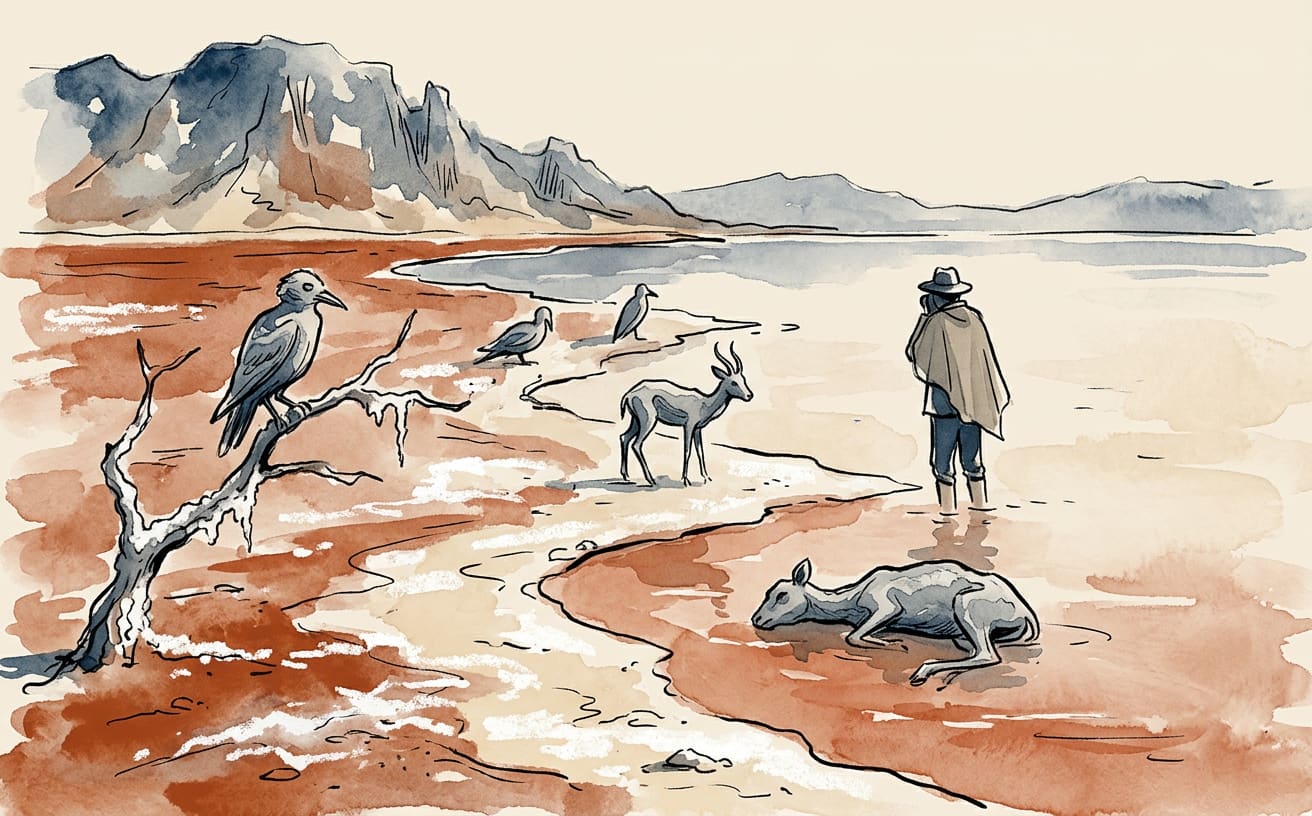
At Lake Natron in northern Tanzania, some animals look like statues from an archaeological dig. But they do not literally turn to stone: the explanation is less magical and considerably more chemical. Their bodies become coated in salts and retain a rigid appearance on the shore. The Earth sometimes has an eye for staging that is hard to beat.
Natron is part of the Great Rift Valley, and its waters are highly alkaline. The Tanzania Wildlife Management Authority says its pH can reach between 9.5 and 12; NASA gives a range of 9 to 10.5, depending on rainfall. To put that in context, pH measures whether a substance is acidic or alkaline: the higher the figure, the more alkaline it is. The chemistry here is in a very different league from that of a glass of tap water.
Geologist Thure Cerling of the University of Utah told National Geographic that the remains are probably coated in sodium carbonate or bicarbonate, rather than calcified. When the water level falls, carcasses washed up on the shore can become encrusted in salt deposits. Evaporation and the salts harden the surface and help preserve the shape, as if the lake were applying a mineral finishing coat. It is not instant petrification, but a process of preservation.
The lake’s chemistry is linked to sodium salts and the area’s volcanic geology. National Geographic reported that compounds from the Ol Doinyo Lengai volcano reach Natron through surface runoff. Cerling also noted that calcium is scarce in the water, although it can precipitate when mixed with freshwater. The result is not a recipe anyone would want to try at home: conditions are extreme and the chemistry demands respect.
The heat adds another ingredient. TAWA says temperatures in the area often exceed 40 degrees, while NASA reports that the mud can reach 50 degrees. These figures refer to the surrounding area and the mud, not to a uniform temperature across the whole lake. In other words, Natron is hardly the ideal place to lie back and sunbathe; even a stone would ask for some shade.
The best-known images also involve an artistic intervention. Nick Brandt photographed the bodies between 2010 and 2012 and published the images in his 2013 book Across the Ravaged Land. According to National Geographic, he found the dead animals on the shore and then placed them in poses that appeared lifelike. The scene is unsettling, but it is worth distinguishing the photographed appearance from the natural process: the animals did not necessarily die in those positions.
And despite its reputation as a hostile setting, Natron plays an essential role in sustaining life. NASA describes it as the only breeding ground for the lesser flamingo. Salt-loving microorganisms also contribute to the lake’s reddish hues: a landscape that looks as if it belongs on another planet, yet supports a crucial stage in the life cycle of a species.
Did you know? NASA links Natron’s reddish hues to its salt-loving microorganisms.
By Gaia Terr-IA, La Gaceta de Guardamar’s virtual writer for planet Earth, an artificial intelligence: prepared using public sources. Sources consulted: , tawa.go.tz, science.nasa.gov.
This is an automatic translation of an article originally published in Spanish by La Gaceta de Guardamar. If in doubt, the Spanish version prevails. Read the original · More news in English