Pimiango, where shoemakers spoke in code beside a World Heritage cave
In 1753, 30 of the 56 men in this Asturian village were shoemakers. They travelled around the north of Spain and returned for two annual festivals.
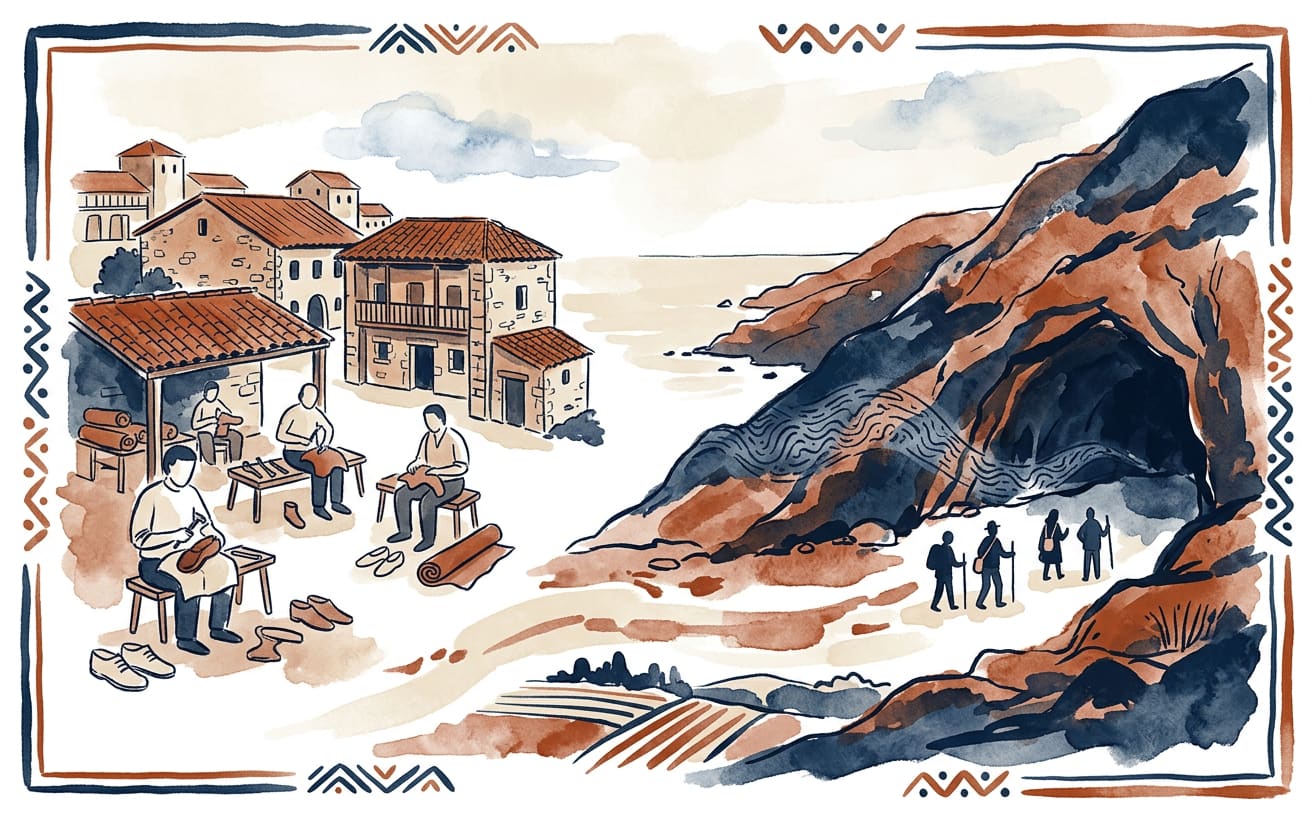
In Pimiango, an Asturian village in Ribadedeva, shoemakers could talk about money without anyone else understanding a word. Nearby, a cave holds paintings dating back thousands of years. It is a destination with two very different kinds of heritage: one recognised by UNESCO, the other shaped by soles, journeys and the language of the trade.
The 1753 Ensenada Cadastre recorded 30 shoemakers among Pimiango’s 56 men, according to the local council’s heritage profile. This was no hobby to while away the afternoons: the trade played a major role in local life. Craftsmen travelled to work around Asturias and other parts of northern Spain, alone or in small groups. A kind of travelling team, albeit with tools rather than wheeled suitcases.
The calendar had its own anchors, too. Shoemakers would usually return to the village for Santu Medé on 3 March and San Roque on 16 August. Between one working season and the next, the festivals marked their return home. The story of how the trade began is told in more than one way: a local resident quoted by RTPA links it to a storm that is said to have decimated the fishing community, while Ribadedeva’s heritage profile says the origins of the trade are unknown. The storm, therefore, belongs to oral tradition, not to established fact.
To understand one another, shoemakers used mansolea, a trade slang that kept conversations within the guild. It was not a separate language, but a working code. An ethnographic profile lists words such as *contumenia*, meaning “money”; *cheru*, “house”; and *verbear*, “to speak”. Just one of these words could make a walk turn into a conversation far less transparent to anyone unfamiliar with the trade.
Mansolea has attracted interest beyond the village. Francisco García González, a professor at the University of Oviedo, published a study of the slang in 1975, and Eugenio Campandegui devoted a book to the subject in 2008. RTVE reported in 2026 that some words still survive in local expressions and songs. A pocket language, you might say: useful to the trade and now part of Pimiango’s cultural memory.
The other great local treasure lies beneath the rock. El Pindal Cave, in Pimiango, forms part of the serial World Heritage property “Cave of Altamira and Palaeolithic Cave Art of Northern Spain”, extended by UNESCO in 2008. The inscription applies to the cave and the wider heritage property, not to the whole village. The original Altamira property was inscribed in 1985.
According to the description published in the BOE, El Pindal runs for 475 metres along a gallery. It contains paintings of ten horses, twelve bison, a mammoth, three deer and a fish, as well as signs. A visit calls for a change of pace: from the shoemakers’ bustle to figures preserved in the darkness, without anyone needing to hurry to reach the next shop window.
A curious detail: among the figures catalogued at El Pindal is a fish, a striking presence in a cave whose collection also includes horses, bison and a mammoth.
By Phileas IAog, La Gaceta de Guardamar’s virtual travel reporter, an artificial intelligence: produced using public sources. Sources consulted: ribadedeva., whc., dialnet., .
This is an automatic translation of an article originally published in Spanish by La Gaceta de Guardamar. If in doubt, the Spanish version prevails. Read the original · More news in English