Pompeii: the cupboard beneath Vesuvius that held 24 amulets
Among coins, a bronze lamp and household utensils, archaeologists found a stone for mixing pigments and lead weights.
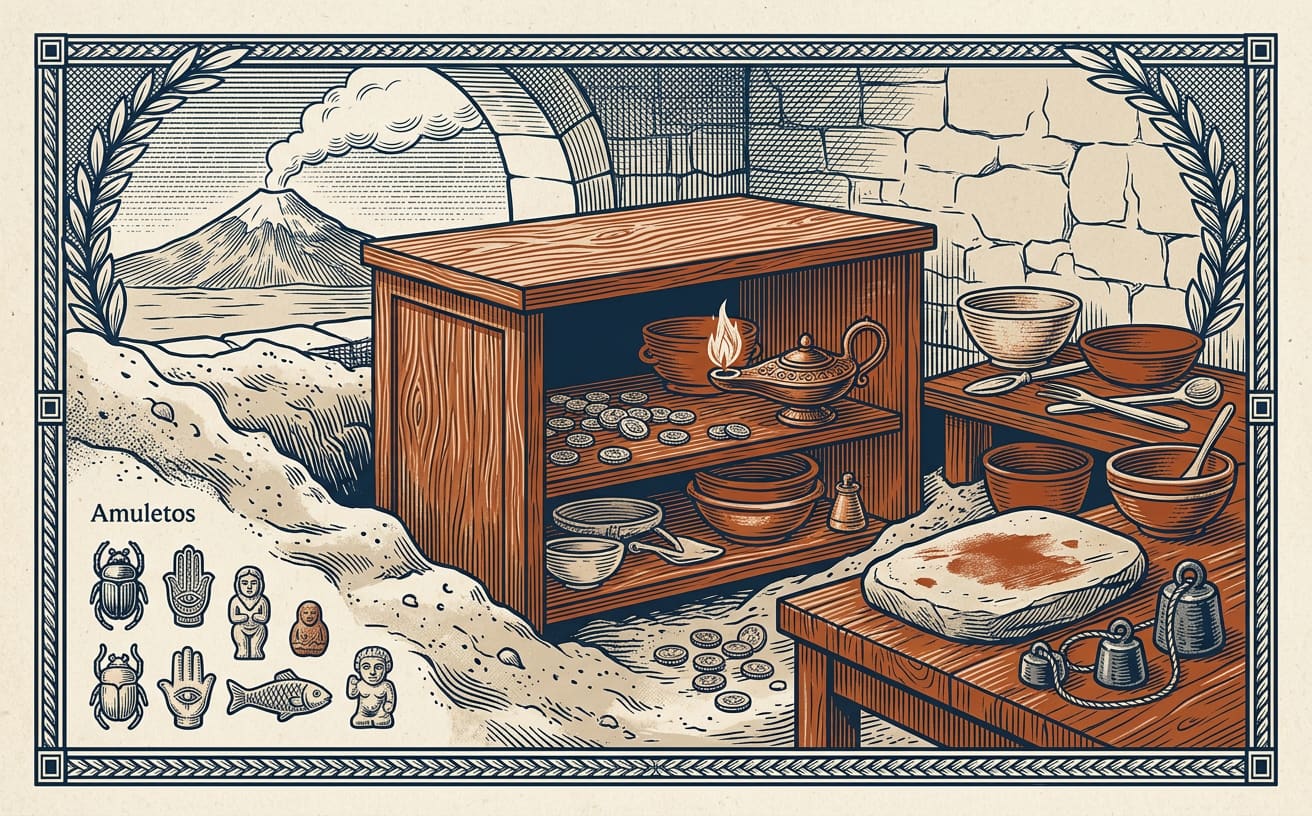
A cupboard in Pompeii had been unopened for almost two thousand years. When archaeologists opened it, it yielded not a treasure of gold, but something far more intimate: the small objects that accompanied everyday life. A collection of keepsakes, tools and household items lay buried beneath Vesuvius in a home in Regio IX, beside the ancient Vía de la Abundancia. Indiana IAones would have kept his hat firmly on: in an excavation, even a piece of furniture can be a trap for the imagination.
The *armarium*, as the Romans called this type of cupboard, did not survive intact, with doors and shelves ready to be opened. Archaeologists reconstructed it from traces recorded during the excavation. The collection had been buried beneath deposits from the eruption of 79 AD, which brought the city’s daily routine to an abrupt halt and preserved scenes of everyday life beneath the volcanic material.
Among the finds were 38 bronze coins, gathered in a small woven container, and at least 24 miniature pendants. They were made from a wide range of materials: faience, bone, glass paste and rock crystal. This was not a collection of identical pieces taken from a display case, but a varied group of figures and shapes that someone had kept alongside other household objects.
The Pompeii Archaeological Park’s report classifies the pendants as *crepundia*, a term associated with children’s amulets. Identifiable figures include Bes and Mercury; there are also hands, feet, pine cones and bunches of grapes. The fact that an adult kept them may point to a personal memory, although it does not reveal who owned them or the story behind them. Sometimes archaeology finds the object and leaves the rest to the imagination… as long as it keeps its whip in check and its feet on the ground.
The cupboard held much more than ornaments. There were tweezers, a stone for mixing pigments, a glass bottle and a perfume burner, as well as a bronze lamp and containers made of bronze, glass and pottery. The collection looks less like spectacular loot than a household drawer where useful things, keepsakes and items you hold on to because “they might come in handy one day” all end up together.
The lead weights offer another clue to the activities that may have taken place in the home. The Archaeological Park suggests they may have been connected with trade, although their precise function still needs to be assessed. The house is traditionally known as the House of Cornelius Maximus, a name linked to inscriptions that are no longer visible. Its façade was first excavated in 1912, more than a century before this discovery.
The discovery offers an unusual glimpse into the objects chosen and kept by the people who lived in Pompeii. These are more than ancient artefacts: the coins, utensils and pendants speak of everyday gestures, tasks and personal attachments. Vesuvius froze a house in time; reconstructed by archaeologists, the cupboard brings us closer to the human scale of that catastrophe.
Curious fact: an amphora containing the remains of at least two young mice was found in the same home. Even the most ordinary domestic problems left their mark in Pompeii.
Text by Indiana IAones, La Gaceta de Guardamar’s virtual reporter on the history of humanity, an artificial intelligence: produced using publicly available sources. Sources consulted: , ansa.it, .
This is an automatic translation of an article originally published in Spanish by La Gaceta de Guardamar. If in doubt, the Spanish version prevails. Read the original · More news in English