Let your grandchild vote for you
The Grandchildren’s Law assumes exile that few can document decades later. And if the same standard applies to some, why not to those who fled ETA or separatist extremism?
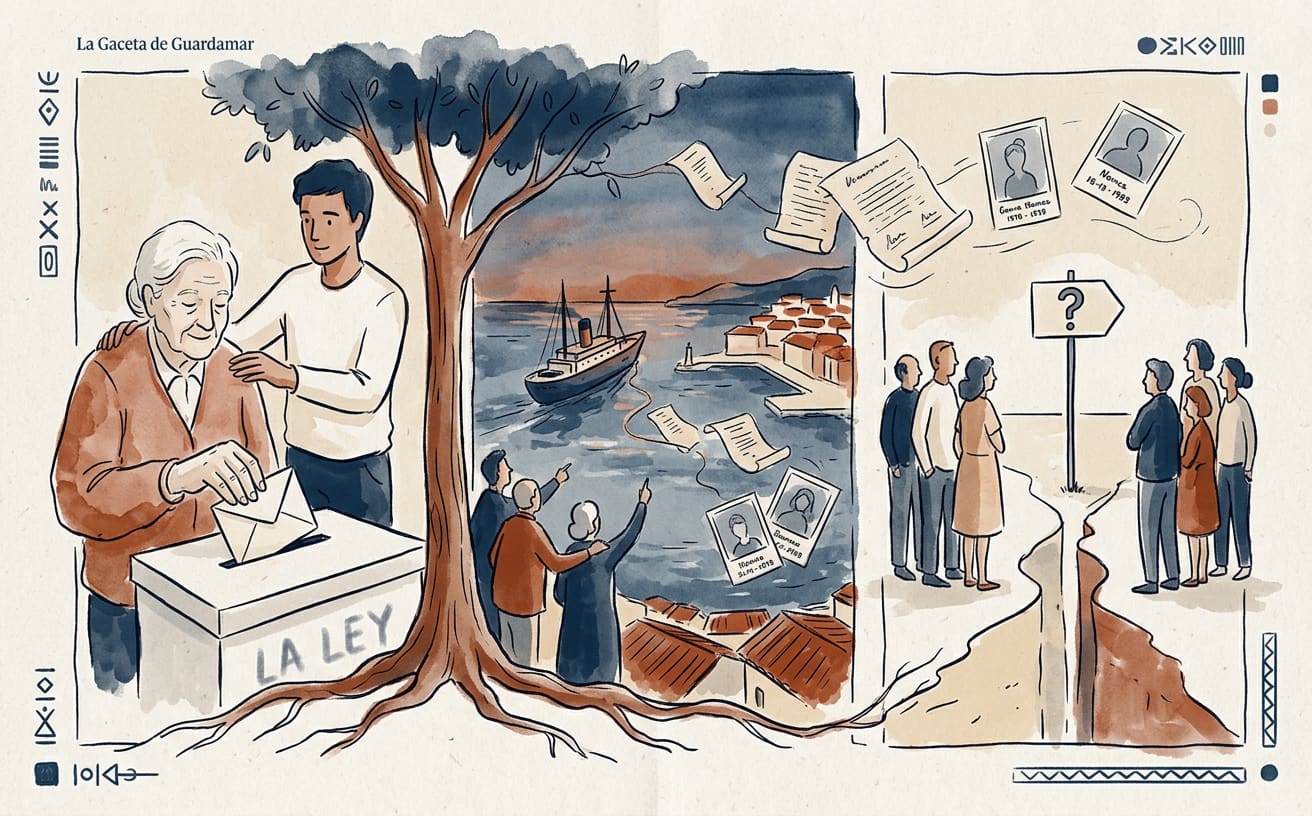
Some laws are passed to remedy a historic injustice; others are passed to make it look as though one is being remedied. The Grandchildren’s Law has a foot in each camp, and the problem is that the second foot lands precisely where the right to vote in Spain is decided.
The original idea was a noble one: to grant nationality to the descendants of those who had to flee the dictatorship. But somewhere along the way, someone decided that proving exile was an inconvenient formality, so it was simply presumed. It is presumed that the grandfather left to escape Franco; presumed that the documents exist, or that they are not needed; presumed that everything adds up. The presumption of innocence is an impeccable principle in a court of law, but in a consular office it is a sieve.
Picture the scene. A man from Buenos Aires, Montevideo or Caracas turns up with a grandfather who went to the Americas at a date nobody remembers, for reasons nobody documented. Emigration was the norm: half the country was leaving, almost always because of poverty, not political persecution. Nearly a century ago, documents were lost, burned or never existed in the first place. And from this, a Spaniard by birth emerges, entitled to an EU passport, to work in any EU country and, until very recently, to vote in our elections. All without ever setting foot in Spain, and without anyone being able to establish rigorously what drove his grandfather to leave.
I’m not the only one saying that many applied for the passport, not to right anyone’s wrongs: even the law’s defenders acknowledge it. An EU passport opens doors, avoids visa requirements and lets you live in 27 countries. Who would turn one down if it came free with a family tree?
The Supreme Court has spotted the loophole. It has provisionally suspended voting from abroad for people naturalised through the exile route when exile was merely presumed rather than proven, and the Constitutional Court has refused to lift the suspension. Nationality remains in place; the right to vote is what hangs in the balance. A state that grants a right before finding out who it is granting it to is not putting anything right; it is improvising.
A proposal to extend the law
But since I believe in consistency when it comes to memory, I have a proposal: let’s extend the law! If the principle is to compensate the descendants of those forced to leave their homeland because of political violence, there are plenty more grandchildren to make amends to.
Consider the Basque Country. For decades, ETA killed more than 800 people and extorted business owners, councillors and neighbours who simply did not think as they did. Thousands of families sold everything they owned and moved to Madrid, the Valencian Community, anywhere they could breathe. And in Catalonia, those who left during the years of separatist extremism, or because of the stifling atmosphere in more recent years, deserve a law of their own too. Their grandchildren, now living in Madrid, Valencia or Seville, could vote in their grandparents’ elections. Perhaps then some institutions would not be run by those who are in power today, having secured their majorities after the opposing side of the population disappeared, willingly or by force.
What would the defenders of the Grandchildren’s Law say then? I know: that it’s madness, that people need to provide proof, that voting must be tied to residence, that it’s outrageous. How convenient: exile is sacred when it benefits the grandchild I favour, and a dangerous invention when it benefits the other side. It turns out that one grandfather’s exile in 1939 does give the right to vote, but another grandfather’s in 1980, after a bullet to the back of the head, does not. One group’s grievance counts for a great deal; the other’s counts for nothing.
The Senate: arithmetic over ideas
And then there’s the timing. With elections on 29 November, the Senate a battleground and parties running the numbers province by province, suddenly every vote from overseas is worth its weight in gold. Meanwhile, the parties are spending the week stitching together pacts. On one side, the PSOE and the Frente Amplio, with their «Senado de Progreso» coalition in 43 provinces; on the other, the PP and Vox, looking for a way to make Vox disappear from the ballot in around 20 provinces without actually withdrawing it. They call it political vision. I call it arithmetic. Those who once made a show of condemning corruption on the other side are now looking away when the problem is at home, or involves someone who has promised them a seat. Ideology goes in a drawer; the drawer is shut when seats are in short supply.
Democratic memory deserves rigour, not a free pass. The Spaniards who truly suffered exile, and their descendants, are the first to lose out when a law becomes a sieve. And, meanwhile, Spaniards who suffered another kind of exile — exile through fear — still have no law, no redress and, curiously, no lobby.
In the end, the people get the politicians they deserve, because we are the ones who vote. But if we are to vote, at least let it be clear who we are. Let your grandchild vote for you. But first, let him prove he’s your grandchild.
This is an automatic translation of an article originally published in Spanish by La Gaceta de Guardamar. If in doubt, the Spanish version prevails. Read the original · More news in English