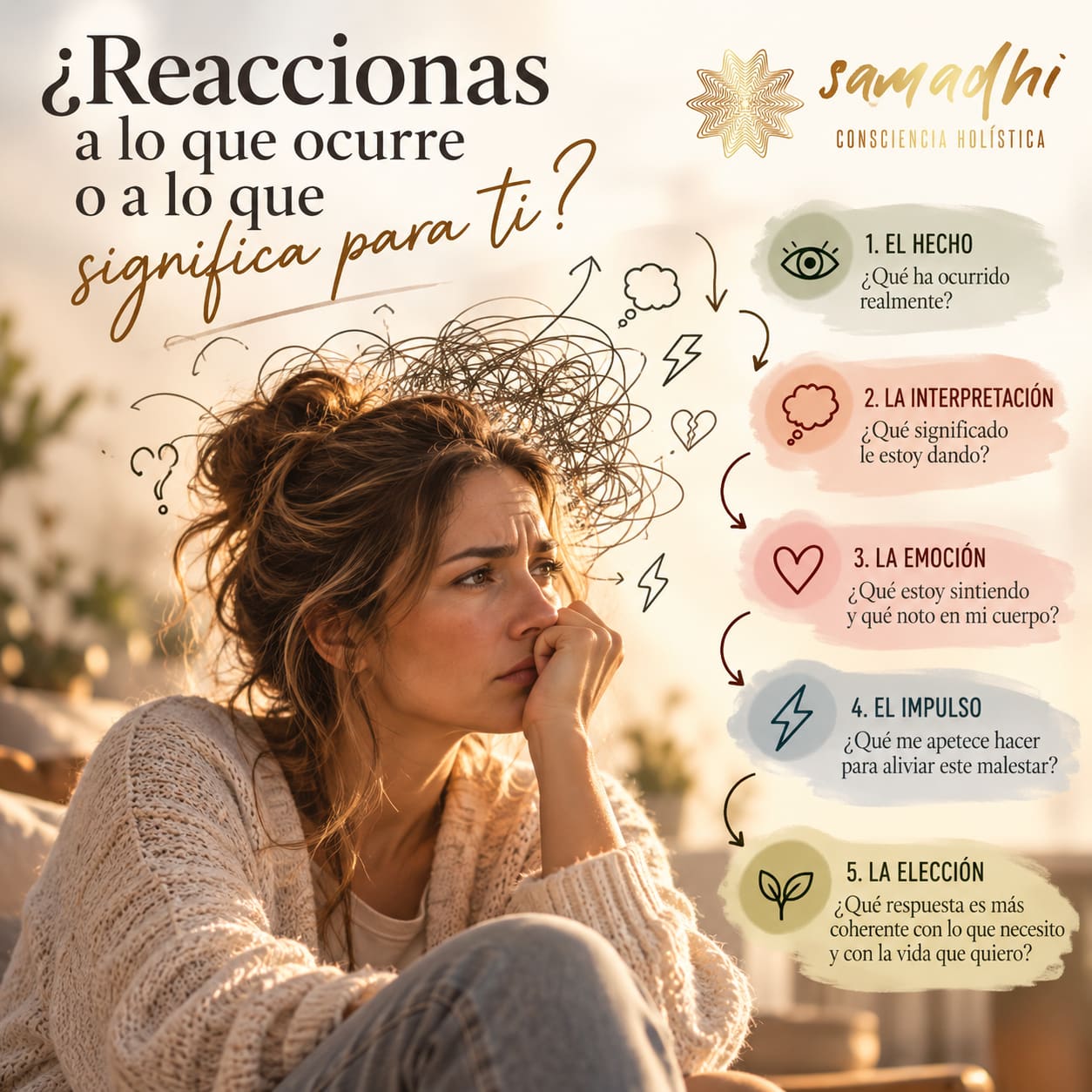
Are you reacting to what happened, or to what it means to you?
Before we knew what love was, we had already learned how it was expressed. Childhood and our earliest relationships left their mark, and may still influence how we love and let ourselves be loved.
DESAFÍ-ARTE
Are you reacting to what happened, or to what it means to you?
Has it ever happened to you that something seemingly minor triggered a much stronger reaction than you expected? A comment that bothers you for hours, a silence you interpret as distance, a change of plans that makes you angry, or a reply that makes you feel you are not important to someone.
Sometimes what happens and what we feel seem inseparable. Someone does something and we react. But what if there were something more between the two? What if we were responding not only to what happened, but also to what it means to us?
Imagine sending a message to someone we love and waiting a while for a reply. The fact is simple: they have not replied yet. But our mind may start to build a story. Perhaps they are busy. Perhaps something has happened to them. Or perhaps another thought creeps in: I don’t matter to them as much any more; they’re losing interest; I’ve done something wrong.
The situation is the same, but the meaning we give it can change how we feel and how we act.
And this brings us to a question worth asking ourselves: where does our way of interpreting what happens to us come from?
The invisible chain behind our reactions: Often, between what happens and the way we react, there is a chain of internal events that unfolds so quickly we are not even aware of it.
When faced with an unexpected situation, our mind tries to find an explanation. And when we do not have all the information, we may fill in the gaps with our own interpretations.
One thought leads to another. What is happening now may connect with memories, past experiences, fears and beliefs we have built up over the course of our lives. What began as a specific situation can become a much bigger story in a matter of seconds.
Then fear, insecurity, sadness, anger or distress take hold. Our body may react too: we feel tense, restless, our heart races or we find it difficult to relax. And we feel the urge to do something to ease that discomfort: keep messaging, complain, withdraw, lash out, seek explanations or prepare for the worst.
Perhaps we end up reacting not so much to what happened, but to everything we have come to believe is happening.
Our minds can anticipate possible threats and help protect us. Past experiences can influence this response, especially when a situation reminds us of something that hurt us or stirs up the fear that it might happen again.
The problem arises when we mistake our interpretation for a fact and start experiencing something as real before we know whether it is actually happening.
This does not mean our emotions are false or that all our suffering is caused by our thoughts. It means we can learn to distinguish between what happened, how we are interpreting it and what that interpretation is bringing up in us.
Where does our way of interpreting the world come from?
Each person sees life through the lens of their own story. The experiences we have had, the relationships we have built and the ideas we have learned all influence what we expect from others and how we respond when things do not go as we hoped.
Much of what we learn begins in our earliest relationships. When we are small, we do not yet have the tools to identify our emotional needs, understand what we feel or explain why something hurts us.
We learn by watching how our parents or carers relate to one another, how they treat each other, how they show affection, how they resolve disagreements and how they respond when someone needs comfort, attention or understanding.
We also learn through our own experience: how we feel when we seek affection, what happens when we express a need and whether there is room for us to show what we feel.
Perhaps we saw love expressed through care and being there for one another. Perhaps we learned that we had to be strong, not cause problems, please others or keep quiet to maintain harmony. We may have received affection, but not always known how to identify or express what we needed.
Every story is different. This is not about looking for someone to blame or judging how our parents did things; they had their own stories, resources and limitations too. It is about understanding that we build our ideas about love, security and relationships from what we experience, observe and learn.
Over time, some of these experiences can turn into beliefs we take for granted without ever questioning them.
When what we have learned becomes a way of reacting
If we learned that love means always being available, we may struggle to set boundaries. If we associate love with sacrifice, we may come to think that looking after ourselves is selfish. If we see disagreement as a threat, we may avoid expressing how we feel for fear of losing the other person.
We may also expect the people who love us to guess what we need, interpret a brief period of distance as a lack of affection, or feel that a change of plans means we are no longer important.
Without realising it, we can end up reacting according to an idea of love we learned in the past, rather than looking at the relationship and the facts in front of us.
These patterns are not necessarily mistakes. Many began as ways of adapting, feeling accepted or coping with difficult situations. But what helped us at one point does not have to be the only way we respond today.
Understanding where some of our reactions come from does not mean excusing any behaviour, putting up with what hurts us or taking responsibility for other people’s decisions. It means starting to distinguish between our past, what is happening in the present and the needs we can learn to express.
Returning to the facts to regain the freedom to choose: When a situation unsettles us, perhaps the first step is not to look immediately for an explanation, but to pause and ask ourselves: what do I actually know has happened?
Not what I fear has happened. Not what I think it means. Not what might happen tomorrow.
What facts are in front of me, here and now?
Then we can notice what interpretation we are making, what emotion it brings up and what urge we feel.
Perhaps we will discover that we need reassurance, clarity, affection, respect or simply time to understand what has happened. From there, we can decide whether we need to talk, ask for clarification, set a boundary or wait until we have more information.
This pause does not guarantee that the discomfort will go away, nor does it mean we should ignore signs of a relationship that is hurting us. It allows us to respond with more information and less impulsiveness.
We cannot always prevent the first thought or emotion from arising. But we can learn to recognise them and create a space before we act.
Because between what happens and what we do about it lies an opportunity to understand ourselves better.
Your challenge for the week: The next time a situation makes you feel uncomfortable, try pausing for a few moments and working through this sequence:
1. The fact. What actually happened, without adding interpretations?
2. The thought. What meaning am I giving it? What am I assuming is happening?
3. The emotion. What am I feeling, and what do I notice in my body?
4. The urge. What do I feel like doing to ease this discomfort?
5. The choice. What response would be more in keeping with what I need and the relationship I want to build?
You do not have to find all the answers or change the way you act overnight. Simply start by observing.
Sometimes we will discover that our fears do not match the facts. At other times, we will confirm that something needs to change and that we must act to look after ourselves. In either case, seeing things more clearly helps us make more considered decisions.
We may not be able to choose everything that happens to us, but we can learn to understand better what is going on inside us and discover new ways to respond.
Desafí-ARTE: the art of understanding yourself, questioning what you have learned and discovering new ways to relate to yourself, to others and to life.
This is an automatic translation of an article originally published in Spanish by La Gaceta de Guardamar. If in doubt, the Spanish version prevails. Read the original · More news in English