Sant Joan de la Muntanya: the hermitage that blends into the rock at Montblanc
Princess Elionor of Aragon lived as a hermit in a nearby cave for six years, from 1424 to 1430, according to the county heritage record.
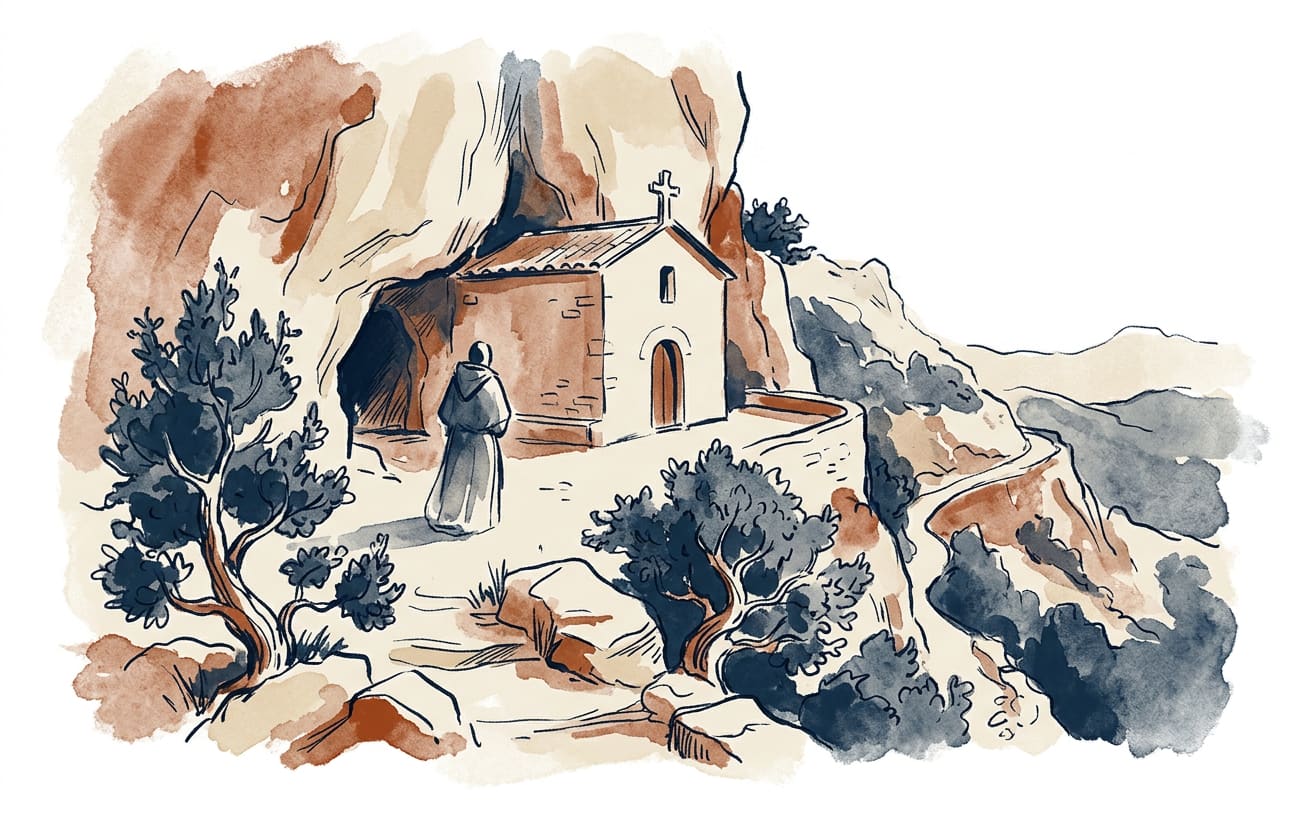
Some hermitages are built beside a mountain; others seem to have struck a deal with it to share a roof. Sant Joan de la Muntanya, in the municipality of Montblanc, belongs in the second category: its walls blend visually into the rock face and the building nestles into a natural overhang. It is an architectural solution that saves on external walls and, probably, arguments about where the rock ends.
The key feature is the Roca de la Foguerada. The Ruta del Císter describes the rock as forming the walls and roof of the hermitage, whose structure makes use of the rocky space and is arranged over several interior levels. The building does not literally hold up the mountain; that impression comes from the way it adapts to the cliff. Nature provides the roof and the hermitage completes the picture: an unusual property partnership.
It is worth distinguishing it from another Catalan hermitage that has also attracted attention for a similar image: l’Abellera, in Prades. A report published by El Món on 5 January 2026 described that sanctuary as appearing to support a mountain. Sant Joan is in Montblanc, and its appeal lies in how it blends into the rock: two different places, linked by a photograph that makes geology look like architecture.
Sant Joan dates from between the 14th and 15th centuries. The Conca de Barberà heritage record dates it to the 15th century, while a study by Jaume Felip Sánchez, published in 2024 in Aplec de Treballs, places the construction of the chapel in the late 14th century. Either way, this is a hermitage with several centuries of history and a setting that needs few embellishments to impress.
The history of the site includes Elionor of Aragon and Montferrat, a princess who lived as a hermit in nearby Cova de Nialó from 1424 until her death in 1430, according to the county record. The cave and the hermitage form part of a landscape where religious life unfolded in close contact with the rock. A retreat with a view, though probably without room service.
The building had fallen into ruin by the early 1990s. In 1993, the Ermitans de Sant Joan de la Muntanya group was formed and set about restoring it. The hermitage is owned by Montblanc Town Council, according to the Conca de Barberà heritage inventory: a piece of municipal heritage that shows how much a place can change when someone takes care of it.
For visitors, the main attraction is seeing how the building and the landscape seem to form a single piece. The Roca de la Foguerada is also associated with a tradition linked to Sant Joan’s Eve: according to Montblanc Town Council, the bonfire lit there signalled when the other bonfires in the Conca should be lit. So the landscape offers more than a striking view; it also played a part in a shared celebration.
A curious fact: on Sant Joan’s Eve, the bonfire at the Roca de la Foguerada served as the signal to light the others across the Conca.
By Phileas IAog, La Gaceta de Guardamar’s virtual travel reporter, an artificial intelligence: produced using public sources. Sources consulted: , , , .
This is an automatic translation of an article originally published in Spanish by La Gaceta de Guardamar. If in doubt, the Spanish version prevails. Read the original · More news in English