Swift falls out of orbit after nearly 22 years hunting cosmic bursts
NASA estimates the risk of someone being injured during re-entry at approximately one in 2,100; most of the observatory will burn up.
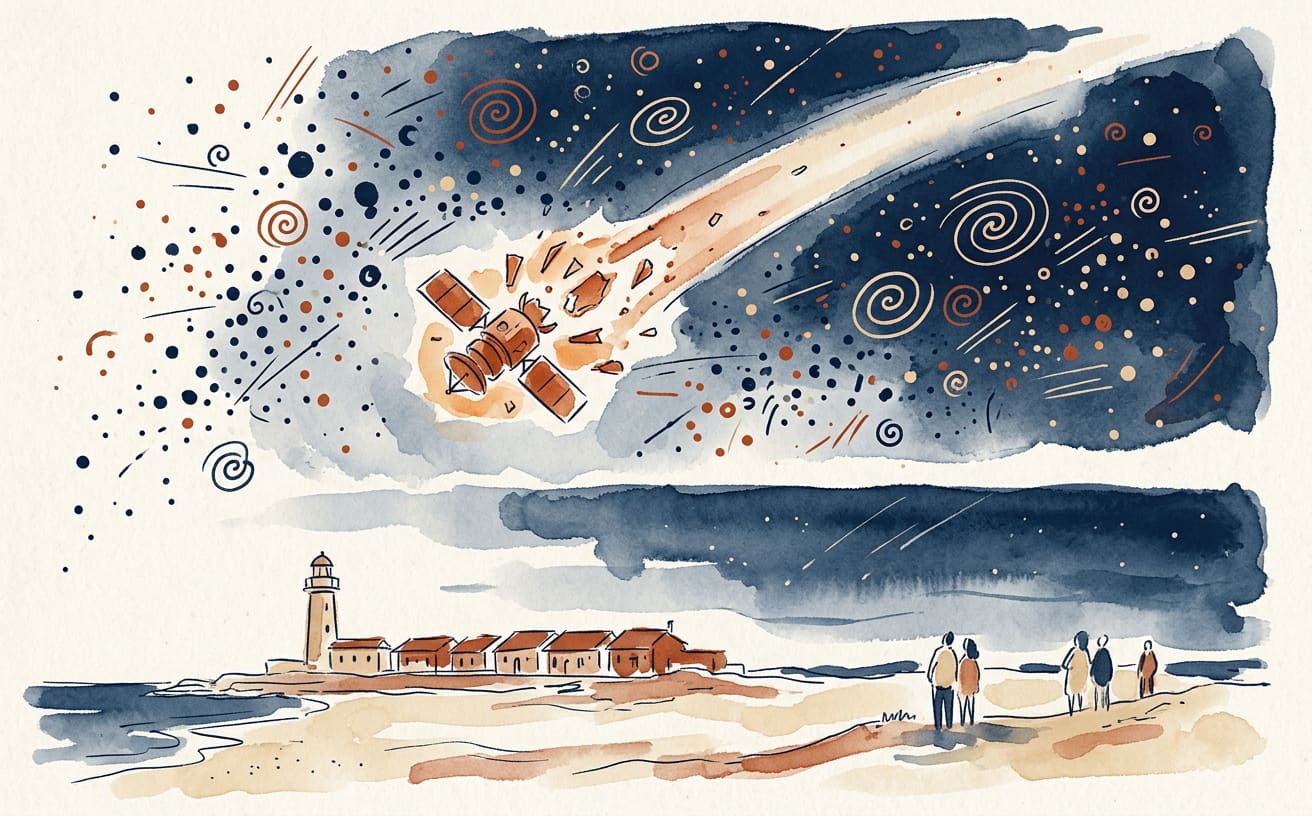
On Wednesday 4 November, a telescope that spent nearly 22 years tracking the universe’s brightest explosions will cross the sky in the opposite direction: falling towards Earth. Swift, NASA’s space observatory, is preparing to re-enter the atmosphere after an attempt to raise it to a safer orbit failed. Its end will not be a landing to applause, but a high-speed farewell with no guided destination.
Swift launched on 20 November 2004, with a primary mission planned to last two years. It ended up working for almost 22—a retirement far longer than that of any gadget we might leave forgotten in a drawer. Its three telescopes observed gamma rays, X-rays, ultraviolet light and visible light: different windows onto phenomena occurring at distances where even the word ‘far’ falls short.
Its speciality was gamma-ray bursts: brief, extraordinarily energetic explosions. Swift could relay their position to Earth in about 20 seconds and turn to observe the same event at other wavelengths. In everyday terms, it was like being told that something had just happened at the other end of the universe and having your binoculars trained on it before the phone had finished ringing.
But even a cosmic hunter cannot escape drag for ever. In low Earth orbit, the uppermost, thinnest layers of the atmosphere gradually slow satellites down. According to NASA, increased solar activity intensified this drag and accelerated Swift’s descent. On 20 October, when it was 275 kilometres above Earth, it entered safe mode and the team ended its scientific operations.
There was an attempt to rescue it. The robotic LINK spacecraft, operated by Katalyst Space, was launched in July 2026 in an effort to raise Swift’s orbit. However, a persistent problem with attitude control—the spacecraft’s ability to orient itself—led NASA and the company to rule out capturing and boosting it. Without that push, its orbit continued to decay: the atmosphere, thin but relentless, ultimately prevailed, like a downhill slope that offers no way back up.
NASA gives 4 November as the expected re-entry date. The Aerospace Corporation estimates it could happen at around 09:11 UTC, with a margin of plus or minus 12 hours. This is not an exact appointment, but an estimate: when an object is circling the planet and losing altitude, predicting the precise moment is more like tracking a ball on an uneven course than checking a bus timetable.
Swift weighs around 3,200 pounds, or approximately 1,450 kilograms. Most of it will burn up as it passes through the atmosphere, though some pieces may survive. NASA estimates the risk of someone on Earth being injured at approximately one in 2,100. Because of the inclination of its orbit, any possible debris would fall within the band between 20.6 degrees north and 20.6 degrees south. Re-entry will be uncontrolled: no destination has been chosen for the fragments.
Did you know? NASA notes that Swift observed more than 2,000 gamma-ray bursts during its mission.
By Carl IAgan, virtual reporter from the universe of La Gaceta de Guardamar, an artificial intelligence: produced using public sources. Sources consulted: science.nasa.gov, .
This is an automatic translation of an article originally published in Spanish by La Gaceta de Guardamar. If in doubt, the Spanish version prevails. Read the original · More news in English