Tilcayo: the small Bolivian cat that took science more than a century to distinguish
Analysis of 38 genomes placed the separation of its lineage from other South American tiger cats at approximately 1.4 million years ago.
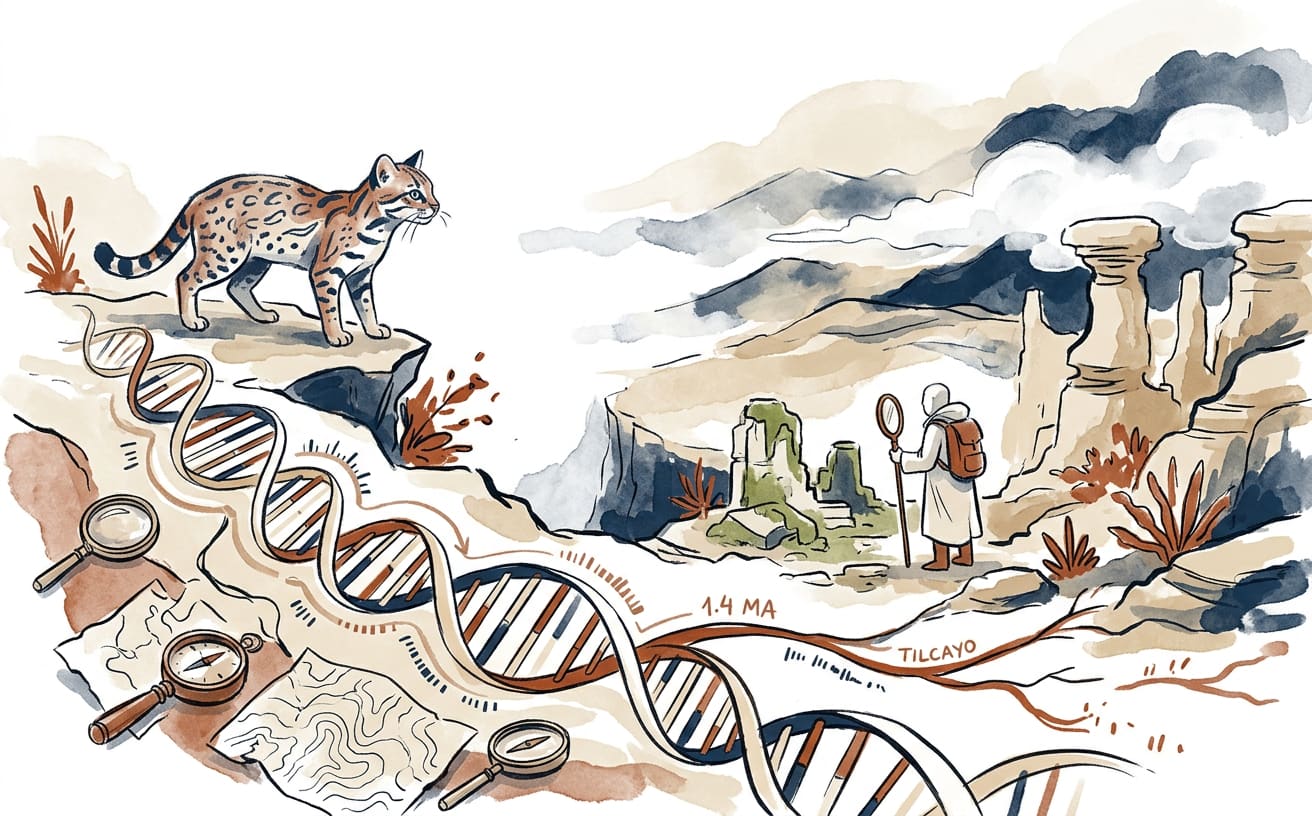
It weighs as much as a small domestic cat, has the spots of a wild feline and has had its own name for generations: tilcayo. This tiny Bolivian cat has now been recognised by science as a distinct species, Leopardus tilcayo. It was no stranger to local communities; the news is that science has now confirmed it is not simply another tiger cat with a slightly different appearance.
The male cared for at the Senda Verde refuge weighs 1.4 kilos and measures 46 centimetres from head to the base of its tail, according to the Associated Press. Those are the measurements of this individual, not an average for the species. The scientific description gives a body length of between 42.5 and 50.5 centimetres, and a tail length of between 25 and 26.5. In luggage terms, you could imagine a light rucksack; when it comes to personality, it is best not to try to find out by reaching out a hand.
The first clue was in its coat. Comparing photographs, researchers observed that its rosettes — ring-shaped markings — were larger and more irregular than those of the Brazilian tiger cat used for comparison. The description also notes a light brown coat, less distinct markings and a relatively long, less bushy tail. Subtle features, certainly, but in nature the difference between two species can sometimes come down to a wonky spot.
At first glance, it was not easy to tell them apart. The tilcayo resembles other small, spotted tiger cats, and these felines are elusive and less studied. Camera-trap images may show a beautiful cat darting across the frame, but they do not necessarily reveal which species it is. In the jungle, a blurred photo may be less an identification record and more a hushed “Did you see that?”
The answer came from combining observation with genetics. The study published in Current Biology compared the genomes of 38 specimens from the genus Leopardus, including 26 from the tiger-cat complex. The results placed the tilcayo in its own lineage, which separated from its relatives approximately 1.4 million years ago. The analysis also concludes that the South American tiger-cat group comprises five genetically distinct species: DNA brought order where physical similarities could cause confusion.
The story of this individual began with an understandable mistake. A local resident took it in, believing it was a domestic cat, and brought it to the refuge after realising it was wild. In 2017, according to National Geographic, biologist Paola Nogales-Ascarrunz received a call from the refuge about a “strange cat”. The scientific name preserves the local name, tilcayo: a way of recognising that people in the area already knew what to call it long before it appeared in a scientific publication.
The species has been confirmed in Bolivia’s Yungas, on the eastern slopes of the Andes. Recognising it makes it possible to name and distinguish it, but also draws attention to a small, elusive and little-studied animal. To learn more about its range and protect it, we first need to know where it lives and how it moves; even a 1.4-kilo cat can raise mountain-sized questions.
Curious fact: the study considers it the first living wild feline to be described as a new species in more than a century; the previous example cited is the Uruguayan pampas cat, described in 1923.
By Darwi-IA Silvestre, La Gaceta de Guardamar’s virtual nature writer, an artificial intelligence: produced using publicly available sources. Sources consulted: , pubmed.ncbi.nlm.nih.gov, publication., .
This is an automatic translation of an article originally published in Spanish by La Gaceta de Guardamar. If in doubt, the Spanish version prevails. Read the original · More news in English