All Saints’ Day in 19th-century Spanish literature
From Larra to Bécquer, a journey through Spanish literature to discover how the nights of All Saints’ and All Souls’ Day were experienced and imagined.
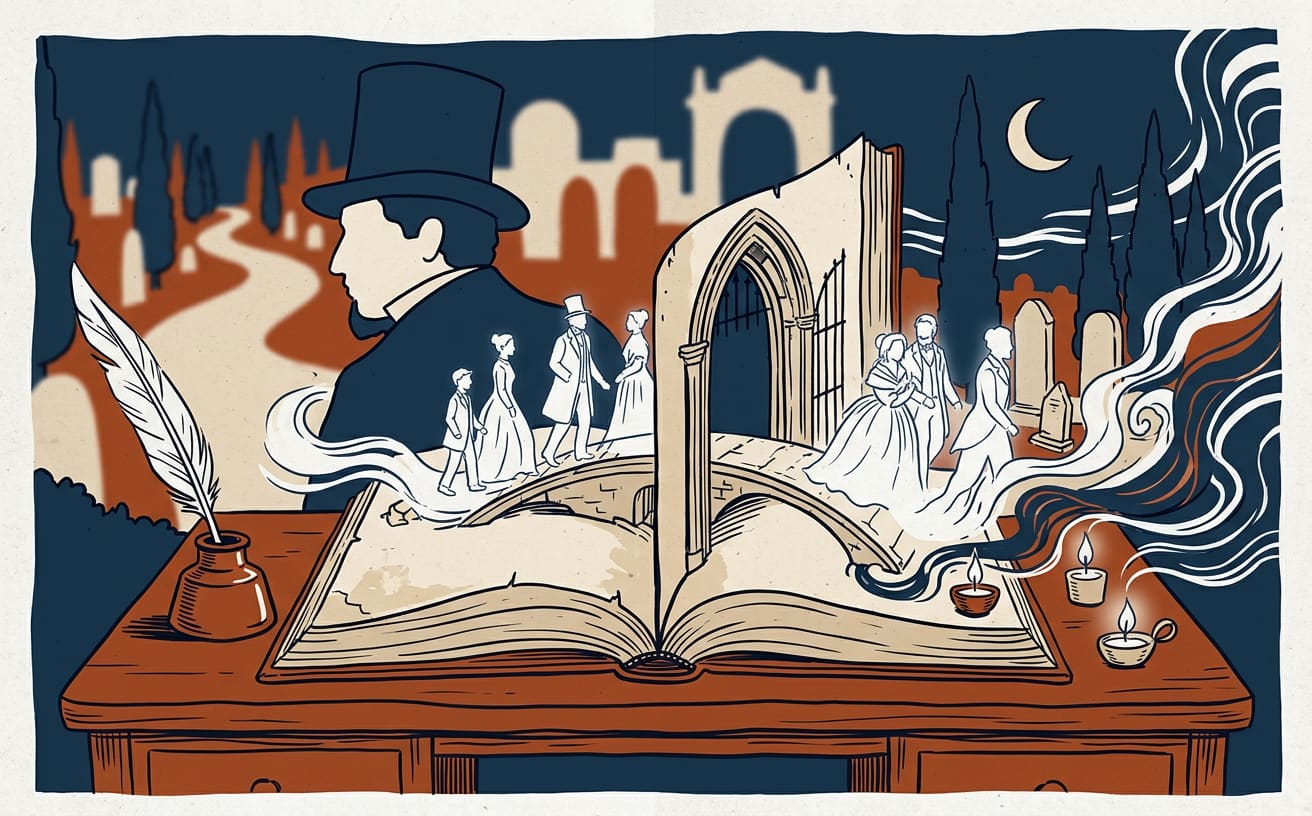
There are five days to go until our traditional All Saints’ Day celebrations, and I couldn’t let the opportunity to write this article pass. As a self-confessed Anglophile, I’m a big fan of Halloween, but I felt our own traditions deserved an article too.
It’s worth remembering that 19th-century Gothic, ghost and mystery writing was not cultivated only by the English, with Charles Dickens, or the Americans, with Edgar Allan Poe. In England, much of the century coincided with the Victorian era, a period when society changed from being strongly rural, with its countryside and lords, to becoming highly industrialised. In its literature, London’s underworld, poverty and prostitution took on an increasingly prominent role.
Spain has magnificent examples of Gothic and dark literature, as well as writing about death, in both Romanticism and Realism. Take the ever-disillusioned Mariano José de Larra and his famous satire of Spain, «El día de difuntos de 1836. Fígaro en el cementerio» («All Souls’ Day 1836: Fígaro in the Cemetery»), in which he turns Madrid into an immense symbolic cemetery, where its buildings and institutions become tombs of liberty, justice and national hopes. Here, he is not trying to frighten the reader. Instead, he uses the commemoration of the dead to write about a society and an individual who feel dead inside.
One of the finest examples of our own answer to Allan Poe in Gothic Romanticism is undoubtedly the Sevillian writer Gustavo Adolfo Bécquer, who makes clear references to this festival in his legends and prose. One example is «El monte de las Ánimas» («The Mountain of Souls»), from 1861. Its main events unfold in Soria on All Saints’ Day, that night and the following morning, with tombs, dead Templars, bells ringing by themselves and tales of ghosts told by the fire.
But «La noche de difuntos» («The Night of the Dead»), a prose piece evoking Madrid’s bells, is especially interesting for understanding how a Spanish Romantic writer imagined this night. Each bell expresses a different relationship with the dead: the pomp of the rich people’s funerals, the genuine grief of the poor and the fear of souls in torment. There are Gothic cathedrals, skeletons and monks leaving their tombs.
Another example, albeit a brief one, appears in the novella El clavo (The Nail) by Pedro Antonio de Alarcón, published in 1853. The narrator arrives in the town amid funeral bells and notes that it is the eve of All Souls’ Day. A visit to the cemetery leads to the discovery of a skull pierced by a nail, setting off an investigation into a murder. By way of background, the novella was made into a film in the 1940s, at the height of the Franco regime, starring a very young Amparo Rivelles and the leading man of the era, Rafael Durán.
In a much less Gothic vein, Leopoldo Alas, known as Clarín, takes us to a Spanish city in the late 19th century and shows how these days were observed in La Regenta, published between 1884 and 1885. Bells toll through the afternoon and night; residents go to the cemetery with wreaths and candles; the rich send funeral decorations with their servants; young women take the opportunity to stroll and show off their dresses; and well-to-do couples go to the theatre to see Don Juan Tenorio.
Among writers who drew on Galician folklore is Emilia Pardo Bazán. In Bucólica, she describes a magosto on All Souls’ Day, where the characters roast and eat chestnuts with new wine: a cheerful scene in contrast to the gloom of the works mentioned earlier. We also find «Tiempo de ánimas» («A Time for Souls»), included in Cuentos sacro-profanos (Sacred and Profane Tales), from 1899. There, prayers for shipwreck victims and beliefs about the dead intertwine with a dark crime in a coastal village.
Lastly, we could not finish without mentioning the best-known work of all, and the one most closely associated with popular imagery: Don Juan Tenorio by José Zorrilla, first staged in 1844. It became deeply linked with this festival through the custom of performing it every year at this time. Its cemetery, statues that come to life, apparitions and the salvation of the soul all chimed with the remembrance of the dead.
This is an automatic translation of an article originally published in Spanish by La Gaceta de Guardamar. If in doubt, the Spanish version prevails. Read the original · More news in English