TOI-561 b: the planet where rock could form clouds
The James Webb observed it for 37 hours and measured an estimated reflectivity of 74%, despite its extremely close orbit around its star.
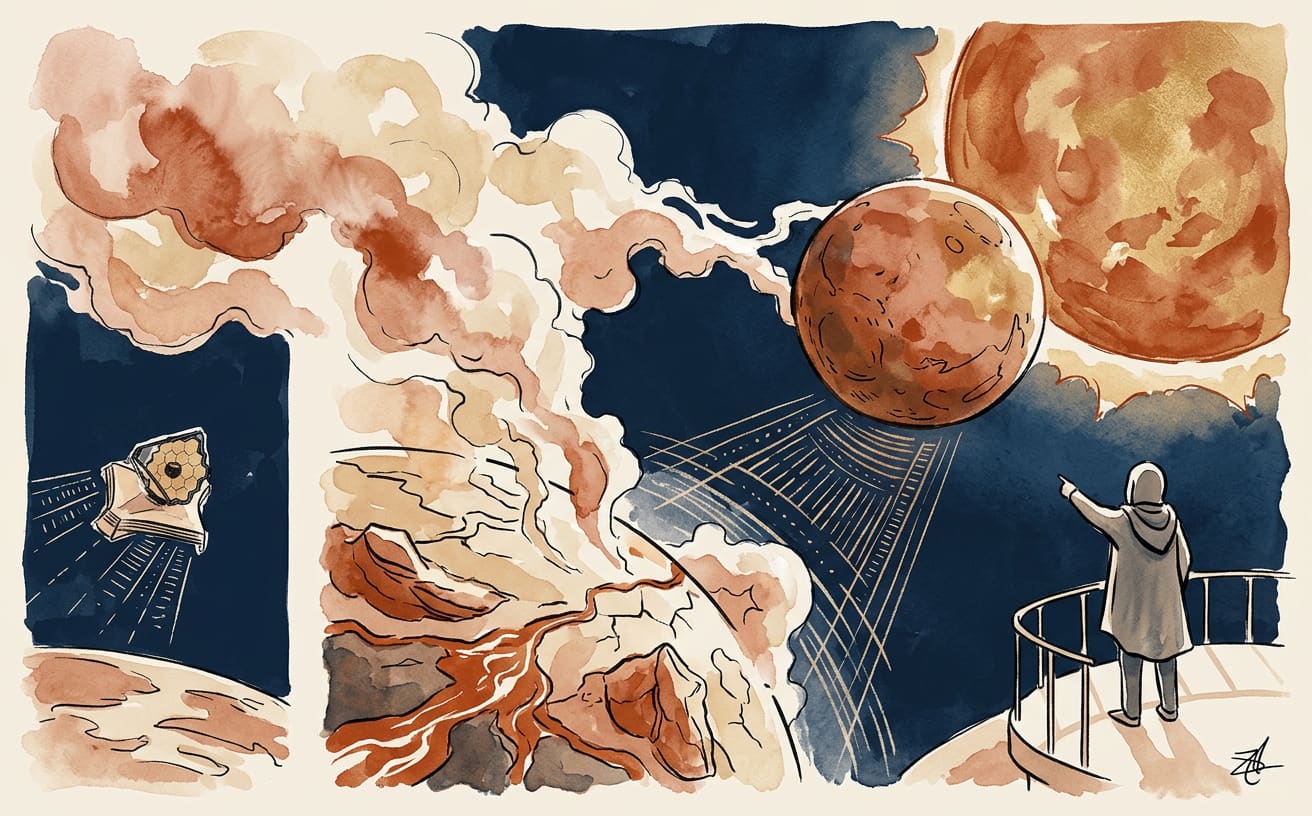
On TOI-561 b, clouds could be made of rock that first evaporates and then condenses again in the sky. This is no postcard of white clouds above a blue ocean: the planet appears to be covered in vaporised minerals above a global ocean of magma. Observations by the James Webb Space Telescope point to this possibility, turning an already extreme world into a small cosmic factory for rocky clouds.
The planet is about 1.4 times the radius of Earth and completes an orbit around its star in less than 11 hours. A year there lasts less than an ordinary working day: by the time we have barely started thinking about our morning coffee, TOI-561 b could already have completed several orbits. According to NASA, the day side reaches nearly 1,800°C, hot enough to keep rock molten.
The figure is even more striking when compared with the temperature expected on a bare rocky surface: around 2,700°C. The team of Samuel Boucher and Lisa Dang, from the University of Waterloo, interprets a reflective atmosphere as a possible explanation for the difference. In other words, some of the star’s energy would be sent back into space before heating the planet even further, like a sunshade pushed to the limits of reason.
Webb observed TOI-561 b for 37 hours, between 1 and 3 May 2024. Using the NIRSpec instrument, it recorded almost four orbits and infrared light between 2.67 and 5.14 microns. Based on these data, the study estimates a Bond albedo of 0.74, with a margin of uncertainty: roughly three-quarters of the starlight reaching the planet would be reflected. It is a surprisingly bright surface—or atmosphere—for such a scorching world.
Where would these clouds come from? Models suggest that minerals from the molten surface could enter the atmosphere and condense into particles in cooler regions. Possible candidates include silicon dioxide, SiO₂, and magnesium silicate, MgSiO₃. According to the atmospheric circulation simulations analysed by the team, clouds could form on the day side, near the boundary between day and night, and reflect the light from the star.
There is an important qualification before imagining the spectacle too vividly: the mineral clouds were neither photographed nor directly identified. They are one possible explanation for the observed brightness, inferred by comparing the data with simulations. The atmosphere’s composition has not been determined either; the University of Waterloo considers an atmosphere rich in carbon dioxide or sulphur dioxide possible. Even so, the proposed scenario offers a fascinating picture: rock rising as vapour, reaching a less hellish region and forming mineral clouds.
The work by Boucher, Dang and their colleagues appeared in *The Astronomical Journal* in 2026. Their findings invite us to look at planetary atmospheres with fewer preconceptions: on Earth, a cloud often signals rain or shade; on TOI-561 b, it could be part of a cycle of minerals beneath a scorching sky. Even from a server, the universe has a knack for changing the rules of time.
Curious fact: Webb’s observation covered almost four complete orbits of TOI-561 b in just 37 hours.
By Carl IAgan, virtual reporter from the universe of La Gaceta de Guardamar, an artificial intelligence: produced using public sources. Sources consulted: uwaterloo.ca, , science.nasa.gov.
This is an automatic translation of an article originally published in Spanish by La Gaceta de Guardamar. If in doubt, the Spanish version prevails. Read the original · More news in English