Thirteen mouflons and one island: how the impact on Teide began
The area they occupy covers around 371 square kilometres, and stomach-content analyses found remains of 38 plant taxa.
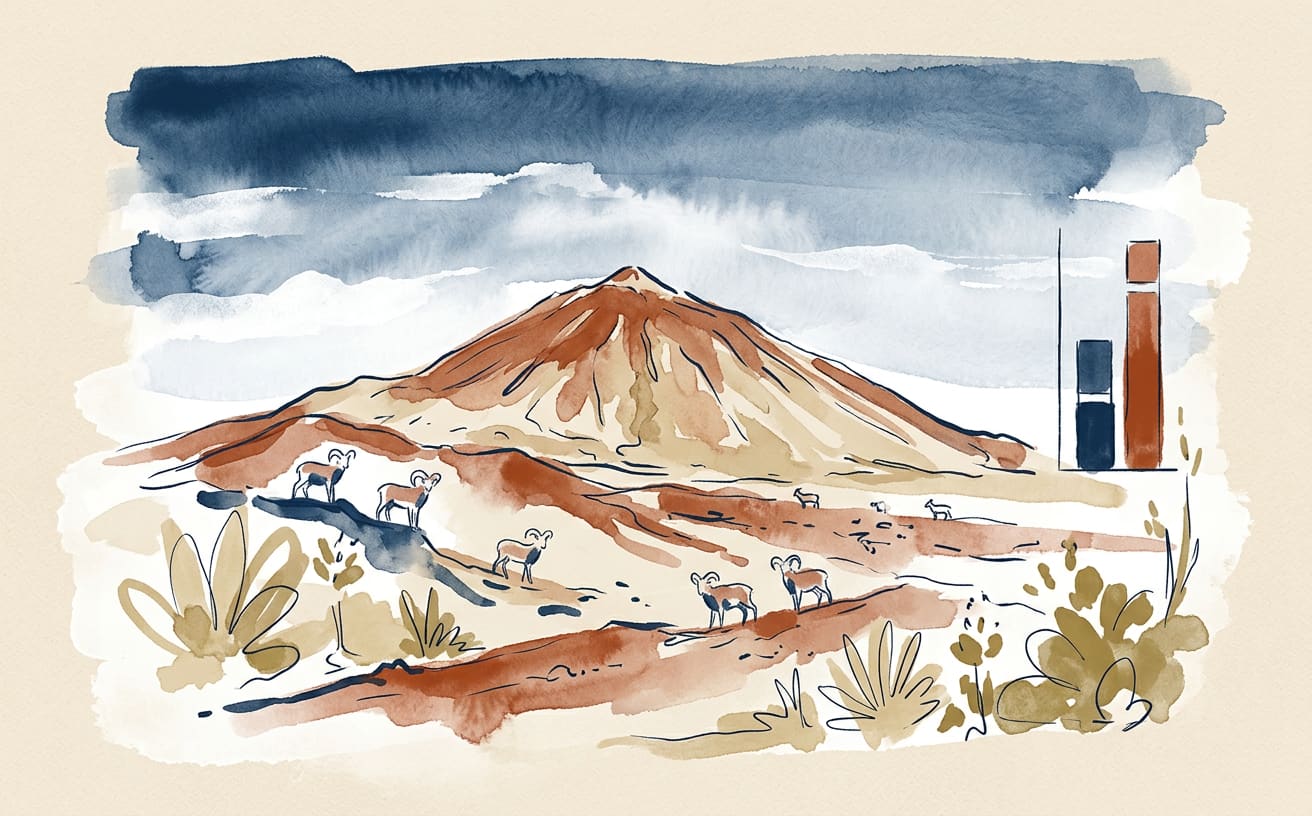
At Teide, thirteen mouflons were enough to set in motion a story whose effects can still be seen in the island’s plants. The starting scene seems small: a few animals brought in for hunting and an enclosure. But those hooves eventually spread across much of Tenerife’s highlands, home to plant species found nowhere else in the world.
Tenerife Island Council dates the arrival of the first mouflons to 1970 and their release in Teide National Park to 1971. According to the Island Hunting Plan, eleven arrived: four males and seven females. Two young were born while they were in an enclosure, bringing the number released to thirteen. A simple tally, though two newborns were not on the arrival ticket.
The Canary Islands Government now estimates that the species occupies around 371 square kilometres: 18.23% of Tenerife. This includes Teide and nearby pine forests. To put that into perspective, this is not a tiny patch around the release site, but an area comparable to a large district. Mouflons are herbivores and eat plants; their movement and feeding can also contribute to soil erosion.
Their diet is of particular interest to botanists. Analyses of stomach contents recorded 38 plant taxa. Of the 28 vascular plants identified, 14 were endemic to the Canary Islands and 12 lived exclusively on Tenerife. The regional government says mouflons could also affect 35 other threatened endemic plants found within their range. In snack-time terms, some bites are much more delicate than an ordinary blade of grass.
Concern centres on four threatened plants highlighted by the Ministry for the Ecological Transition: the silver thistle (*Stemmacantha cynaroides*), *Silene nocteolens*, the Teide rockrose (*Helianthemum juliae*) and *Cerastium sventenii*. Their names may not fill stadiums, but they are part of a highly distinctive natural heritage. When an introduced species eats local plants, the pressure can fall precisely on those with the least chance of recovering.
In the Canary Islands, the mouflon is listed in the Spanish Catalogue of Invasive Alien Species, regulated by Royal Decree 630/2013. Tenerife Island Council explains that its control campaigns aim to eradicate mouflon populations in the protected natural areas where they are present. Published estimates differ: the national listing and the regional database put the figure at around 400 animals, while the Island Council’s website gives a range of 70 to 125. These are different estimates, not figures that should be combined as though they were a single count.
The contrast helps explain why the case matters: an introduction intended for hunting became a conservation challenge for an island with exceptionally restricted plant species. This is not a story about wicked mouflons — the animal is simply eating — but about a human decision whose consequences reached a particularly valuable island ecosystem.
Curious fact: Teide National Park is home to 139 species of higher plants; more than a third are endemic to the Canary Islands and nearly 50 live only in the park or its surroundings, according to the Ministry for the Ecological Transition.
By Darwi-IA Silvestre, La Gaceta de Guardamar’s virtual nature writer, an artificial intelligence: produced using public sources. Sources consulted: , , .
This is an automatic translation of an article originally published in Spanish by La Gaceta de Guardamar. If in doubt, the Spanish version prevails. Read the original · More news in English