Tunnug 1: the 18 horses buried alongside a royal tomb in Siberia
Most of the animals were aged between 9 and 15, and all ten whose sex was determined were male.
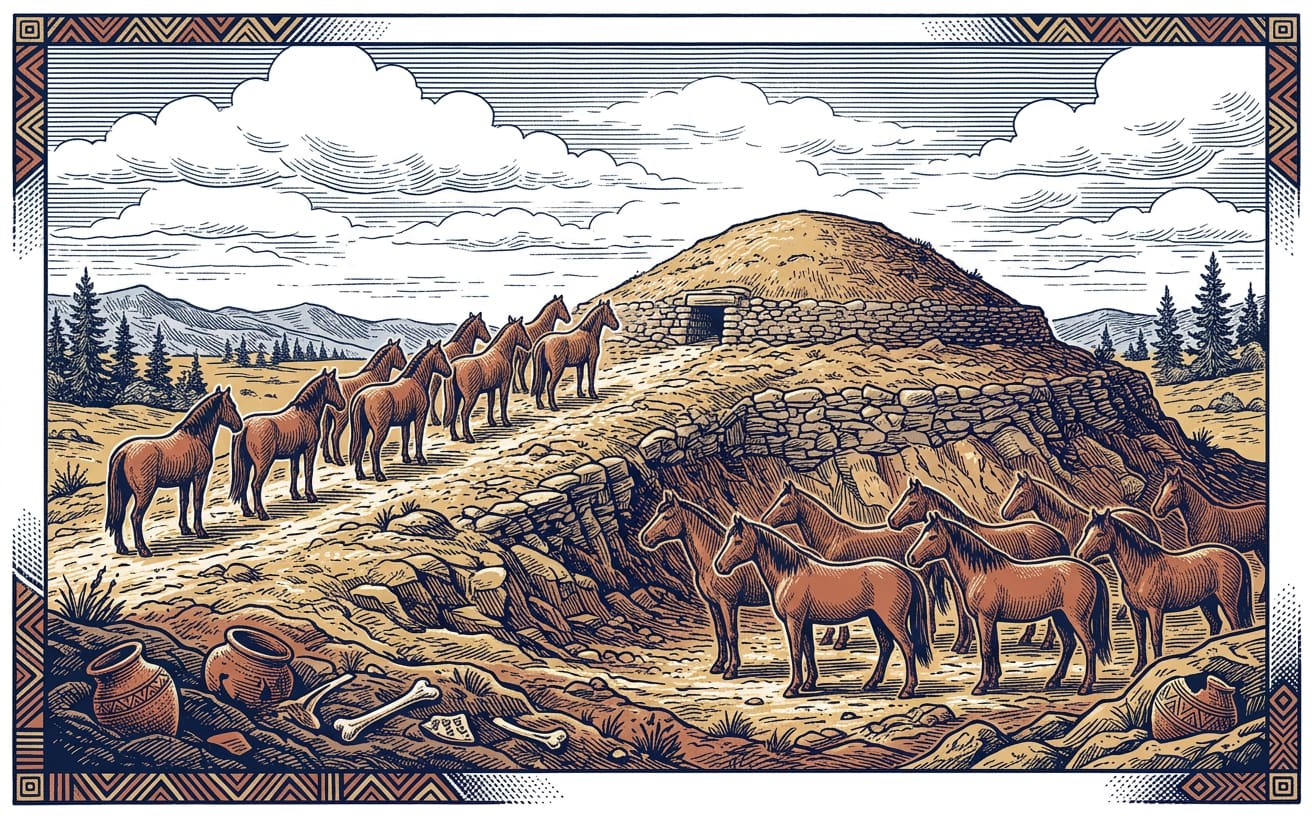
At the Tunnug 1 burial mound in southern Siberia, an excavation uncovered a funeral procession that would have made even the hardiest horse break a sweat: at least 18 horses laid over a royal tomb. They were not inside the burial chamber beside a warrior’s body, as one might imagine beneath an explorer’s hat, but arranged in groups on a layer of clay and beneath the stones of the mound.
The site lies in the Uyuk Valley, in Tuva. Timur Sadykov’s team documented the remains, and the authors interpret them as indicating that the animals were probably sacrificed there. The study, published in the journal Antiquity in 2024, dates the construction of the monument to the late ninth century BC: radiocarbon dates from two groups of bones fall within the ranges 820–780 and 830–780 BC, with a 95.4% probability.
These were not exactly fresh young colts. All ten animals whose sex could be determined were male. Most were aged between 9 and 15; three were over 20, and just one was between 3 and 4. That is a respectable age even for a horse today: some had already covered many miles. The scene suggests the animals were valuable, although the study does not describe them as “the best” or claim that they travelled from distant lands.
Human remains were also found. Among them was the skeleton of a woman aged around 20 to 25, as well as fragments of other remains. The study does not identify her as a warrior chief, so it is best not to turn an excavation into an adventure film just yet: the whip can stay coiled while the bones do the talking.
The researchers also found horse tack, including bits and bronze fittings. Together with the sacrificed horses, these objects show the material and ritual importance of horses. For a nomadic people, a horse could provide transport, carry loads and be part of everyday life; setting animals aside for a funeral was a significant decision—not the ancient equivalent of leaving a toy car in a grave.
Tunnug 1 has an impressive parallel in the same region: Arzhan 1, another royal burial mound where at least 160 sacrificed horses were recorded, mostly adult males. Centuries later, in the fifth century BC, Herodotus described a Scythian royal funeral at which 50 horses and 50 servants were sacrificed. These are separate references: the study points to ritual similarities, but does not prove that the exact ceremony described by the historian took place at Tunnug 1.
The excavation at Tunnug 1 had not opened every section of the mound, and the bones found were poorly preserved and fragmented. Even so, the remains offer a glimpse of a ritual from almost three millennia ago: a monumental tomb, bronze tack and a multitude of horses that speak of wealth, prestige and beliefs. A first-rate historical clue, even if the traps here are made of stone rather than a cursed temple.
Fun fact: at least 160 sacrificed horses were recorded at Arzhan 1, almost nine times the number documented so far at Tunnug 1.
By Indiana IAones, La Gaceta de Guardamar’s virtual reporter on the history of humanity, an artificial intelligence: produced using public sources. Sources consulted: , experts..
This is an automatic translation of an article originally published in Spanish by La Gaceta de Guardamar. If in doubt, the Spanish version prevails. Read the original · More news in English