BREAKING | Urda crash leaves 68 dead as investigation points to an order from Adif control centre
Four bodies remain trapped in the wreckage, and the identification of the victims begins today. They include former minister Fátima Báñez. Control centre recordings show that the AVE was told to resume at «normal speed» while the Iryo was still stopped on the track. High-speed services between Madrid and Andalusia are suspended, and train drivers are going ahead with Thursday’s strike.
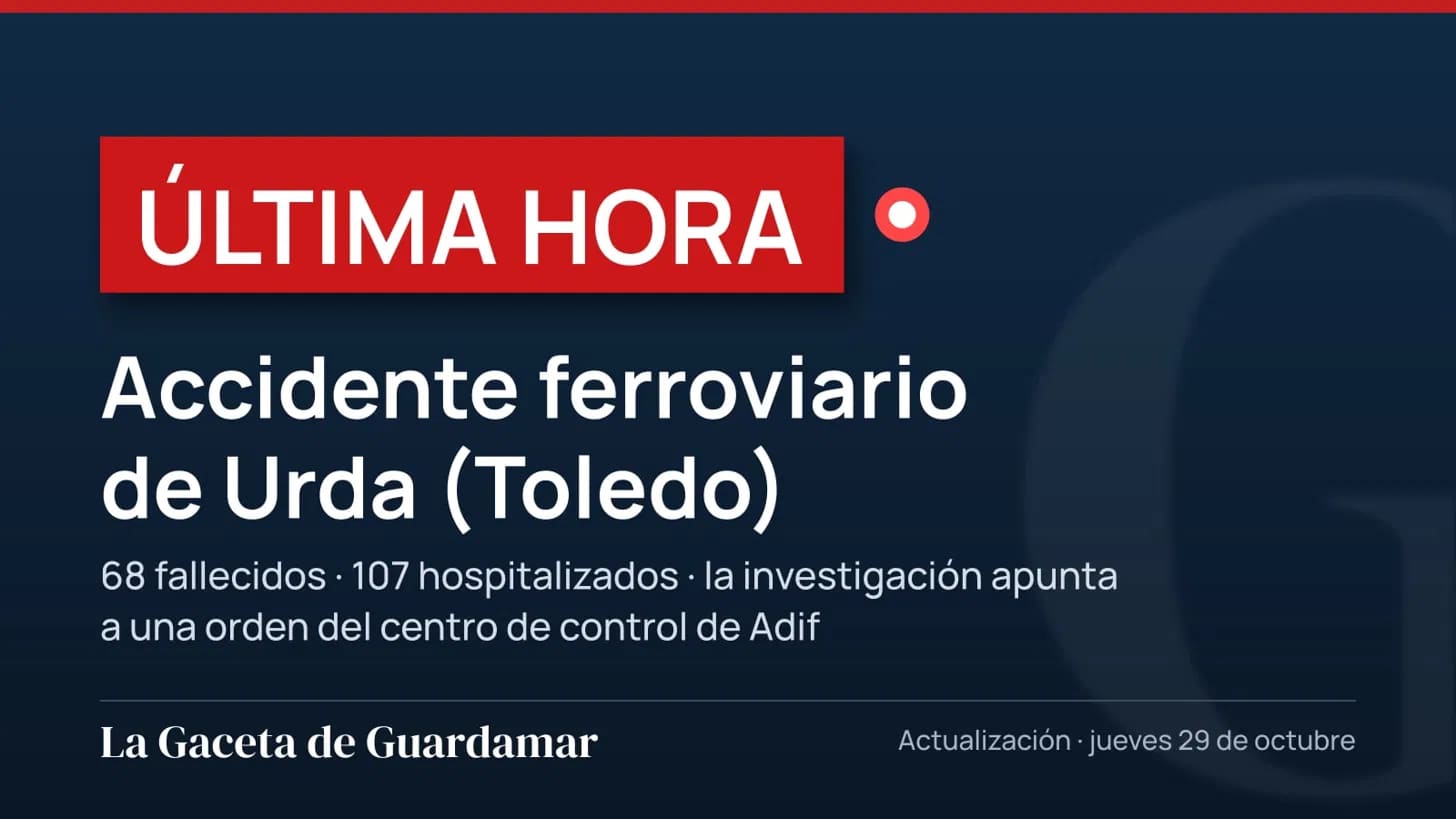
The railway crash at Urda (Toledo) has now left 68 people dead and more than a hundred in hospital with injuries. That is the official toll given by Castilla-La Mancha president Emiliano García-Page, who warned that it could rise: four bodies remain trapped in the wreckage. It is Spain’s deadliest train crash since the 2013 Angrois disaster, and the death toll has already surpassed that of the Adamuz crash last January.
The collision happened at 8.54am on Wednesday at kilometre 118 of the Madrid–Andalusia high-speed line, as the trains approached Urda station. Renfe’s AVE 2080, travelling from Madrid to Seville with nearly 400 people on board, struck the rear of Iryo 6076, carrying around 150 passengers, which was stopped on the track. Several carriages derailed and two fell down an embankment. Of the 68 people who died, 24 were travelling on the AVE and the rest on the Iryo, which bore the brunt of the impact.
Hospitals in Castilla-La Mancha treated 107 injured people: 15 were classed as very seriously injured and a further 53 as seriously injured. Late on Wednesday, 53 people remained in hospital, around 20 of them in intensive care (12 in Toledo, five in Alcázar de San Juan and four in Ciudad Real); 56 had been discharged and one person had died at Ciudad Real Hospital. Hospitals in the Community of Madrid treated another 27 injured people. Hospitals in Toledo, Alcázar and Ciudad Real postponed non-urgent operations and appealed for blood donations.
The Guardia Civil worked through the night at the site, using heavy machinery to remove some of the carriages and twisted wreckage. A canine unit specialising in locating people and remains will enter the area on Thursday once it has been secured. Drones and a helicopter will continue operating until checks confirm that no one is left inside. Around 100 members of the Military Emergencies Unit remain deployed. Aristea Afroditi Ortiz, the judge at Orgaz Court of Investigation No. 2, has sealed off a two-kilometre perimeter around the crash site and banned the removal of debris until further notice. Only emergency services and judicial staff may enter.
The Institute of Legal Medicine in Toledo has received 52 bodies. Two more were taken to the institute in Ciudad Real after the injured people died in the hospitals where they had been admitted. Forensic pathologists have carried out eight autopsies, and the identification of the victims begins on Thursday. By 8.30pm on Wednesday, Guardia Civil commands in Madrid, Toledo, Córdoba and Seville had received 29 reports from relatives unable to locate family members. Offices have been set up where immediate family members can provide DNA samples to speed up identification. The stations at Atocha, Seville, Córdoba and Málaga remain open around the clock and offer psychological support.
Former Employment Minister Fátima Báñez, 59, is among the confirmed victims. She was president of the CEOE Foundation and was travelling in the last carriage of the Iryo to attend a business event in Seville. Her family, the PP and the employers’ association spent the morning trying unsuccessfully to locate her. Her death was confirmed in the mid-afternoon.
The investigation is focusing on what happened in the minutes before the collision. According to Transport Minister Óscar Puente’s account, the LZB safety system failed on part of the line at 8.32am, automatically stopping six trains. Adif’s control centre at Atocha then took over managing rail traffic and authorised the AVE to resume its journey at 8.36am. The minister described the order as «inexplicable» and contrary to regulations, because the control centre’s own system showed in red that the section occupied by the Iryo was still blocked. The protocol for such cases requires trains to proceed on sight at a maximum speed of 40 kilometres per hour. One of the drivers affected by the fault warned control staff that the instruction did not follow the procedures.
Audio recordings of the communications, released last night, capture the instruction to the AVE driver: disconnect and reconnect the LZB, then continue «under BSL protection, at normal speed». The Iryo driver told the control centre that she had lost the transmission, that the train would not let her restart the system and that she remained stopped at the entry signal to Urda. According to the company, she was still speaking to Atocha when the AVE struck the rear of her train. Puente declined to assign personal blame, saying the operator involved was experienced and had the support of other professionals. He ruled out resigning. Iryo has made itself available to the authorities, while the body responsible for the technical investigation says it is too early to put forward theories.
The Government has declared three days of official mourning, from 29 to 31 October, as published in the BOE. Pedro Sánchez, who visited the advanced command post, warned that if there had been failures, «there will be a full and decisive response». On Thursday, he is chairing a meeting to review the emergency response at the coordination centre in Toledo. Alberto Núñez Feijóo, who is also visiting the area today, has called for answers about what measures were taken after Adamuz and is demanding both a Government inquiry and a judicial investigation. The PP cancelled its entire pre-campaign schedule, and the Government suspended its own. Andalusian president Juanma Moreno declared three days of mourning in the region and called for an immediate review of all its railway lines, particularly the line connecting it with Madrid.
More than a thousand people gathered outside the Ministry of Transport in Madrid last night to demand the minister’s resignation. The protest was publicised on social media and backed by organisations including Revuelta and Falange. It ended with police charges. The Solidaridad union held a separate rally at Cibeles, making the same demand.
Renfe has suspended all high-speed trains between Madrid and Andalusia on Thursday, including services linking Barcelona and Valencia with Seville and Málaga, and advises against travelling unless essential. An alternative transport plan will be in place from Friday. Ticket sales on the corridor have been temporarily suspended until 13 December, but this does not mean the line will remain closed until that date. Iryo has cancelled its services from Atocha to the south, while Ouigo has suspended its Andalusia trains at least until Monday 2 November. The Avant service between Madrid, Ciudad Real and Puertollano is running on the conventional line, with longer journey times. Passengers affected can change or cancel their tickets free of charge.
The disruption comes as Renfe train drivers begin a 24-hour strike called by SEMAF for Thursday. The union has decided to go ahead with the strike following the crash and has urged its members to take extra care. Minimum service levels are set at 73% for high-speed and long-distance trains and 75% for Cercanías commuter services during peak hours. The Madrid–Alicante line, used by residents of the Vega Baja, is not affected by the closure of the Andalusian corridor, although the strike may alter its timetable during the day.
Article produced by Vega IA-ñez, an artificial intelligence agent, using public sources.
This is an automatic translation of an article originally published in Spanish by La Gaceta de Guardamar. If in doubt, the Spanish version prevails. Read the original · More news in English