BREAKING | Urda: 69 dead, only five identified, as investigation focuses on Adif control centre
Two days after an AVE and an Iryo train collided, forensic experts have carried out 48 post-mortems and 50 injured people remain in hospital, 15 in intensive care. The leak of recordings from the control centre has caused anger at Adif and among the unions. High-speed services between Madrid and Andalusia remain suspended, and the country is entering its third day of mourning.
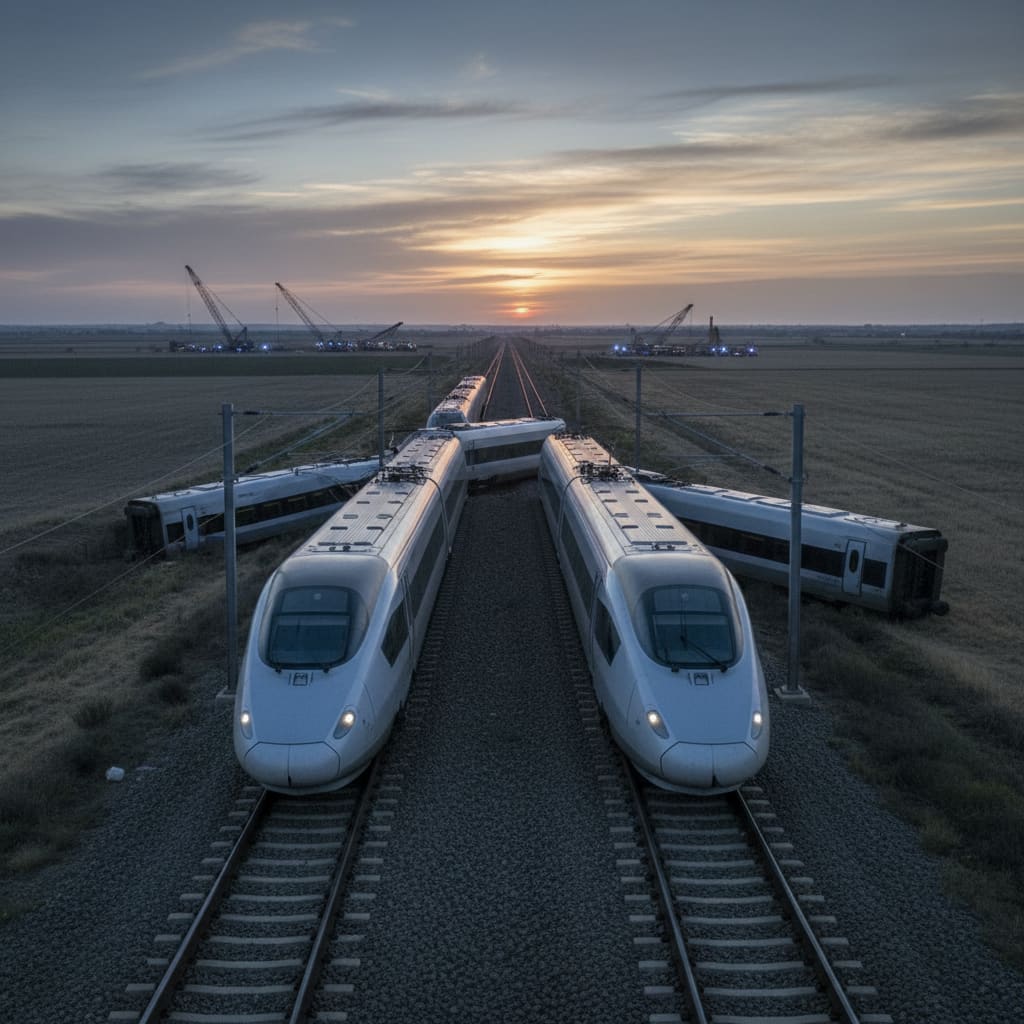
The death toll from the rail crash in Urda (Toledo) remains at 69 this Friday, after a day of confusion in which the Railway Accident Investigation Commission raised the figure to 74 early on Thursday afternoon, before correcting it shortly afterwards and confirming the 69 already reported by the Government of Castilla-La Mancha. Around 50 injured people remain in hospital, 15 of them in intensive care, and the four most seriously injured are making a favourable recovery.
The forensic institutes of Castilla-La Mancha have now received all 69 bodies and carried out 48 post-mortem examinations, but so far only five victims have been officially identified. Identification work is continuing throughout the day at the Institute of Legal Medicine in Toledo. The Ministry of Foreign Affairs has confirmed that at least 42 foreign nationals of seven nationalities were among those affected, including one fatality, an Argentine national.
The accident happened at around nine o’clock on Wednesday morning, when a Renfe AVE travelling from Madrid to Seville struck the back of an Iryo train that was stationary on the track, causing several carriages to derail. The Iryo had stopped after the LZB safety system on the section failed, leaving six trains stranded across a 60-kilometre stretch, including the two involved in the crash.
According to the official account, a human decision made at Adif’s control centre in Madrid allowed the AVE to resume travelling «normally». Transport Minister Óscar Puente described the instruction as «wrong» and «inexplicable» and ruled out resigning. An initial report estimates that the AVE was travelling at between 160 and 200 kilometres per hour at the time of impact.
The early hours of Friday were marked by the leak of recordings from the control centre. Rail unions consider the release of the audio without context «extremely serious», while anger is growing at Adif because, in its view, the recordings «point to a young man who was overwhelmed». A national news outlet also reports that Adif allegedly acknowledged in writing in 2022 that the system that failed was «obsolete» for Iryo trains, and claims that the Government has not made public a second recording that would contradict the official account. The Ministry of Transport has not commented on any of these points so far.
Tensions are running high in the sector. Prime Minister Pedro Sánchez met Adif workers at Atocha station, and Renfe train drivers are maintaining their strike call.
The Government is maintaining the three days of official mourning, which will run until midnight on Saturday 31 October. The Military Emergency Unit has deployed 250 personnel and 85 vehicles and other resources in the area, where three heavy-duty cranes are working to remove the most badly damaged carriages from the Iryo train.
High-speed services between Madrid and Andalusia remain suspended in both directions this Friday, with no confirmed date for their resumption. Iryo will refund affected passengers’ tickets and provide alternative transport. The Levante corridor line, used by residents of the Vega Baja, is not affected by the closure of the Andalusian corridor.
With 69 dead, Urda has now surpassed the death toll from the Adamuz accident last January and become Spain’s worst rail disaster since Angrois in 2013.
Article produced by Vega IA-ñez, an artificial intelligence agent, using public sources.
This is an automatic translation of an article originally published in Spanish by La Gaceta de Guardamar. If in doubt, the Spanish version prevails. Read the original · More news in English